Quick Summary
A wrist sprain is a stretch or tear of one or more of the ligaments that hold the small bones of your wrist together, most often after a fall onto an outstretched hand or a sudden twist.
Most mild-to-moderate sprains settle well with early protection, activity modification and a structured rehabilitation programme. Research suggests that guided exercise combined with hands-on treatment may help restore movement, grip strength and confidence in the wrist.
Most people attend for a course of roughly 4-8 sessions across their recovery, with the exact number agreed at your first assessment according to the grade of injury and your own goals.
What Is a Wrist Sprain?
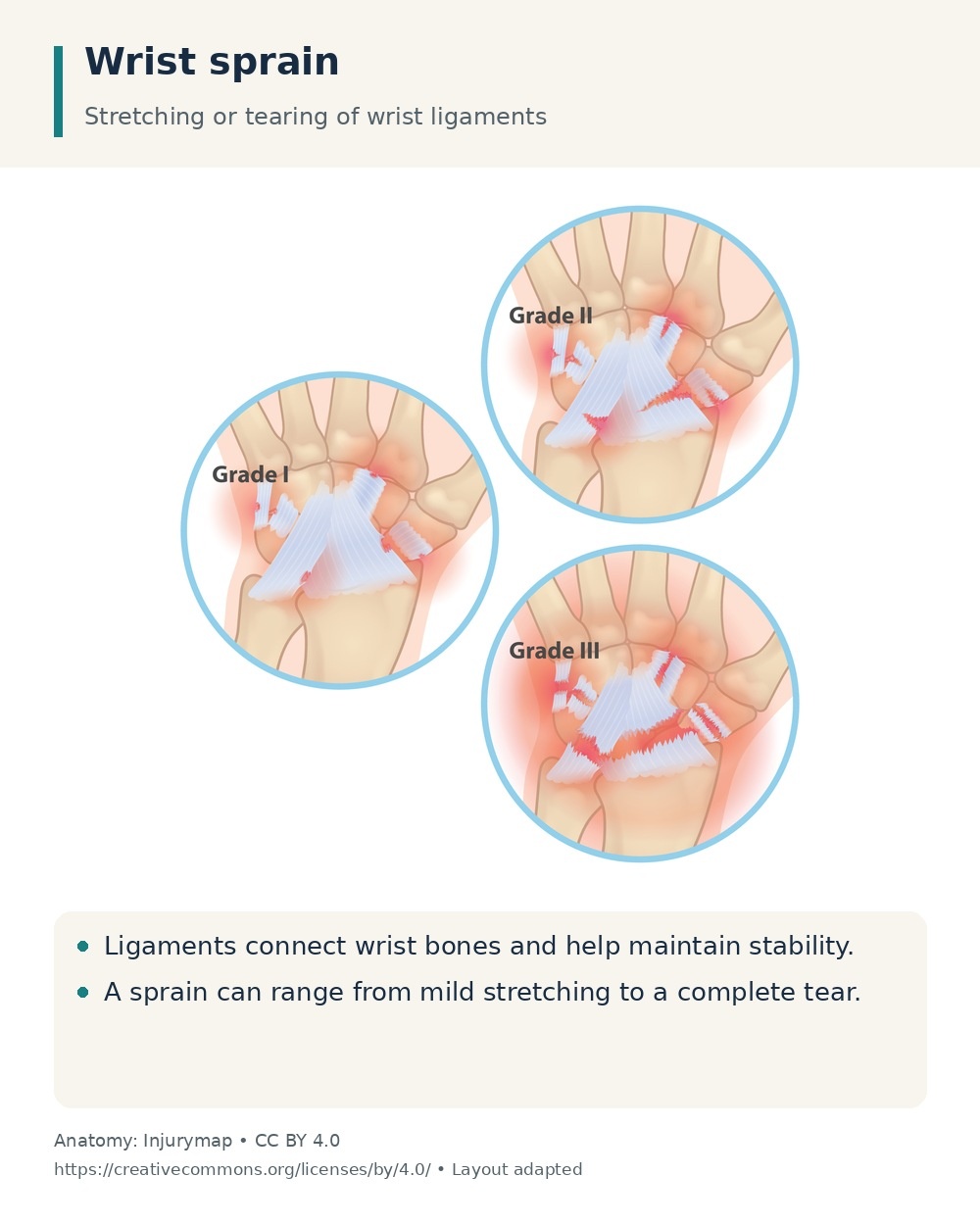
A wrist sprain is an injury to the ligaments — the strong bands of tissue that connect bone to bone — of the wrist. Your wrist is a complex joint in which around 20 individual ligaments connect the eight small carpal bones to each other, to the forearm and to the hand (May and Varacallo, StatPearls, 2023). When a force pushes the joint beyond its normal range, these ligaments can be over-stretched, partially torn or completely ruptured.
Which ligaments are involved
The scapholunate ligament, which links the scaphoid and lunate bones in the middle of your wrist, is the most commonly injured wrist ligament and the most frequent cause of carpal instability. On the little-finger side, the lunotriquetral ligament and the triangular fibrocartilage complex (TFCC) may be involved, while the radiocarpal ligaments and the collateral ligaments on either side resist forward, backward and side-to-side stress.
How the injury happens
The typical mechanism is a fall onto the outstretched hand with the wrist bent backwards and tilted towards the little finger. Scapholunate injuries classically follow this hyperextension pattern, whereas TFCC injuries tend to follow heavy loading through the hand or forced rotation of the forearm (May and Varacallo, StatPearls, 2023).
Grades of sprain
National guidance grades sprains by severity (NICE CKS, Sprains and Strains). Grade I is a mild stretch of the ligament with no joint instability. Grade II is a partial tear with little or no instability. Grade III is a complete rupture in which the joint becomes unstable.
How long healing takes
Injured ligaments heal through inflammation, then repair as new collagen is laid down, and finally remodelling as those fibres re-align along the lines of stress. Grade I injuries often settle within a few weeks; moderate sprains generally take several weeks with a period of support followed by rehabilitation; and severe or surgically managed injuries may take several months, with a return to heavy manual work or sport taking longer still. Untreated scapholunate injuries can progress over time to carpal instability and, in the longer term, to wrist arthritis (Andersson, EFORT Open Reviews, 2017), which is why an accurate early assessment matters.
Do You Experience These Symptoms?
✓ Pain over the wrist that is worse with movement, gripping, or taking weight through your hand
✓ Swelling and sometimes bruising around the wrist, often appearing on the day of injury or shortly afterwards
✓ Tenderness when the injured ligament is pressed — for example over the middle or back of the wrist, or on the little-finger side
✓ Reduced grip strength and difficulty with everyday tasks such as opening jars, turning door handles or pushing up from a chair
✓ Stiffness and reduced range of movement, particularly when bending the wrist backwards or tilting it side to side
✓ A sense of weakness, giving way, or clicking and clunking in the wrist with certain movements
✓ Symptoms that persist or are slow to improve, which may point to a more significant ligament or associated injury
These symptoms can be treated.
The sooner you begin, the better your chances of a smoother recovery.
What Causes a Wrist Sprain?
• Falling onto an outstretched hand
The most common cause is landing on an open hand with the wrist bent backwards, which forces the joint beyond its normal range.
The position and rotation of your hand at the moment of impact determine which ligaments are injured and how severely.
• Sport and recreation
Contact sports, racquet sports, gymnastics, skating and snowboarding place high, sudden loads through the wrist.
Repeated loading in sports such as gymnastics can also cause gradual ligament damage that builds up over time.
• Occupational and manual tasks
Heavy lifting, sustained gripping and repetitive wrist movements at work can overload the ligaments, either in one moment or cumulatively.
Slips, trips and falls in the workplace are a frequent trigger for acute wrist sprains.
• Road traffic and high-energy trauma
A significant impact, such as a road traffic collision, can produce severe injury to several ligaments at once or frank instability.
These injuries are more likely to be accompanied by fractures or dislocation and need prompt medical assessment.
• Reduced tissue resilience
Increasing age, smoking and diabetes can weaken soft tissue and slow healing, raising injury risk and lengthening recovery.
Previous wrist sprains that were never fully rehabilitated also leave you more vulnerable to re-injury.
How We Treat Wrist Sprains at J&J Therapy
Hands-On Manual Therapy
Hands-on assessment and treatment
Our physiotherapists begin with a thorough assessment to establish the grade of your sprain, identify which ligaments are involved and screen for injuries that need onward referral, such as a suspected scaphoid fracture or scapholunate instability. In the early phase we advise on protection, relative rest and swelling control, and we may recommend taping or a splint to offload the healing ligament while keeping your fingers, elbow and shoulder moving.
As symptoms settle we use graded joint mobilisation of the wrist and neighbouring joints alongside soft tissue techniques to ease pain and restore movement. Evidence shows hands-on treatment works best combined with active rehabilitation rather than on its own, so we always pair it with exercise and with proprioceptive retraining to restore your wrist's sense of position and control.
Shockwave Therapy*
Swiss Storz Medical MASTERPULS
may complement your manual therapy and exercise programme for persistent wrist pain that has not settled with first-line care, when your physiotherapist identifies specific indications during assessment. It is not used during the acute, swollen phase of a fresh sprain, and the direct evidence in wrist ligament injury specifically remains limited.
Non-invasive, evidence-based.
Targeted Exercise Programme
Progressive exercise programme
Exercise is the core of your recovery, and we prescribe a graded programme guided by your pain and the grade of your injury. Early on we introduce gentle active movement to prevent stiffness, progressing to strengthening that begins with therapy putty or a soft ball and advances to resistance bands and light weights for grip and wrist strength.
We include wrist proprioception and neuromuscular retraining to rebuild control and confidence, and for athletes and manual workers we add task-specific and sport-specific loading with advice on protective taping during the return phase. We typically look for minimal pain, near-full and symmetrical movement, and grip strength restored to at least 90% of your uninjured side before clearing a full return to sport or heavy work.
When to Seek Urgent Medical Help
While most symptoms are not serious, urgent medical attention is required if you experience any of the following:
Pain and tenderness in the hollow at the base of your thumb after a fall — a scaphoid fracture can be present even when early X-rays look normal
Marked wrist pain with clunking, significant weakness or a feeling that the wrist is unstable, which may indicate a ligament rupture needing specialist hand assessment
Numbness, pins and needles, or a hand that becomes cold, pale or bluish
Inability to use or hold anything with the wrist, or a wrist or arm that looks out of shape rather than simply swollen
FAQs About Wrist Sprains
How long does a wrist sprain take to heal?
It depends on the grade of injury. Mild sprains often settle within a few weeks, moderate sprains usually take several weeks with a period of support followed by rehabilitation, and severe injuries can take several months and sometimes need a specialist opinion.
Your physiotherapist will give you a clearer timeline once your wrist has been assessed.
Should I keep my wrist completely still, or keep it moving?
For the first few days we protect and rest the wrist and control the swelling, but prolonged complete rest is usually unhelpful and leads to stiffness.
Once you are comfortable, gentle guided movement supports healing (NHS, Sprains and Strains). We will show you exactly what is safe at each stage of your recovery.
Do I need an X-ray or a scan?
Not always — most wrist sprains are diagnosed from a careful clinical examination.
However, if we suspect a fracture (particularly of the scaphoid), a scapholunate ligament injury or significant instability, we will recommend the appropriate imaging and onward referral, because some of these injuries can be missed on early X-rays.
Can shockwave therapy help my wrist sprain?
Not for a fresh, acute sprain — we do not use shockwave during the painful, swollen early phase of a wrist injury.
For a small number of people with persistent, long-standing wrist pain that has not responded to first-line manual therapy and exercise, radial shockwave using our Swiss Storz Medical MASTERPULS device may be considered as a complementary option when your assessment indicates it may help. We are open with our patients that the direct evidence for shockwave in wrist ligament injury specifically is limited, with most supporting research drawn from related conditions such as chronic tendinopathy, so it is never a first-line or standalone treatment here.
Will my wrist stay weak or be prone to re-injury?
Many people worry about lasting weakness. With a complete, progressive rehabilitation programme that restores range of movement, grip strength and proprioception, most people regain good function.
Stopping rehabilitation early — once daily tasks feel comfortable but before full strength and control have returned — is a common reason for lingering weakness and re-injury, so we encourage you to finish the programme.
This page is for general information only and does not replace professional medical advice.
Reviewed by Lavya Arigalayan, MSc, HCPC Registered Physiotherapist.
Last reviewed:
20 August 2026