top of page
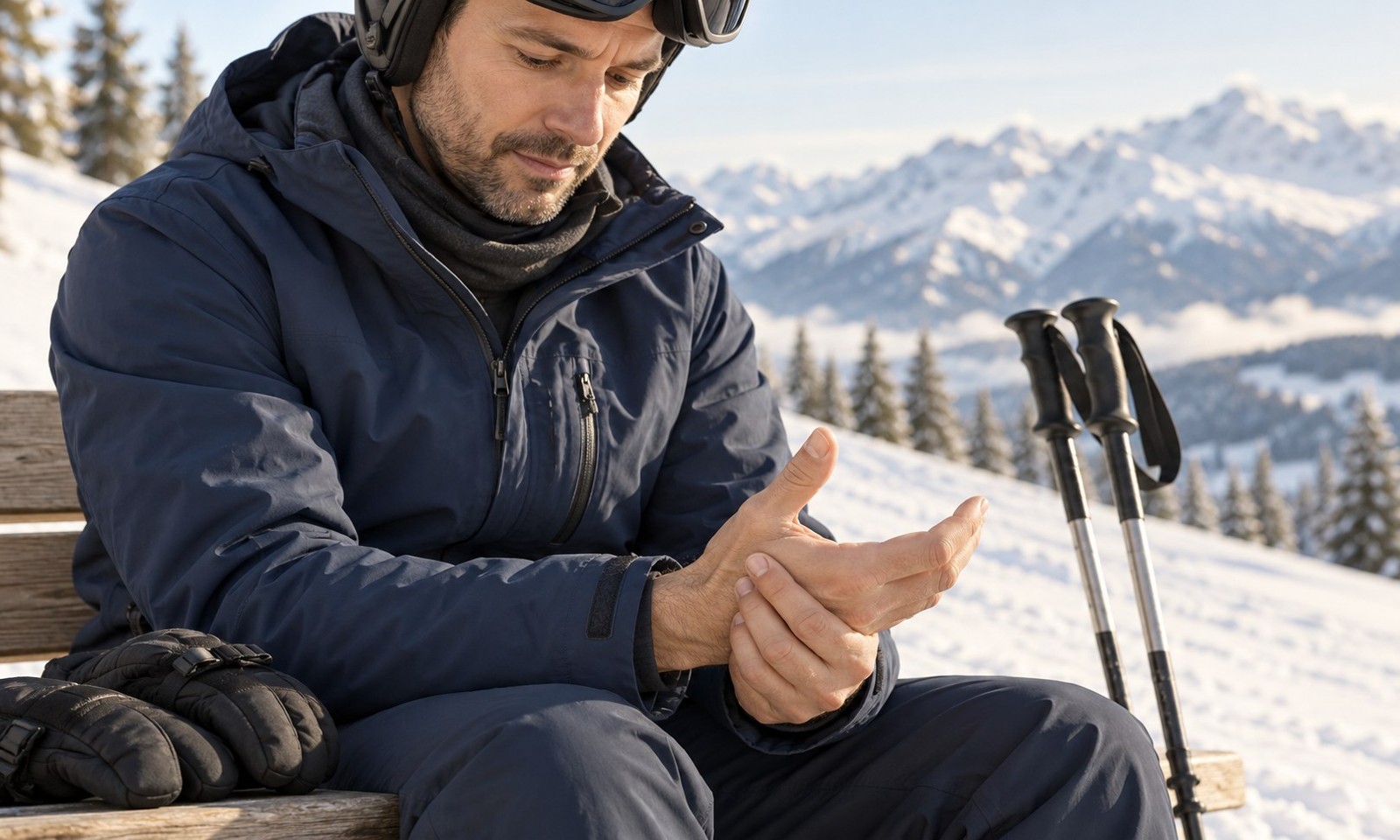
Physiotherapist at J&J Therapy in New Malden assessing a patient's thumb for a skier's thumb ligament injury

Skier's / Gamekeeper's Thumb

300+ Reviews 5.0

Open 7 Days

10+ Years' Experience

HCPC Physio On Team

Insurance Accepted

85% Return Rate

PHYSIOTHERAPY & THERAPEUTIC MASSAGE IN NEW MALDEN

Quick Summary

Skier's thumb — also known as gamekeeper's thumb — is an injury to the ulnar collateral ligament (UCL) at the base of your thumb, usually after the thumb is forced sideways in a fall or a skiing accident. It causes pain, swelling and a feeling of instability when you pinch or grip.


Most mild and stable injuries settle well with a period of protective splinting followed by staged, hands-on rehabilitation. At our New Malden clinic, our HCPC-registered physiotherapists typically structure conservative care across around 6–12 sessions, and refer you promptly for a hand surgery opinion if your assessment suggests a complete tear.

What Is Skier's Thumb?

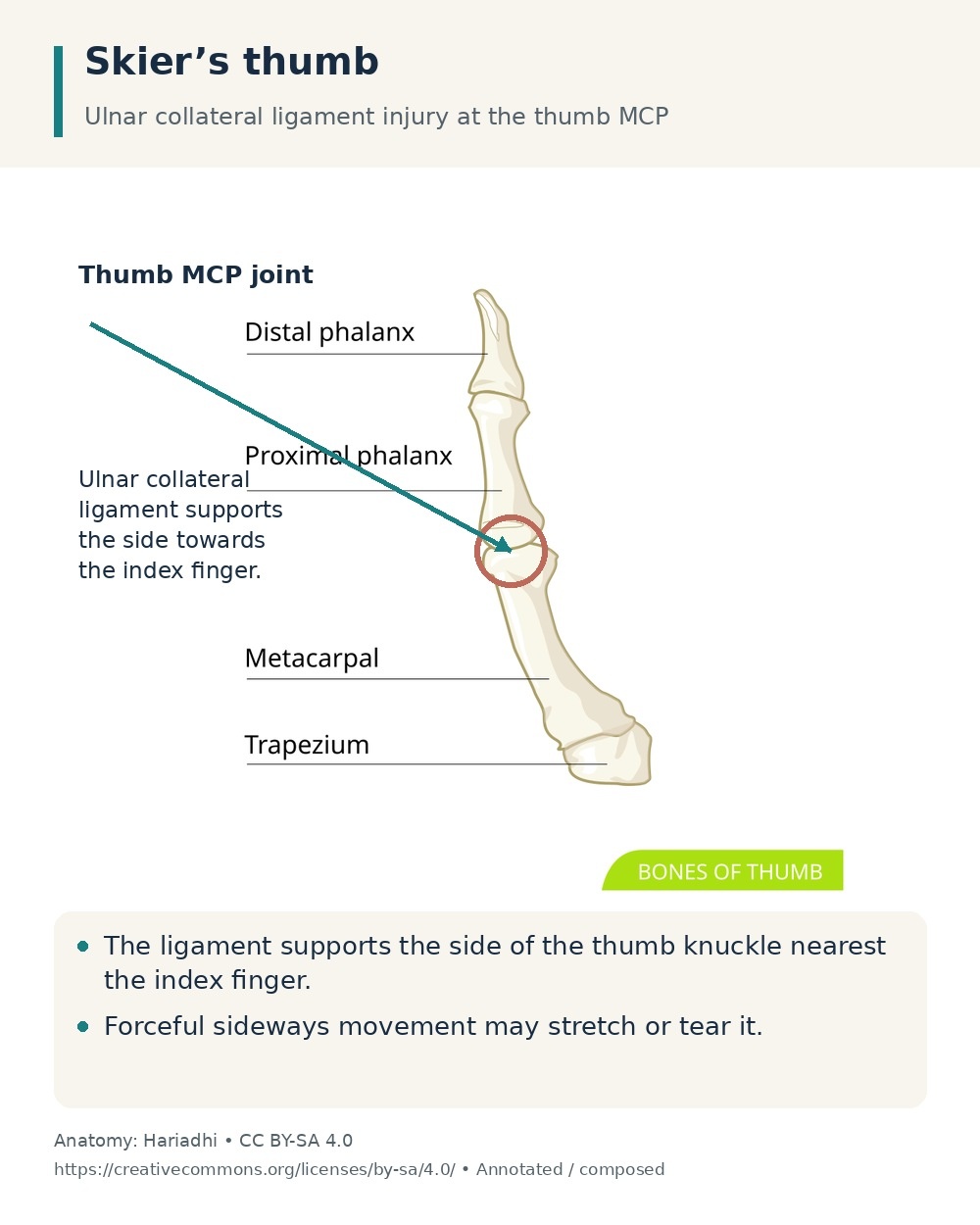
Anatomical illustration of the ulnar collateral ligament at the thumb metacarpophalangeal joint

Skier's thumb is an injury to the ulnar collateral ligament (UCL) of your thumb's metacarpophalangeal (MCP) joint — the knuckle where your thumb meets your hand. The UCL runs along the inner side of this joint and is the main restraint stopping your thumb being forced outwards, so it is essential for a stable, pain-free pinch and grip.


The ligament complex has two parts — a proper collateral band, which is taut when your thumb is bent, and an accessory collateral band, which is taut when it is straight. Both work alongside the volar plate and the overlying adductor aponeurosis to keep the joint stable.


Skier's thumb or gamekeeper's thumb?

Although the two names are often used interchangeably, they describe different patterns. Skier's thumb refers to an acute partial or complete tear from a single traumatic event — classically a fall while gripping a ski pole strap. Gamekeeper's thumb historically described a gradual, attritional stretching of the same ligament from repeated stress.


How these injuries are graded

Grade I is a sprain with the ligament intact and no instability. Grade II is a partial tear with mild laxity but a firm endpoint on testing. Grade III is a complete rupture with marked laxity and no firm endpoint. Grade I and II injuries are generally managed conservatively, while a Grade III rupture usually needs a surgical opinion.


Why a complete tear is different

In a complete rupture, the torn end of the ligament can become displaced and trapped above the adductor aponeurosis. This is known as a Stener lesion, and it acts as a mechanical block that holds the ligament ends apart so the ligament cannot heal on its own (Stener, Journal of Bone and Joint Surgery Br, 1962). Research suggests a Stener lesion is present in the majority of complete tears, and a small bony avulsion at the ligament's attachment is also common. This is why a suspected complete rupture should never simply be splinted and left — it needs prompt assessment and imaging (Dean et al., Journal of Hand Surgery Eur Vol, 2024).

Do You Experience These Symptoms?

✓  Pain and tenderness along the inner side of the base of your thumb, at the MCP joint

✓  Swelling and bruising around the thumb base, often developing within hours of the injury

✓  Weakness or pain when pinching, gripping or holding objects such as jars, keys or door handles

✓  A sense that your thumb is unstable or gives way when you try to pinch firmly

✓  Stiffness and reduced movement of the thumb, particularly in the days after the injury

✓  Sometimes a small palpable lump on the inner side of the thumb knuckle, which may indicate a Stener lesion

✓  Difficulty with everyday tasks needing a firm pinch, such as writing, fastening buttons or using cutlery

These symptoms can be treated.
The sooner you begin, the better your chances of a smoother recovery.

What Causes Skier's Thumb?

•  Skiing and snowboarding falls

The classic mechanism is falling while still gripping a ski pole, which levers the thumb violently outwards away from the hand.

Thumb injuries account for a substantial proportion of all skiing injuries, which makes this a common presentation at our clinic after winter sports holidays.


•  Falls onto an outstretched hand

A trip or slip where you land with your hand splayed can overload the ulnar collateral ligament in an instant.

This is one of the most frequent everyday causes we see outside of sport, particularly on wet pavements and stairs.


•  Ball sports injuries

A ball striking the tip or side of an extended thumb can force the joint into abduction and strain or tear the ligament.

Goalkeepers, basketball, rugby, netball and volleyball players are particularly exposed to this mechanism.


•  Repetitive attritional stress

Repeated stretching of the ligament through occupational or manual tasks can gradually weaken it over months or years.

This produces the slower-onset instability historically described as gamekeeper's thumb, rather than a single dramatic injury.


•  Direct trauma and work accidents

A sudden wrench of the thumb while using tools, wringing out cloths or catching yourself during a workplace slip can tear the ligament.

These injuries may also involve a small avulsion fracture, so imaging is often needed before rehabilitation begins.


Not sure which condition applies to you?

How We Treat Skier's Thumb at J&J Therapy

Hands-On Manual Therapy

Hands-on assessment and treatment from our HCPC-registered physiotherapists.
We test the stability of your thumb joint, screen for the signs that need a surgical opinion, and use gentle joint mobilisation and soft-tissue techniques to restore movement and settle swelling once the ligament is protected.
Graded, protected loading of the pinch mechanism follows as healing allows.

Shockwave Therapy*

Shockwave therapy is not a first-line treatment for skier's thumb and has no role in an acute ligament injury. Where a complete tear, Stener lesion or fracture is suspected, the correct pathway is prompt assessment and, if needed, referral to a hand surgeon.
In a small number of cases with chronic, stubborn thumb-base symptoms that persist after the ligament has healed, and once instability and fracture have been excluded, our physiotherapists may discuss shockwave therapy using our Swiss Storz Medical MASTERPULS system as an optional, second-line adjunct alongside your rehabilitation.
We will only recommend it if a thorough assessment confirms it is appropriate for you.

Targeted Exercise Programme

A staged, individually prescribed exercise programme.
Early stages restore gentle, protected range of movement after immobilisation. Strengthening — including putty work, pinch and grip exercises and intrinsic thumb work — is typically introduced once the ligament has had time to heal.
Functional, sport-specific and work-specific loading is added last, guided by your recovery rather than the calendar.

When to Seek Urgent Medical Help

While most symptoms are not serious, urgent medical attention is required if you experience any of the following:

  • Marked instability with no firm endpoint when the thumb is tested, or a palpable lump at the inner base of the thumb — this may indicate a complete rupture or Stener lesion and needs prompt hand surgery assessment

  • Your thumb gives way and cannot hold a pinch at all

  • Severe pain, visible deformity, or inability to move the thumb after a high-force injury — a fracture must be excluded with an X-ray

  • Numbness, pins and needles, or a cold, pale or dusky thumb — seek same-day medical care

FAQs About Skier's Thumb

  • How do I know if my skier's thumb is serious?

A stable sprain stays painful but your thumb still feels solid when you pinch. Warning signs of a complete tear include marked instability, a sense that the thumb gives way, or a lump at the inner base of the thumb. Our physiotherapists assess this with stability testing and will arrange imaging or an onward referral if the findings suggest a more serious injury.


  • Will I need surgery?

Not always. Most Grade I and stable Grade II injuries heal well with splinting followed by rehabilitation. A complete rupture, a Stener lesion or a displaced avulsion fracture usually needs surgical repair. Evidence shows outcomes are best when a complete tear is treated early, which is why prompt assessment matters.


  • How long does recovery take?

For stable injuries, expect a period of splinting followed by staged rehabilitation, with a return to demanding sport or heavy manual work commonly discussed at around 10–12 weeks. Recovery after surgery is often longer. Timelines are individual and depend on the severity of your injury and how your thumb responds to loading.


  • My injury happened months ago — is it too late to treat?

No. Older injuries can still cause pain, weakness and instability, and they are well worth assessing. Many settle with targeted rehabilitation to restore pinch strength and control, while thumbs with persistent instability may benefit from a surgical opinion.


  • Can shockwave therapy treat my skier's thumb?

Shockwave is not a first-line treatment for this injury and has no role in an acute tear or where a complete rupture, Stener lesion or fracture is suspected — those need prompt assessment and possibly surgery. Occasionally, for chronic thumb-base symptoms that persist after the ligament has healed, we may discuss shockwave using our Swiss Storz Medical MASTERPULS system as an optional second-line adjunct, but only after a full assessment confirms it is suitable.


Not sure this condition matches your symtoms?
Find your condition and explore related pain areas.

Logo_Navy.png

Ready to start your recovery?
Book your Initial Assessment today.

This page is for general information only and does not replace professional medical advice.

Reviewed by Lavya Arigalayan, MSc, HCPC Registered Physiotherapist.

Last reviewed

20 August 2026

bottom of page