Quick Summary
A TFCC (triangular fibrocartilage complex) injury is one of the most common causes of pain on the outer, little-finger side of your wrist — typically felt when you twist your forearm, grip firmly, or push through your hand.
The reassuring news is that most stable TFCC injuries respond well to non-surgical care. Research suggests that a period of protection followed by structured rehabilitation resolves symptoms for the majority of patients (Park et al., Orthopedics, 2010).
Our HCPC-registered physiotherapists combine hands-on manual therapy with a targeted, progressive exercise programme. Most people can expect 6–12 weeks of guided rehabilitation, with milder cases often improving within 4–6 weeks.
What Is a TFCC Injury?
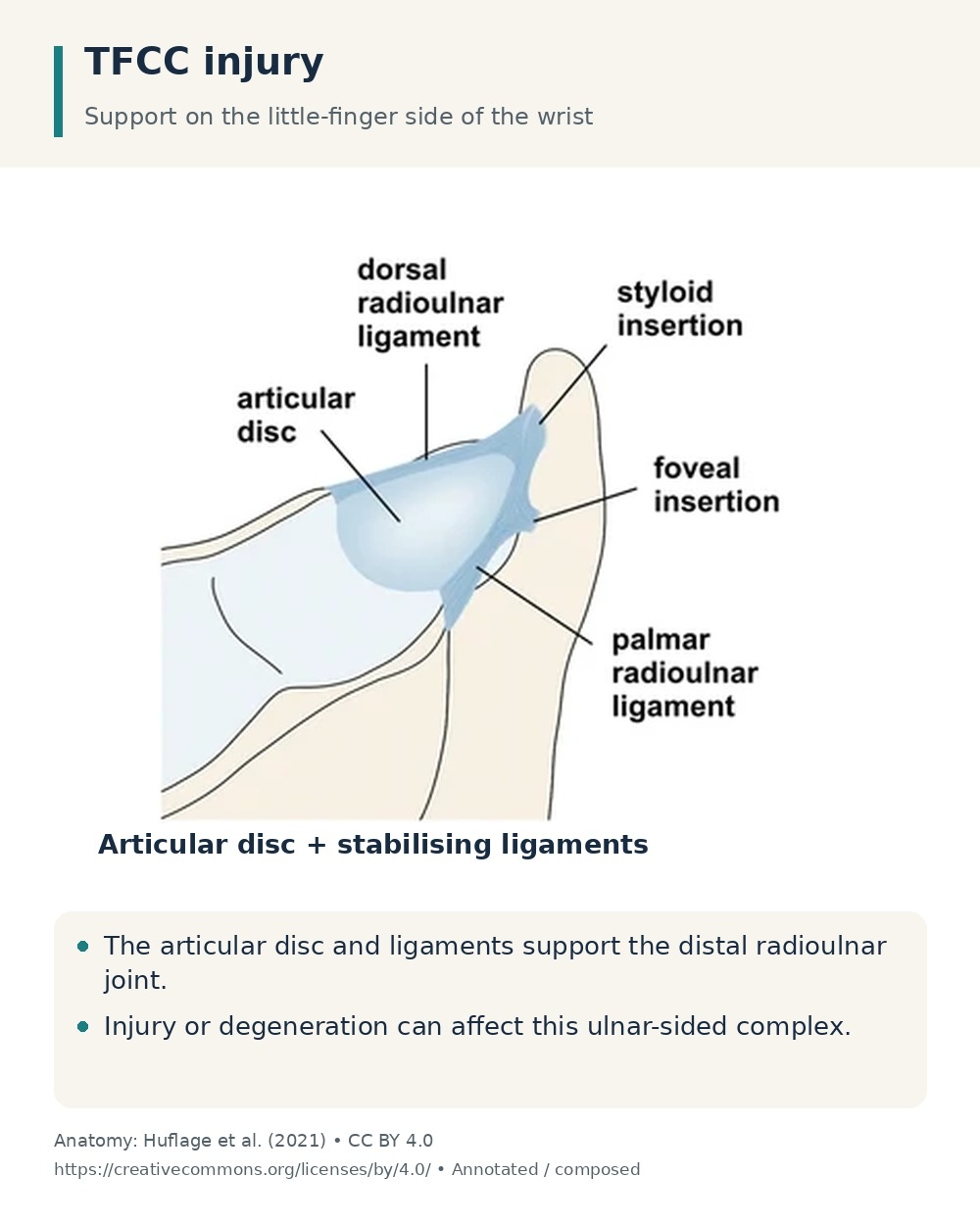
The triangular fibrocartilage complex (TFCC) is a small but sophisticated network of cartilage and ligaments on the ulnar (little-finger) side of your wrist. It is the main stabiliser of the distal radioulnar joint — the joint between your two forearm bones — and it acts as a cushion, transmitting load from your hand into your forearm.
The complex is made up of the central articular disc, the volar and dorsal radioulnar ligaments, the ulnocarpal ligaments, the ulnar collateral ligament, and the sheath of the extensor carpi ulnaris tendon. Biomechanical testing shows the ulnocarpal joint carries around 18% of the load crossing a neutral wrist, rising to roughly 42% when the ulna sits just 2.5 mm longer — which explains why small differences in forearm bone length matter so much (Palmer and Werner, Journal of Hand Surgery, 1981).
Traumatic and degenerative injuries
Injuries are usually grouped using the Palmer classification into traumatic tears — often from a fall or forced twist — and degenerative tears, which form part of the ulnocarpal impaction spectrum (Palmer, Journal of Hand Surgery, 1989). Where a relatively long ulna concentrates load on the ulnar side of the wrist, the central disc gradually thins and wears.
Why tear location matters
Blood vessels reach only the outer 10–40% of the disc, leaving the central portion essentially without a blood supply (Bednar et al., Journal of Hand Surgery, 1991). Peripheral tears therefore have genuine healing potential, while central tears may not repair biologically — although evidence shows they frequently become pain-free with rehabilitation.
Age-related change is also very common and often silent. An MRI review of 1,134 patients found incidental TFCC signal changes in 28% overall, rising from 19% of 18–30 year olds to 64% of those over 70 (Chan et al., Journal of Hand Surgery, 2018). A scan finding alone does not confirm the source of your pain — careful clinical assessment does. The most important question we answer is whether your distal radioulnar joint is stable, because stable injuries respond particularly well to physiotherapy.
Do You Experience These Symptoms?
✓ Pain on the outer, little-finger side of your wrist, especially when twisting your forearm — turning a key, opening a jar, or using a screwdriver
✓ Pain when gripping firmly, carrying shopping, or wringing out a cloth
✓ Discomfort when pushing up from a chair, leaning on your hand, or bearing weight through the wrist during press-ups, planks, or yoga
✓ Clicking, catching, or a popping sensation as you rotate your wrist or forearm
✓ Reduced grip strength, or a sense of weakness and unreliability in the hand
✓ Tenderness in the soft hollow between the bony bump on the little-finger side of your wrist and the base of your palm
✓ Swelling, or a feeling of looseness and instability in the wrist with more significant tears
These symptoms can be treated.
The sooner you begin, the better your chances of a smoother recovery.
What Causes a TFCC Injury?
• Falling onto an outstretched hand
A sudden load through an extended, deviated wrist is the classic mechanism for an acute traumatic tear.
This is also why TFCC injuries so often accompany wrist fractures.
• Forceful or repetitive twisting and gripping
Rotating the forearm under load — in racket sports, golf, gymnastics, throwing, and manual trades — repeatedly stresses the TFCC and the surrounding tendons.
Over time this can cause fraying or a frank tear.
• A relatively long ulna and ulnocarpal impaction
When the ulna sits longer than the radius, more load is driven through the ulnar side of the wrist.
This gradually thins and erodes the central disc, and is a leading cause of degenerative tears.
• A previous distal radius fracture
The TFCC is the most frequently injured soft-tissue structure alongside wrist fractures, with reported rates ranging widely depending on how it is assessed (Yan et al., Journal of International Medical Research, 2019).
A fracture that heals slightly short further increases ulnar-sided loading.
How We Treat TFCC Injury at J&J Therapy
Hands-On Manual Therapy
Gentle mobilisation of the distal radioulnar and wrist joints, with soft-tissue work to the forearm muscles and extensor carpi ulnaris, to settle pain and restore comfortable forearm rotation — alongside advice on splinting and load management. Research suggests conservative care matches surgery for TFCC lesions with a stable distal radioulnar joint (Sander et al., European Journal of Trauma and Emergency Surgery, 2021).
Shockwave Therapy*
Shockwave therapy is not a first-line treatment for TFCC injuries, and current evidence for its use in this specific condition is limited.
In selected cases, our Swiss Storz Medical MASTERPULS may complement your manual therapy and exercise programme when your physiotherapist identifies specific indications during assessment — for example, associated tendon-related ulnar-sided pain that has not settled with initial care.
Where it is used, it is always applied away from the nerves and blood vessels on the little-finger side of the wrist. Your physiotherapist will discuss whether it is appropriate for you.
Targeted Exercise Programme
A staged, symptom-guided programme: protected early activation, then dynamic stabiliser training for the extensor carpi ulnaris and pronator quadratus, proprioceptive retraining, and progressive grip, rotation and weight-bearing work to rebuild capacity. Evidence shows a structured non-operative programme can markedly reduce pain and restore function (Tse et al., Hand Surgery and Rehabilitation, 2023).
When to Seek Urgent Medical Help
While most symptoms are not serious, urgent medical attention is required if you experience any of the following:
Obvious deformity of your wrist or forearm after a fall, or an inability to move the wrist (possible fracture)
A wrist that feels grossly unstable, gives way, or shows a prominent clicking bump on the little-finger side
Numbness, pins and needles, or weakness spreading into your little and ring fingers, or a cold, pale hand
A hot, red, swollen wrist with fever, or rapidly worsening pain (possible infection or inflammatory arthritis)
FAQs About TFCC Injury
How long does a TFCC injury take to recover?
It depends on the type and severity of your injury. Milder, stable injuries often settle within about 4–6 weeks, while many people need a guided rehabilitation programme of roughly 6–12 weeks.
Some peripheral tears and injuries following a wrist fracture take several months, and a full return to heavy loading or sport can take three to four months. Your physiotherapist will give you a realistic timeline after assessing you.
Will a TFCC tear heal without surgery?
Often, yes — particularly when the joint between your two forearm bones is stable. Research suggests conservative management is a reliable first-line option for stable lesions, with outcomes comparable to surgery in appropriately selected patients (Sander et al., European Journal of Trauma and Emergency Surgery, 2021).
Tears at the outer edge of the complex have a blood supply and can heal. Central tears may not repair biologically, but evidence shows they frequently become pain-free once strength and control are restored.
Do I need a splint or a cast?
Possibly, in the early phase. A short period of protection allows irritated tissue to settle, and research suggests the type of support matters for certain traumatic tears, with above-elbow immobilisation producing better outcomes than a short wrist splint (Xiao et al., The Bone and Joint Journal, 2021).
We use bracing selectively and for the shortest effective period, then move you promptly into active rehabilitation to avoid stiffness and loss of strength.
When is surgery considered?
Surgery is generally considered when there is confirmed instability of the distal radioulnar joint, a complete tear at the deep attachment, or when a thorough course of conservative care — typically around three to six months — has not relieved your symptoms.
Options at that stage may include arthroscopic repair or debridement, or a procedure to shorten the ulna. Most people never reach this point, and we will refer you for a hand surgery opinion if we think it is warranted.
Do you use shockwave therapy for TFCC injuries?
Not as a first-line treatment, and we would rather be transparent about why. Published evidence for shockwave therapy in TFCC injury is currently very limited, and the little-finger side of the wrist carries important nerves and blood vessels that we avoid treating directly.
In selected cases — for example associated tendon-related ulnar-sided pain that has not settled — your physiotherapist may discuss shockwave as a complementary option following assessment, applied safely away from those structures. It is never offered as a replacement for hands-on treatment and rehabilitation.
This page is for general information only and does not replace professional medical advice.
Reviewed by Lavya Arigalayan, MSc, HCPC Registered Physiotherapist.
Last reviewed:
20 August 2026