
Quick Summary
Pain at the base of the big toe after it bends backwards may be a joint sprain. Protecting the injury early helps guide a safe return to walking and sport. Our physiotherapists in New Malden can assess your symptoms and help you choose appropriate next steps for your goals.
Understanding Turf Toe
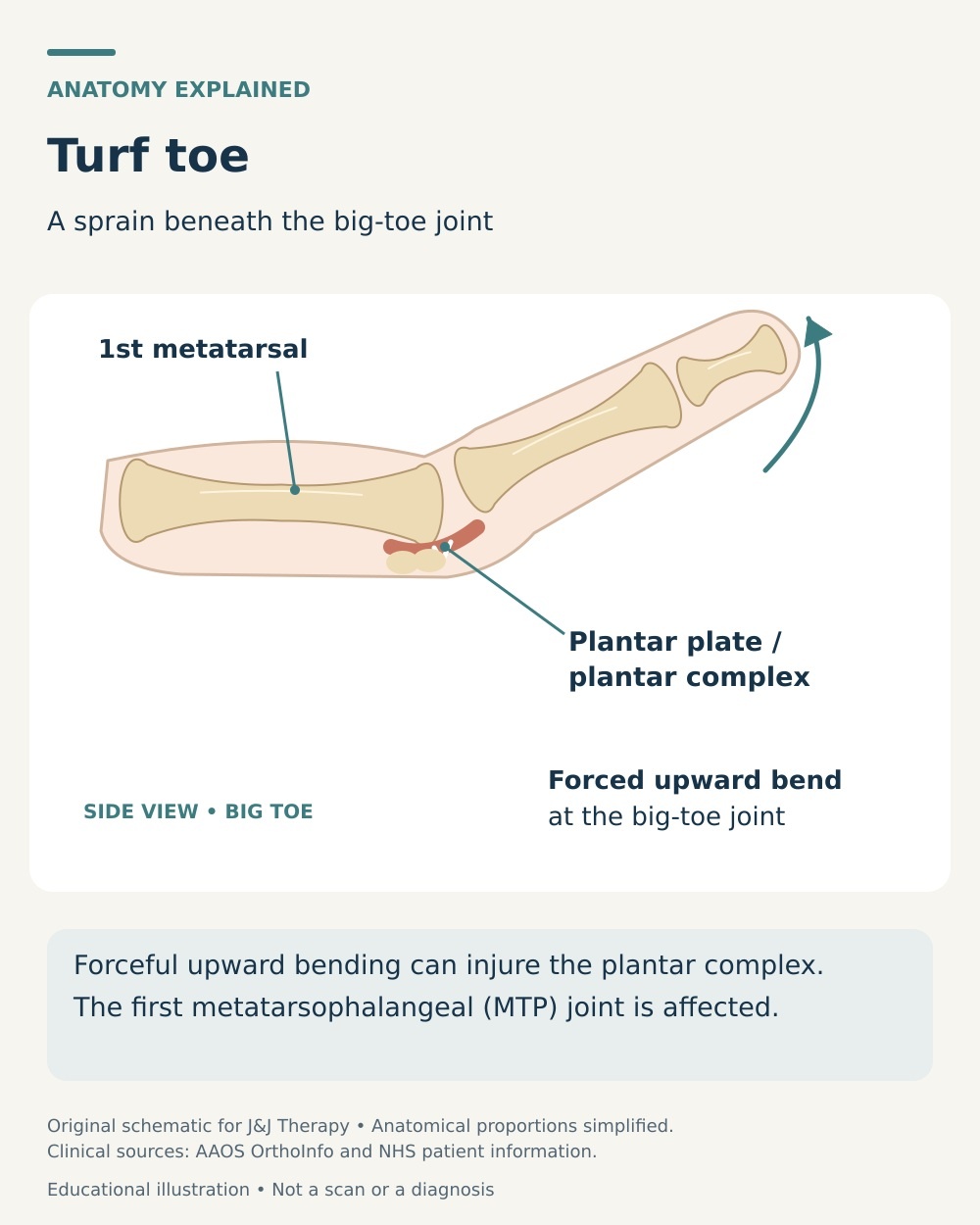
Turf toe is an injury to the soft tissues supporting the big-toe joint, usually when the toe is forced upwards. It ranges from a mild stretch to a significant tear of the structures beneath the joint. It can happen on many surfaces, not only artificial turf.
Assessment at J&J Therapy
We assess the injury history, walking and toe function after checking whether imaging or urgent care is needed. Significant bruising, instability or inability to push off may require a specialist assessment. Protection is tailored to the severity rather than pushing through toe pain.
Do You Experience These Symptoms?
- Pain under or around the big-toe joint after injury.
- Swelling or bruising and difficulty pushing off while walking.
- Pain with sprinting, jumping or bending the toe upwards.
An assessment helps guide your next step, based on your symptoms, health and goals.
Why symptoms may develop
A planted forefoot with the heel lifted can allow the big toe to bend back too far. Footwear, playing surface and the force of injury may contribute. Severe pain can also reflect a fracture or damage to the small sesamoid bones beneath the joint.
Treatment and rehabilitation options
Hands-On Manual Therapy
Early care avoids forceful upward bending and direct deep pressure on injured tissues. Later, gentle mobilisation may help appropriate movement once the joint is ready. Hands-on treatment cannot replace protection of a significant plantar-plate injury. We explain the purpose and check your comfort and response throughout treatment.
Is Shockwave Suitable?
Shockwave is not a routine treatment for an acute turf-toe sprain. The priority is identifying the injury, protecting the joint and restoring function through graded rehabilitation. Your physiotherapist can explain the more suitable options and how their effect will be reviewed during your ongoing rehabilitation.
Targeted Exercise Programme
A stiff-soled shoe, taping or a boot may be advised after assessment. Rehabilitation develops comfortable toe movement, foot and calf strength and a gradual return to push-off, running and cutting. More severe injuries follow specialist restrictions. Your home plan is adapted as your function and confidence improve.
When to Seek Urgent Medical Help
While most symptoms are not serious, urgent medical attention is required if you experience any of the following:
- Seek urgent GP or NHS 111 advice for severe pain after injury, inability to bear weight, or a hot swollen joint with fever.
- Go to A&E for an obvious deformity or a foot that becomes cold, pale or numb.
- If you have diabetes and a new foot wound, redness or swelling, contact your GP or diabetic foot team the same day; use NHS 111 if unavailable. Persistent altered sensation also needs medical review.
Your questions answered
Can a toe sprain be serious?
Yes. A substantial injury beneath the big-toe joint can affect stability and push-off, and may coexist with a fracture. Do not dismiss severe symptoms because the injury involves a toe.
When can I return to football or running?
When walking, toe movement and progressive sport tasks are sufficiently comfortable and controlled. Recovery varies with injury grade, so a fixed return date is not reliable.
Which appointment should I book?
Start with a Physiotherapy Initial Assessment for new, persistent or recurring symptoms. We can assess the problem and agree a plan linked to your daily activities. If you have already had medical care or surgery, bring the relevant instructions.
Book a Physiotherapy Assessment or call our reception team on 07935 869938. Find J&J Therapy at CI Tower, Ground Floor, New Malden.
Related conditions
Hallux Rigidus · Stress Fracture (Foot & Ankle)
Sources and further reading

This page is for general information only and does not replace professional medical advice.
Information updated 15 October 2026. General information only; this page cannot diagnose your symptoms. Treatment is agreed after assessment. For urgent or severe symptoms, use the medical services described above.