
Quick Summary
Localised bone pain during walking or running needs assessment before massage or exercise progression. Rehabilitation begins with appropriate protection and a confirmed management plan. Suspected bone injury should be medically assessed before you begin rehabilitation with our New Malden team. We agree practical goals and review your progress.
Understanding Stress Fracture (Foot & Ankle)
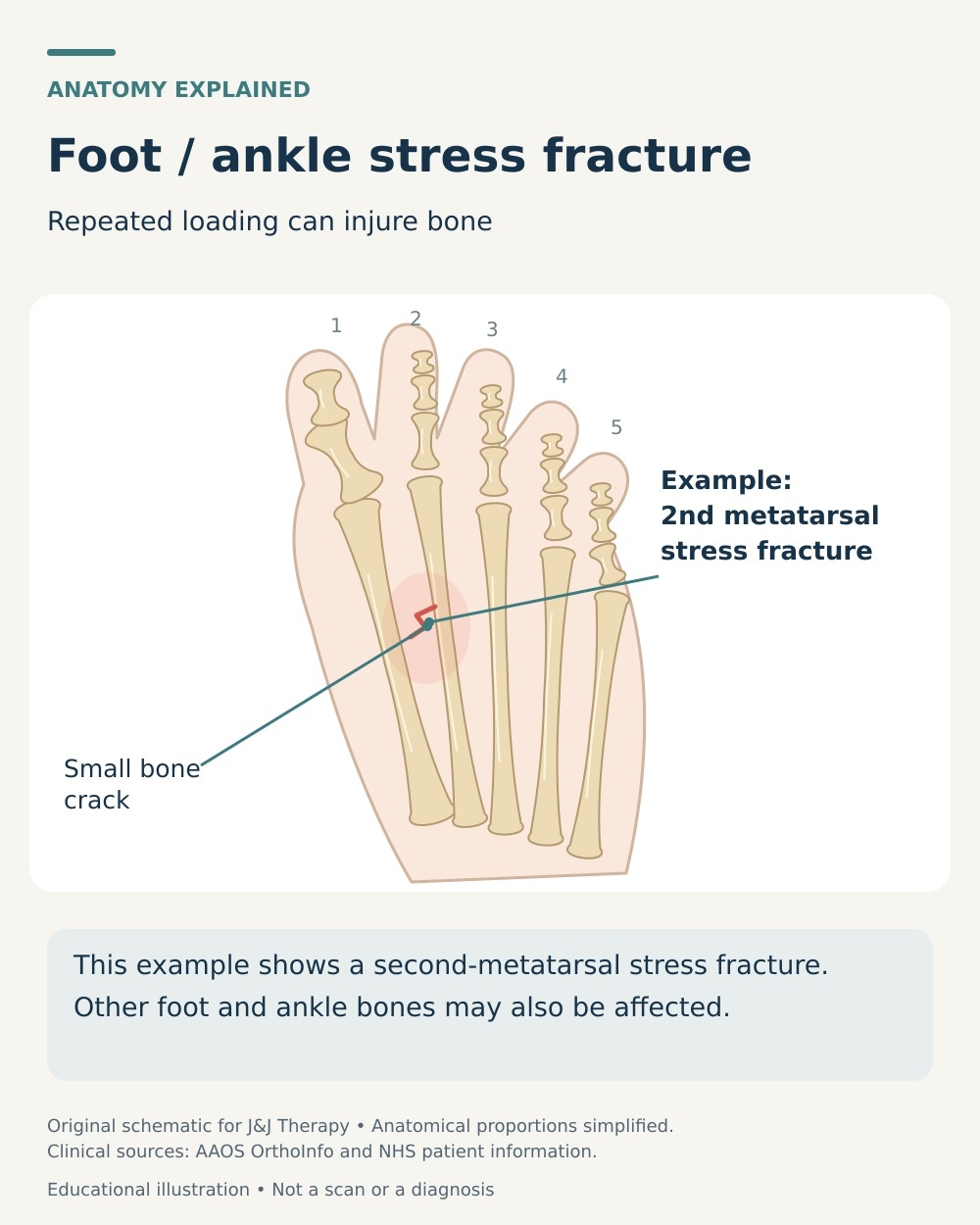
A bone stress injury occurs when repeated loading exceeds the bone’s ability to adapt. It can progress from a stress reaction to a small fracture. The location matters: some foot and ankle bones have a higher risk of delayed healing and need specialist management.
Assessment at J&J Therapy
Suspected bone stress injury needs medical assessment and possibly imaging; early X-rays can be normal. We help identify the need for referral and coordinate rehabilitation once the diagnosis, protection and weight-bearing instructions are clear.
Do You Experience These Symptoms?
- A specific tender spot on a bone rather than a broad muscle ache.
- Pain that increases with impact and may progress to ordinary walking.
- Local swelling, or pain that persists after activity or at rest.
An assessment helps guide your next step, based on your symptoms, health and goals.
Why symptoms may develop
Rapid training changes, insufficient recovery and low energy availability can contribute. Reduced bone strength, some medicines and hormonal factors may also matter. A stress fracture can occur without a single accident and is not restricted to athletes.
Treatment and rehabilitation options
Hands-On Manual Therapy
Massage and mobilisation are not used over a suspected fracture to test or treat the pain. Later hands-on care may address surrounding stiffness only when safe within the medical plan. Comfort measures must not encourage premature impact loading. We explain the purpose and check your comfort and response throughout treatment.
Is Shockwave Suitable?
Routine clinic radial shockwave is not recommended as a substitute for investigating or protecting a suspected stress fracture. Specialist treatments for selected bone-healing problems are a separate pathway and should not be confused with standard soft tissue shockwave sessions. Your physiotherapist can explain the more suitable options and how their effect will be reviewed during your ongoing rehabilitation.
Targeted Exercise Programme
Initial activity follows the medical team’s instructions, which may include a boot or restricted weight-bearing. After appropriate healing and clearance, we rebuild movement, strength and impact tolerance gradually. Recovery also considers training, nutrition and bone-health factors to reduce recurrence risk.
When to Seek Urgent Medical Help
While most symptoms are not serious, urgent medical attention is required if you experience any of the following:
- Arrange prompt medical assessment for localised bone tenderness, pain with ordinary walking or symptoms worsening despite reduced activity.
- Seek urgent help if you cannot bear weight, have major swelling or the foot is deformed after injury.
- A cold, pale or numb foot needs emergency assessment.
Your questions answered
Can a normal X-ray rule it out?
Not always, particularly early on. Persistent localised bone pain may require further assessment or imaging even when an initial X-ray is normal.
Can I keep running if it warms up?
Do not use warming-up as a safety test for suspected bone injury. Stop the provoking impact activity and seek assessment; the safe alternative depends on the site and severity.
Which appointment should I book?
Suspected stress fracture needs medical assessment first. Once the diagnosis and weight-bearing plan are clear, Physiotherapy can support rehabilitation. Bring any scan reports and specialist instructions. Call our reception team if you need help choosing an appropriate appointment.
Related conditions
Sources and further reading

This page is for general information only and does not replace professional medical advice.
Information updated 15 October 2026. General information only; this page cannot diagnose your symptoms. Treatment is agreed after assessment. For urgent or severe symptoms, use the medical services described above.