Quick Summary
Hallux rigidus is osteoarthritis of the joint at the base of your big toe (the first metatarsophalangeal joint), causing pain, stiffness and difficulty pushing off when you walk. It is the most common form of arthritis in the foot, affecting around 1 in 40 adults over the age of 50. Our HCPC-registered physiotherapists combine hands-on manual therapy with a targeted, progressive exercise programme to reduce pain, protect the joint and keep you moving. Most patients notice meaningful improvement within 6–12 sessions alongside footwear adjustments.
What Is Hallux Rigidus?
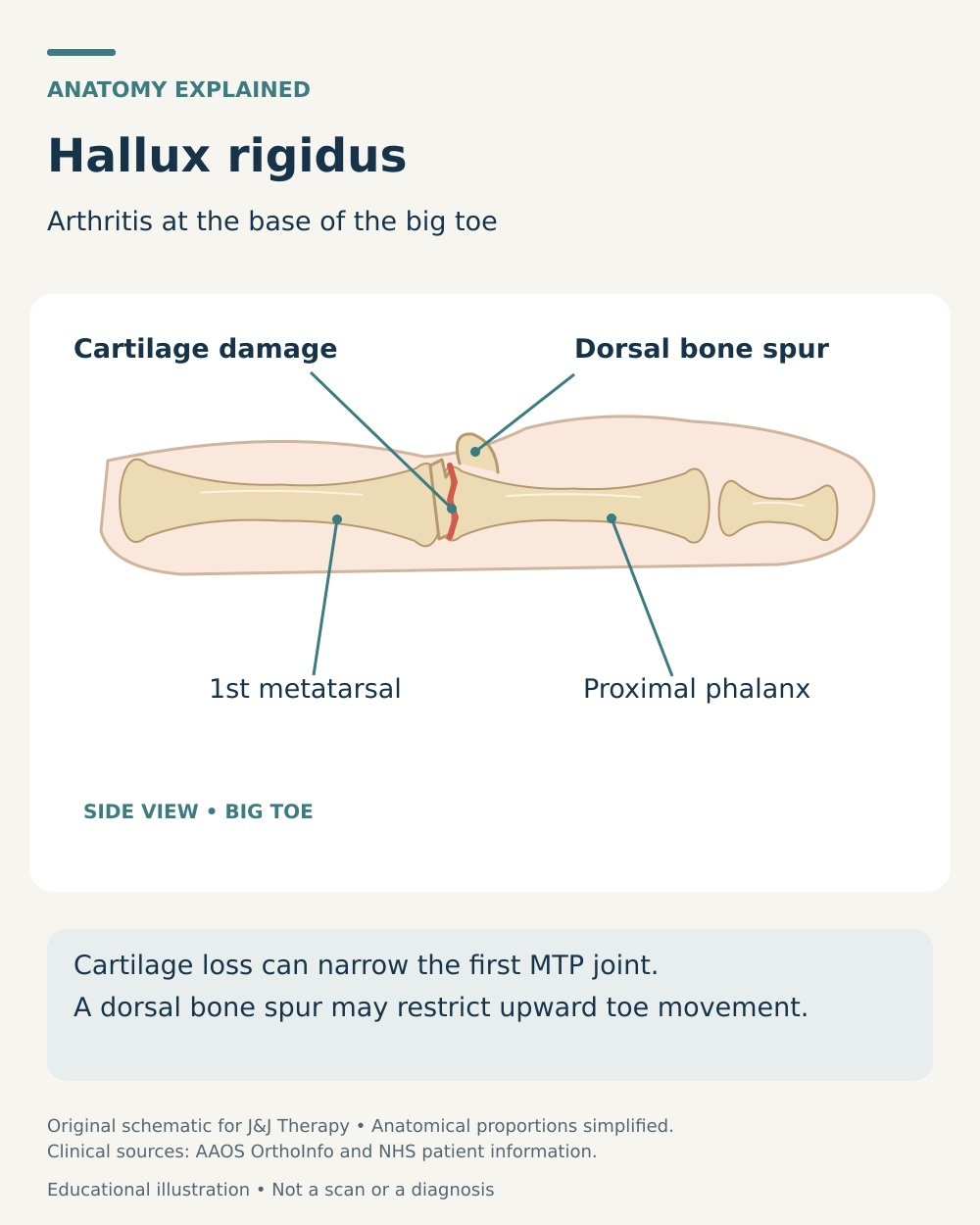
Hallux rigidus is the most common form of osteoarthritis in the foot. It affects the first metatarsophalangeal (MTP) joint, where the long first metatarsal bone meets the base of your big toe. The condition begins with degeneration of the cartilage — typically at the top (dorsal) surface of the joint first — followed by joint space narrowing and the formation of a dorsal osteophyte, or bone spur, on top of the joint (Coughlin & Shurnas, JBJS, 2003).
This dorsal spur explains much of the pain. As you push off during walking, your big toe needs to bend upwards, and the spur causes the joint to catch and jam at the top — a mechanism known as dorsal impingement. Because the big toe carries roughly 40–60% of your body weight during the stance phase of walking, and two to three times body weight during running, this joint is particularly vulnerable to wear.
Hallux limitus and hallux rigidus
These terms describe the same condition at different stages. Hallux limitus is the earlier stage, where upward bending is restricted to less than the approximately 65 degrees needed for normal walking, but some movement remains. Hallux rigidus is the later stage, where movement is largely or completely lost.
How it differs from a bunion
Hallux rigidus is not the same as a bunion (hallux valgus). In hallux rigidus the bump forms on the top of the joint and the main problem is stiffness; in a bunion the bump is on the inner side and movement is usually preserved. The two can occur together, and research suggests hallux valgus is an independent risk factor for hallux rigidus (Senga et al., BMC Musculoskeletal Disorders, 2021).
Grading the condition
Physiotherapists and surgeons commonly use the Coughlin and Shurnas grading system, which runs from Grade 0 (stiffness without pain, normal X-ray) through to Grade 4 (movement below 10 degrees with pain throughout the range). Knowing your grade helps us set realistic goals and choose the right combination of treatment.
In UK research, symptomatic radiographic foot osteoarthritis affects 16.7% of adults over 50, and the big toe joint is the single most commonly affected joint at 7.8% (Roddy & Menz, Therapeutic Advances in Musculoskeletal Disease, 2018). Structural changes on X-ray are even more common, reported in 25% of UK adults over 50 — 32% of women compared with 18% of men (Menz et al., Osteoarthritis and Cartilage, 2015). It typically develops between the ages of 30 and 60 and becomes more common with age.
Do You Experience These Symptoms?
✓ Pain in the big toe joint, especially when pushing off to walk, running or climbing stairs
✓ Stiffness and a gradual loss of upward bending in your big toe
✓ A bony bump on the top of the joint that rubs against your shoes
✓ Swelling and tenderness around the base of the big toe
✓ Difficulty finding comfortable footwear, or pain in certain shoes
✓ Walking on the outside of your foot to avoid loading the toe, sometimes causing knee, hip or lesser-toe pain
✓ A deep ache in the joint even at rest as the condition progresses
These symptoms can be treated.
The sooner you begin, the better your chances of a smoother recovery.
What Causes Hallux Rigidus?
• Age-related wear and osteoarthritis
In most cases no single cause is identified — the joint simply wears out over time.
Because the big toe joint carries a high proportion of your body weight with every step, it is particularly prone to osteoarthritic change as you get older.
• Previous injury or trauma
A single significant injury, such as a hyperextension sprain (turf toe) or a badly stubbed toe, can damage the cartilage.
Repeated minor trauma over many years has a similar effect, which makes hallux rigidus one of the more common forms of arthritis to follow an identifiable injury.
• Foot structure and biomechanics
An elevated or unusually long first metatarsal, differences in the shape of the joint surface, and altered first-ray mechanics concentrate load on the top of the joint.
These structural traits can cause the joint to jam during push-off and may accelerate cartilage wear.
• Family history
There is a recognised hereditary tendency, so hallux rigidus can run in families.
If a parent or sibling has had big toe arthritis, you may develop it at a younger age than average.
• Associated conditions
Gout, rheumatoid arthritis and knee osteoarthritis are all independent risk factors for developing hallux rigidus.
Where one of these is suspected, we will assess accordingly and liaise with your GP if further investigation is needed.
How We Treat Hallux Rigidus at J&J Therapy
Hands-On Manual Therapy
Swiss-trained hands-on techniques focused on the big toe joint.
Our physiotherapists use first MTP joint mobilisation with distraction and dorsal glide to improve movement and ease dorsal impingement, alongside sesamoid mobilisation, soft-tissue work on the flexor hallucis and intrinsic foot muscles, and first-ray mobility work.
A clinical trial found that sesamoid mobilisation, flexor hallucis strengthening and gait training added to standard physiotherapy produced greater big toe extension, greater strength and lower pain than standard care alone (Shamus et al., JOSPT, 2004).
Shockwave Therapy*
Swiss Storz Medical MASTERPULS
may complement your manual therapy and exercise programme when your physiotherapist identifies specific indications during assessment — for example, persistent soft-tissue pain around the joint that has not settled with first-line care.
Non-invasive, evidence-based. It is not a first-line treatment for hallux rigidus, and we will be open with you that direct research evidence for shockwave in big toe joint osteoarthritis is currently limited.
Targeted Exercise Programme
A targeted programme tailored to your grade and your goals.
We combine gentle big toe mobility work within a pain-free range, progressive loading and flexor hallucis strengthening, intrinsic foot (foot core) exercises, calf and gastrocnemius work to reduce forefoot load, and gait retraining to restore a more normal push-off.
We also advise on stiff-soled or rocker-sole footwear with a wide, deep toe box, and on shoe-stiffening inserts or a Morton's extension orthosis where appropriate — a randomised trial found shoe-stiffening inserts reduced foot pain more than sham inserts at 12 weeks (Munteanu et al., Osteoarthritis and Cartilage, 2021).
When to Seek Urgent Medical Help
While most symptoms are not serious, urgent medical attention is required if you experience any of the following:
Sudden severe pain with redness, heat and swelling in the big toe joint, especially with a fever (possible gout or joint infection)
A wound, ulcer or break in the skin over the joint that is not healing, particularly if you have diabetes or poor circulation
Rapidly worsening numbness, tingling or loss of sensation in the toe, or the toe becoming pale or cold
Pain that stops you sleeping or bearing weight at all, or that is not controlled by simple measures
FAQs About Hallux Rigidus
Will my hallux rigidus get worse without treatment?
Hallux rigidus is a progressive, degenerative condition, so the underlying joint changes tend to advance over time and the damage to cartilage and bone cannot be reversed. However, symptoms do not always worsen at the same rate, and many people manage well for years with the right footwear, activity adjustments, physiotherapy and load management.
Starting conservative care early, while you still have movement in the joint, gives the best chance of keeping you comfortable and active.
Will I need surgery, such as a cheilectomy or fusion?
Not necessarily. Non-surgical care is recommended first, and research suggests a majority of people get adequate relief without an operation — one review of 772 patients reported that 55% had treatment success with conservative care alone.
If conservative treatment does not settle your symptoms, the surgical options depend on your grade: a cheilectomy (removing the dorsal bone spur) is used for milder disease, while fusion (arthrodesis) is the established option for end-stage arthritis. We will help you get the most out of conservative treatment and, if needed, support an onward referral to a foot and ankle surgeon.
What footwear helps most?
Stiff-soled or rocker-sole shoes with a wide, deep, high toe box are usually best, because they limit the painful upward bending of the big toe and reduce pressure on the bump on top of the joint. It is worth avoiding high heels, pointed or narrow shoes, and very flexible soles.
A shoe-stiffening insert or a Morton's extension can offload the joint further. A randomised trial found prefabricated foot orthoses and rocker-sole footwear were similarly effective for pain, with better adherence in the orthoses group (Menz et al., Arthritis Care & Research, 2016). We can advise on what suits your feet and lifestyle.
Can I still run or exercise?
Often yes, particularly in the earlier grades, though you may need to adjust how you train. Low-impact options such as cycling, swimming and the elliptical maintain your fitness while sparing the joint.
If you want to keep running, supportive stiff-soled shoes, softer surfaces and reduced volume can help. We will assess your joint and design a programme that keeps you active while protecting the toe, and advise you on when to scale back.
Can shockwave therapy help my hallux rigidus?
Sometimes, as a conditional addition to your programme rather than a first-line treatment. Our physiotherapists may use the Swiss Storz Medical MASTERPULS radial shockwave device to complement your manual therapy and exercises if your assessment identifies specific indications, such as persistent soft-tissue pain around the joint.
We will be open with you that direct research evidence for radial shockwave in big toe joint osteoarthritis is currently limited, even though shockwave is evidence-based for several other foot conditions. It is non-invasive, and we will only recommend it if we think it is right for you.
This page is for general information only and does not replace professional medical advice.
Reviewed by Lavya Arigalayan, MSc, HCPC Registered Physiotherapist.
Last reviewed: