Quick Summary
Shin splints — known medically as medial tibial stress syndrome (MTSS) — cause an aching pain along the inner edge of your shinbone, most often when you start or rapidly increase running, jumping or other high-impact training.
At J&J Therapy in New Malden, our HCPC-registered physiotherapists combine hands-on manual therapy, a progressive loading and running programme, and Swiss Storz Medical MASTERPULS radial shockwave therapy, which research suggests may shorten recovery time in persistent cases.
Most patients need a course of treatment, typically 3–6 sessions, alongside a graded home programme.
What Is Shin Splints?
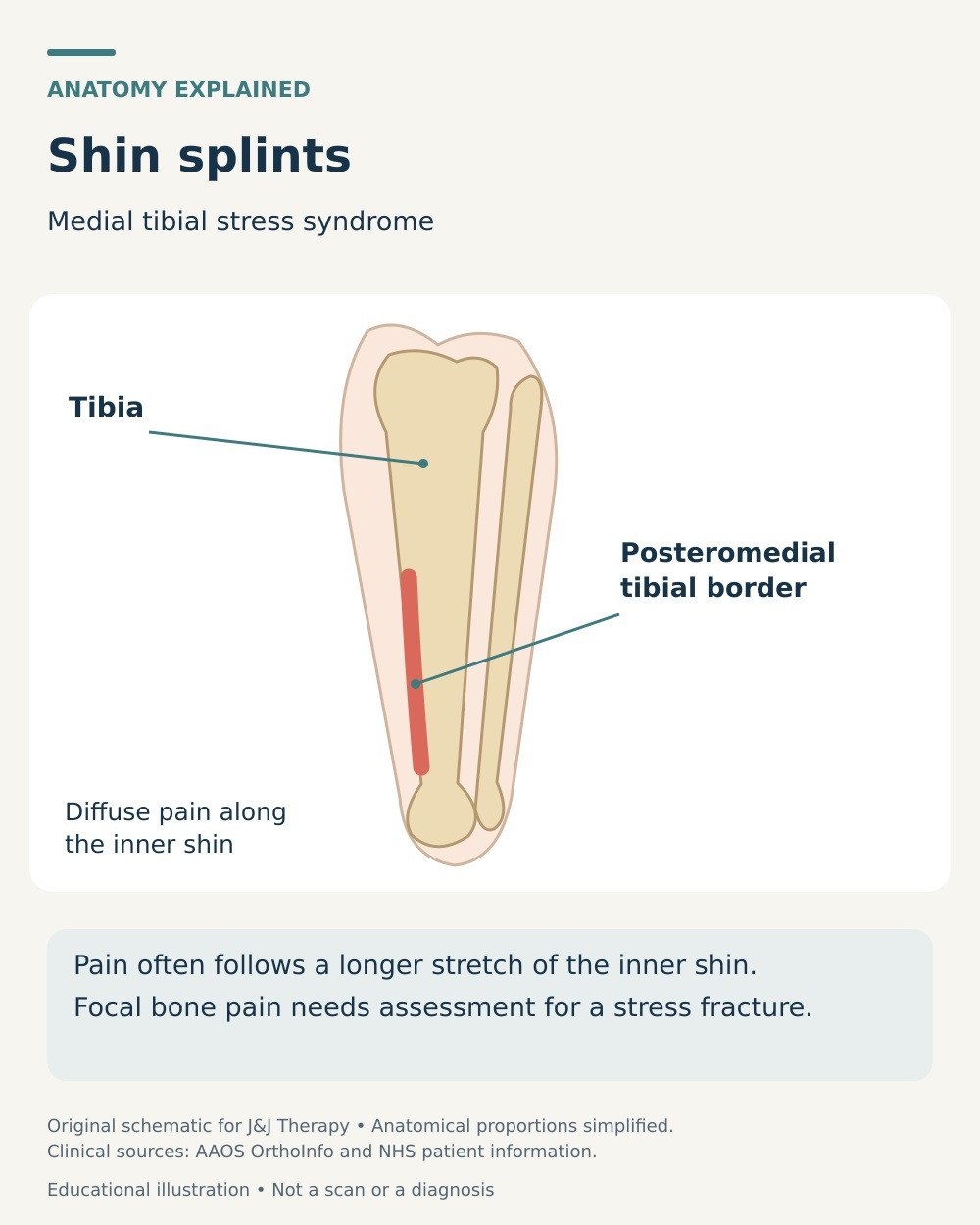
Shin splints, or medial tibial stress syndrome, describes exercise-induced pain along the middle-to-lower two-thirds of the inner (posteromedial) border of the tibia — your shin bone. It is one of the most common lower-limb overuse injuries in runners, jumping athletes, dancers and military recruits, and its impact can be considerable: a prospective study of 6,608 British Army recruits found that MTSS accounted for the single greatest share of total rehabilitation days of any musculoskeletal injury recorded.
A bone stress injury, not simply inflammation
MTSS was historically described as a "periostitis" — irritation of the lining of the bone caused by muscle traction. Current evidence has largely moved away from this model. Biopsy, bone-density and imaging studies indicate that MTSS is better understood as a bone stress injury, in which repetitive loading produces microdamage in the tibial cortex faster than the bone can remodel it (Franklyn & Oakes, World Journal of Orthopedics, 2015).
For this reason, MTSS is regarded as an early point on the bone stress injury continuum. Left unmanaged, it can progress towards a tibial stress fracture — although the two conditions are not the same, and not every case of shin splints goes on to become a fracture.
How we diagnose it
Shin splints is a clinical diagnosis. Research shows it can be identified reliably from your history and a physical examination alone, with almost-perfect agreement between clinicians, so routine scans are not needed in typical presentations (Winters et al., British Journal of Sports Medicine, 2018). The hallmark finding is diffuse tenderness spread over 5 cm or more of the inner shin border.
Our physiotherapists also assess for other causes of exercise-related shin pain, including tibial stress fracture, chronic exertional compartment syndrome, and nerve or vascular causes — each of which needs a different management approach.
Do You Experience These Symptoms?
✓ Aching or throbbing pain along the inner edge of your shinbone
✓ Pain that builds with running, jumping or marching and settles with rest
✓ Tenderness spread across a broad area — 5 cm or more — when you press along the bone
✓ Discomfort that is worst at the start of activity and may ease as you warm up
✓ Symptoms that began after a change — new footwear, harder surfaces or more training
✓ Mild swelling or a tender, slightly uneven feel along the shin in longer-standing cases
✓ In more advanced cases, discomfort during everyday walking or lingering after exercise
These symptoms can be treated.
The sooner you begin, the better your chances of a smoother recovery.
What Causes Shin Splints?
• Rapid increases in training load
A sudden jump in running distance, intensity, hill work or frequency is the most common trigger.
Your tibia adapts to load gradually, so when loading outpaces bone remodelling, microdamage accumulates and pain develops.
• Foot posture and biomechanics
Increased navicular drop — a marker of a flatter, more pronated foot — is associated with roughly twice the risk of developing shin splints.
These movement patterns can raise the bending and strain forces travelling through the inner tibia each time your foot strikes the ground.
• Reduced calf and hip strength
The calf complex, particularly the soleus, helps absorb load and reduce bending force through the shin during running.
Reduced strength or endurance in the calf and hip muscles, and fatigue late in a session, allow greater tibial strain.
• Footwear and training surfaces
Worn-out running shoes lose their cushioning, and hard or uneven surfaces increase impact loading through the lower leg.
Combined with a rapid increase in training, these external factors add to the cumulative stress placed on your shin.
• Individual risk factors
A meta-analysis identified female sex, higher body weight, greater navicular drop, a previous running injury and increased hip external rotation range as significant risk factors (Reinking et al., Sports Health, 2017).
Knowing your own risk profile helps us tailor both your rehabilitation and your longer-term prevention plan.
How We Treat Shin Splints at J&J Therapy
Hands-On Manual Therapy
Our physiotherapists use hands-on soft-tissue techniques and mobilisation of the calf complex, ankle and foot to reduce muscular tightness, restore ankle range of movement and address the biomechanical restrictions contributing to your symptoms. Manual therapy is delivered as part of a multimodal plan — evidence shows it works best alongside load management and progressive strengthening rather than on its own. We pair every session with clear education so you understand how to modify your activity while your shin recovers.
Shockwave Therapy*
Swiss Storz Medical MASTERPULS radial shockwave therapy applies acoustic pulses along the inner tibial border to stimulate local blood flow and support the bone remodelling response in the affected area. Research suggests it may shorten recovery time when combined with a graded loading programme, and it is particularly useful in persistent cases that have not settled with rehabilitation alone. Non-invasive, evidence-based. Typically 3–6 sessions.
Targeted Exercise Programme
Progressive loading is the cornerstone of recovery from shin splints. Your programme begins with relative rest — reducing high-impact volume while maintaining fitness through cycling, swimming or pool running — then builds progressive strengthening for the soleus and calf, tibialis posterior, foot intrinsics and gluteal muscles to improve your tibia's tolerance to load. Where appropriate, we use running gait retraining, since research suggests a moderate increase in step rate of around 5–10% may reduce impact loading through the shin. We then guide you through a structured walk-run progression, increasing volume gradually and guided by your symptoms, and advise on footwear and orthoses where indicated.
When to Seek Urgent Medical Help
While most symptoms are not serious, urgent medical attention is required if you experience any of the following:
Focal, pinpoint pain over a small area of bone, especially if it is worsening — this may indicate a tibial stress fracture and needs imaging
Pain at rest or at night, or pain that persists when you are not weight-bearing
Predictable cramping or pressure at a set distance, with tingling or numbness — possible compartment syndrome requiring specialist assessment
Significant swelling, redness, or calf pain and warmth — seek prompt medical review
FAQs About Shin Splints
Are shin splints and a stress fracture the same thing?
No. They sit on the same bone stress continuum, but shin splints cause diffuse pain over a broad area of 5 cm or more that eases with rest, whereas a stress fracture typically causes sharp, focal pain over a small spot that can persist at rest or at night. If we suspect a stress fracture, we will refer you for imaging.
How long do shin splints take to heal?
It varies with severity and how long your symptoms have been present. Many people improve within a few weeks of load management and rehabilitation, and a recovery period of four to six weeks is common, though longer-standing cases can take several months. In a prospective study of novice runners, the median recovery time for MTSS was around 72 days — the longest of any running injury studied.
Can I keep running with shin splints?
Often you can stay active with reduced, modified loading — shorter, slower, flatter runs kept within comfortable limits, or low-impact cross-training. Continuing to push through worsening pain is the most common reason shin splints return, so your progression should always be guided by your symptoms.
Does shockwave therapy work for shin splints?
Research suggests shockwave therapy may help, particularly in persistent cases. Controlled studies have reported higher success rates and faster recovery when radial or focused shockwave is added to a graded running programme (Rompe et al., American Journal of Sports Medicine, 2010; Moen et al., British Journal of Sports Medicine, 2012). The evidence base remains limited, and shockwave works best as an adjunct to loading rehabilitation rather than on its own. At J&J Therapy we use the Swiss Storz Medical MASTERPULS device, typically over 3–6 sessions.
How do I stop shin splints coming back?
Increase your training load gradually, build and maintain calf and hip strength, replace worn-out running shoes, avoid sudden spikes in mileage or hill work, and address foot posture with footwear or orthoses where indicated. A previous episode is the strongest predictor of a further one, so ongoing maintenance strengthening matters.
This page is for general information only and does not replace professional medical advice.
Reviewed by Lavya Arigalayan, MSc, HCPC Registered Physiotherapist.
Last reviewed: