top of page
Physiotherapist at J&J Therapy in New Malden assessing the base of a patient's thumb for CMC joint arthritis

Thumb CMC Joint Arthritis

300+ Reviews 5.0

Open 7 Days

10+ Years' Experience

HCPC Physio On Team

Insurance Accepted

85% Return Rate

PHYSIOTHERAPY & THERAPEUTIC MASSAGE IN NEW MALDEN

Quick Summary

Thumb CMC joint arthritis — osteoarthritis of the trapeziometacarpal joint at the base of your thumb — is one of the most common and most disabling forms of hand osteoarthritis, affecting around 22% of UK adults aged over 50 and roughly three times as many women as men. The good news is that it responds well to non-surgical care: our HCPC-registered physiotherapists combine hands-on manual therapy, a targeted thumb-stability exercise programme, and joint-protection advice, in line with NICE and EULAR guidance. Most patients follow a course of approximately 6–8 sessions over 8–12 weeks, alongside a home programme.

What Is Thumb CMC Joint Arthritis?

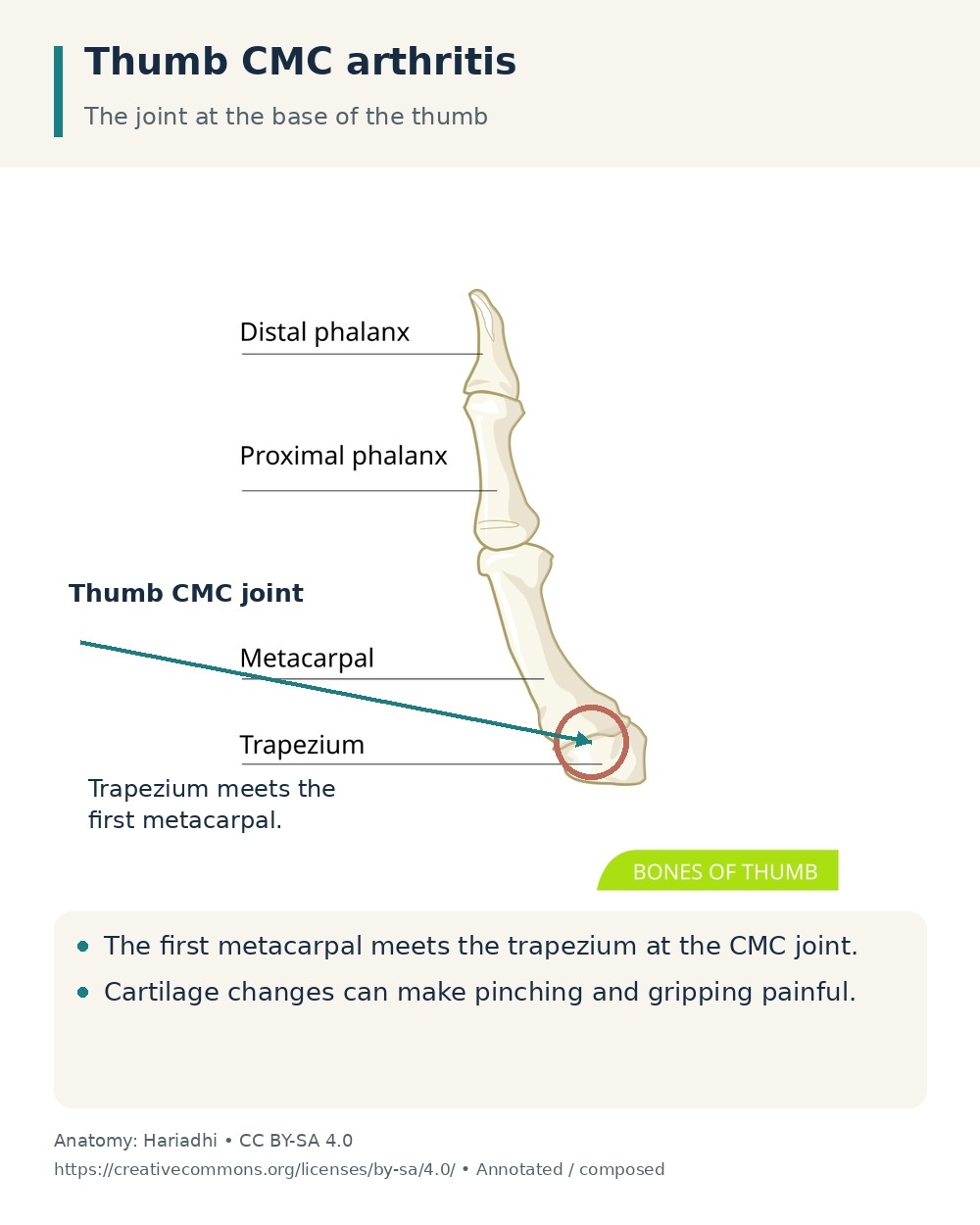
Anatomical illustration of the thumb carpometacarpal saddle joint showing the trapezium, first metacarpal and stabilising ligaments

Thumb CMC joint arthritis — also called trapeziometacarpal, basal thumb, or thumb base osteoarthritis — is wear of the small saddle-shaped joint between the trapezium bone in your wrist and the base of your thumb.

This joint is made of two interlocking saddle shapes, which gives your thumb its remarkable range of movement but leaves it with very little bony stability. It therefore relies heavily on its ligaments — particularly the beak (anterior oblique) ligament on the palm side and the dorsoradial ligament on the back of the thumb — together with the surrounding muscles.


When these ligaments become lax, the joint loses its congruence and the base of the thumb slides slightly out of position. Load is then spread unevenly across the cartilage, and over time that cartilage wears. The forces involved are surprisingly high: research suggests that a 1 kg pinch generates roughly 12 kg of compression at the joint, rising to around 120 kg during a strong grasp — which helps explain why such a small joint wears so readily.


Doctors describe the changes seen on X-ray using the Eaton–Littler stages:

Stage I: Normal joint outlines with possible slight widening, reflecting early inflammation or looseness. No slippage of the joint.

Stage II: Slight narrowing of the joint space, minor hardening of bone, and small bone spurs. Up to one-third slippage.

Stage III: Marked narrowing, larger bone spurs, and more than one-third slippage of the joint.

Stage IV: Stage III changes plus involvement of the neighbouring scaphotrapezial joint.


Importantly, what shows on an X-ray often does not match how much pain you feel, and NICE advises against routine imaging simply to make the diagnosis. We diagnose this condition clinically — through your history and hands-on assessment. The classic test is the grind test, where we gently compress and rotate the thumb; evidence shows it is highly specific but misses many cases, so a negative test does not rule the condition out. We also carefully distinguish it from De Quervain's tenosynovitis and from scaphoid problems, which cause pain in a similar area.

Do You Experience These Symptoms?

✓  A deep ache or pain at the base of your thumb, usually worse with activity and eased by rest

✓  Pain and weakness when gripping, pinching or twisting — opening jar lids, turning keys, or using door handles

✓  Tenderness, and sometimes visible swelling, over the joint at the base of your thumb

✓  Reduced grip and pinch strength making everyday tasks harder, from fastening buttons to carrying shopping

✓  Stiffness after rest or first thing in the morning, typically easing within about 30 minutes

✓  Grinding, clicking or a catching sensation when you move your thumb

✓  In longstanding cases, a squared-off appearance or bump at the joint, with the thumb sitting closer to the palm

These symptoms can be treated.
The sooner you begin, the better your chances of a smoother recovery.

What Causes Thumb CMC Joint Arthritis?

•  Age and post-menopausal hormonal change

Prevalence rises steeply with age and peaks in women around and after the menopause.

Hormonal change is thought to affect ligament and cartilage tissue, which helps explain why the great majority of symptomatic cases occur in women over 50.


•  Ligament laxity and joint instability

Because the saddle joint has so little bony constraint, it depends on its ligaments — particularly the beak and dorsoradial ligaments — to stay centred.

When these stretch or weaken, the base of the thumb shifts out of position and the cartilage is loaded unevenly, driving degeneration.


•  Repetitive gripping, pinching and twisting

Years of repeated thumb loading generate very high forces across a very small joint surface.

Occupations and hobbies involving sustained pinching or gripping are recognised factors in both developing and aggravating the condition.


•  Sex, genetics and family history

Thumb base arthritis affects women roughly three times as often as men, and it frequently runs in families.

Many people with the condition also have osteoarthritis affecting other joints in the hand.


•  Previous injury and higher body weight

A past fracture, sprain or dislocation involving the thumb base can alter joint mechanics and accelerate wear.

A higher body mass index is also associated with a greater likelihood of developing hand osteoarthritis.

Not sure which condition applies to you?

How We Treat Thumb CMC Joint Arthritis at J&J Therapy

Hands-On Manual Therapy

Hands-on treatment from our HCPC-registered physiotherapists to settle pain and improve how your thumb moves and loads. We use graded joint mobilisation of the CMC joint — gentle distraction and gliding techniques — alongside soft-tissue work to the thenar and thumb-web muscles, and radial nerve mobilisation where indicated. Randomised trials suggest these techniques may reduce pain sensitivity and improve function, and we always pair them with exercise rather than using them alone. Typically delivered over 4–6 hands-on sessions.

Shockwave Therapy*

Swiss Storz Medical MASTERPULS
may be considered only when your physiotherapist identifies specific indications during assessment — it is never our first-line approach for this joint. Evidence at the thumb base is currently limited to a small number of trials, and the area sits close to nerves and blood vessels with little protective tissue, so we assess suitability carefully and explain honestly what the research does and does not show.
Non-invasive, assessment-based.

Targeted Exercise Programme

Exercise is the cornerstone of care and is recommended for every patient by both NICE and EULAR. Our physiotherapists build a programme around dynamic joint stability rather than loading through pain: first dorsal interosseous strengthening to help re-centre the joint, thenar strengthening with thumb-web stretching to balance the forces around it, and proprioceptive control work that research suggests improves pain and joint position sense. We combine this with joint-protection strategies, activity modification, and advice on the most suitable splint for you — evidence shows orthoses may meaningfully reduce pain, particularly during flare-ups.

When to Seek Urgent Medical Help

While most symptoms are not serious, urgent medical attention is required if you experience any of the following:

  • A hot, red, swollen and very painful thumb joint with fever or feeling unwell (possible joint infection) — seek same-day medical care

  • Severe pain, deformity, or inability to move or load the thumb after a fall or injury (possible fracture)

  • New numbness, tingling or weakness spreading into your hand or fingers

  • Rapidly worsening or unremitting night pain, or several hot swollen joints at once

FAQs About Thumb CMC Joint Arthritis

  • Is thumb CMC arthritis the same as De Quervain's tenosynovitis?

No — although both cause pain near the base of the thumb. De Quervain's is irritation of the tendons at the wrist, and is suggested by pain over the bony point on the thumb side of your wrist that is reproduced by a specific tendon stretch test. Thumb CMC arthritis is joint pain, reproduced when we compress and rotate the joint itself. Our physiotherapists distinguish the two during assessment — and because the grind test misses a proportion of cases, we never rely on a single test alone.


  • Will physiotherapy make my thumb arthritis go away?

No treatment reverses established osteoarthritis, and we would never claim otherwise. What evidence shows is that exercise, manual therapy, splinting and joint protection may meaningfully reduce your pain, improve grip and pinch strength, and help you keep doing the daily tasks that matter — often enough to avoid or delay injections or surgery.


  • Will I need a splint?

Often, yes. An orthosis is recommended by EULAR for thumb base osteoarthritis and research suggests it may reduce pain, particularly during flare-ups. We will advise on the right type for you — a rigid hand-based splint tends to favour function, while a longer splint tends to favour pain relief — and show you how to combine it with your exercises so the thumb muscles stay active.


  • Do you offer shockwave therapy for the base of the thumb?

Shockwave is not a routine treatment for this joint. The current evidence is limited to a small number of trials, most using focused rather than radial shockwave and without placebo comparison, which suggest it may help pain in some people. The thumb base also sits over nerves and blood vessels with little protective tissue. We therefore only consider it after an individual assessment, and always prioritise manual therapy, exercise and splinting first.


  • When should I be referred to a hand surgeon?

If a good course of conservative care does not control your symptoms, or the joint is advanced or unstable, we can arrange onward referral. Options at that point may include a corticosteroid injection to settle a flare-up, or surgery such as trapeziectomy, which remains the most established procedure with good long-term outcomes.

Not sure this condition matches your symtoms?
Find your condition and explore related pain areas.

Logo_Navy.png

Ready to start your recovery?
Book your Initial Assessment today.

This page is for general information only and does not replace professional medical advice.

Reviewed by Lavya Arigalayan, MSc, HCPC Registered Physiotherapist.

Last reviewed

20 August 2026

bottom of page