Quick Summary
A calf strain is an injury to the gastrocnemius or soleus muscle at the back of your lower leg, usually caused by a sudden push-off, sprint or change of direction. Most calf strains settle well with the right rehabilitation, but they have a high recurrence rate — research shows a large proportion of repeat injuries happen within six months of the original one, most often when strength work is stopped too early.
At J&J Therapy in New Malden, our HCPC-registered physiotherapists confirm the diagnosis, rule out more serious causes of calf pain, and guide you through a graded loading programme. Most patients attend for a course of treatment alongside a home exercise plan, with the aim of returning you to walking, running and sport with a calf that is genuinely strong again rather than simply pain-free at rest.
What Is a Calf Strain or Tear?
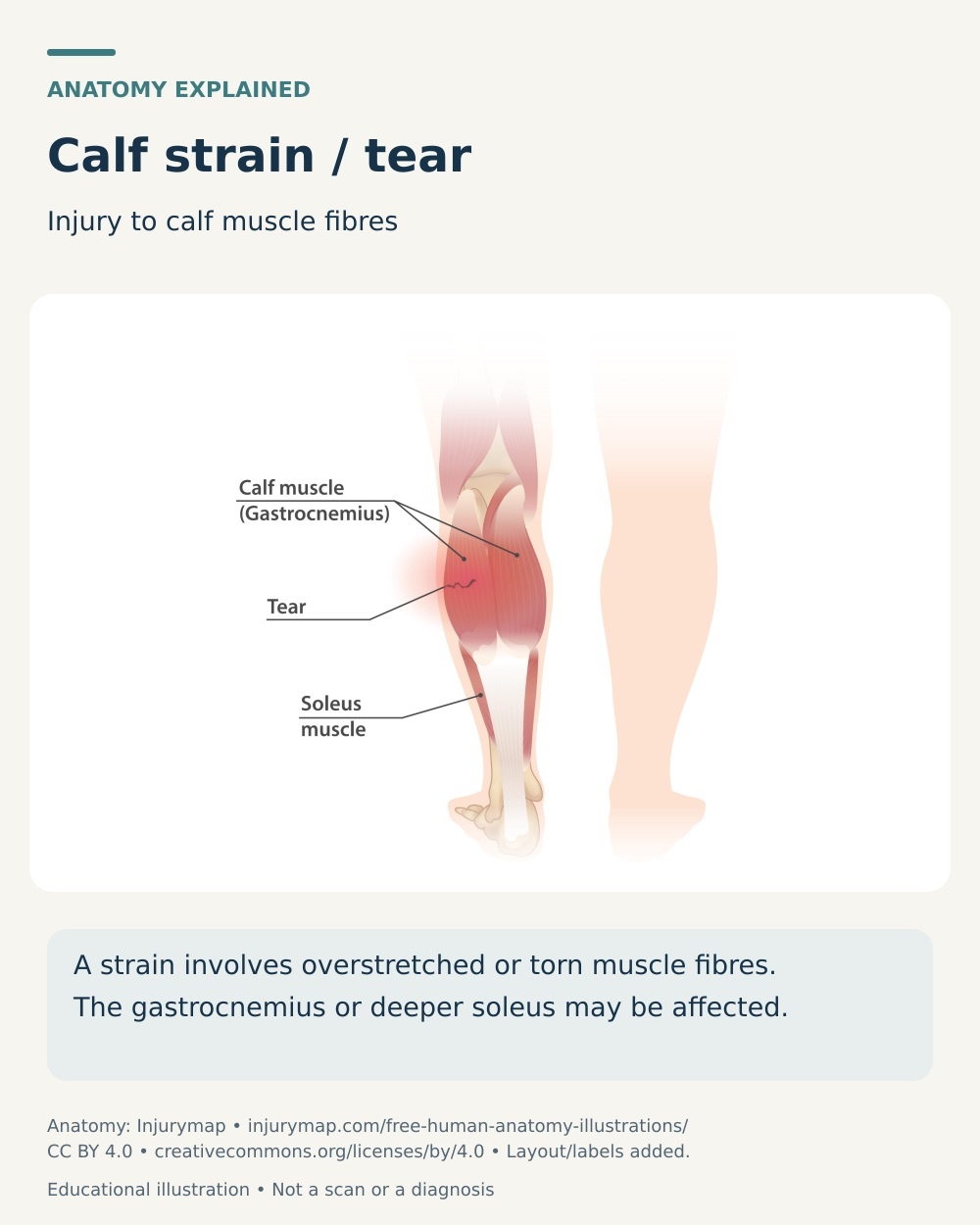
Your calf is made up of two main muscles. The gastrocnemius is the larger, more visible muscle that crosses both the knee and the ankle, and the soleus sits underneath it and crosses the ankle only. Both join into the Achilles tendon. A calf strain happens when muscle fibres are overstretched or torn, most commonly at the junction where muscle meets tendon.
Injuries are usually graded by severity. A mild strain involves a small number of fibres and often settles within one to two weeks. A moderate strain involves more extensive fibre damage with pain, swelling and noticeable weakness. A severe tear involves a large proportion of the muscle and can take several months to recover fully. In the UK, sports medicine services increasingly use the British Athletics Muscle Injury Classification, which describes both how much tissue is involved and exactly where the injury sits — myofascial, musculotendinous or intratendinous.
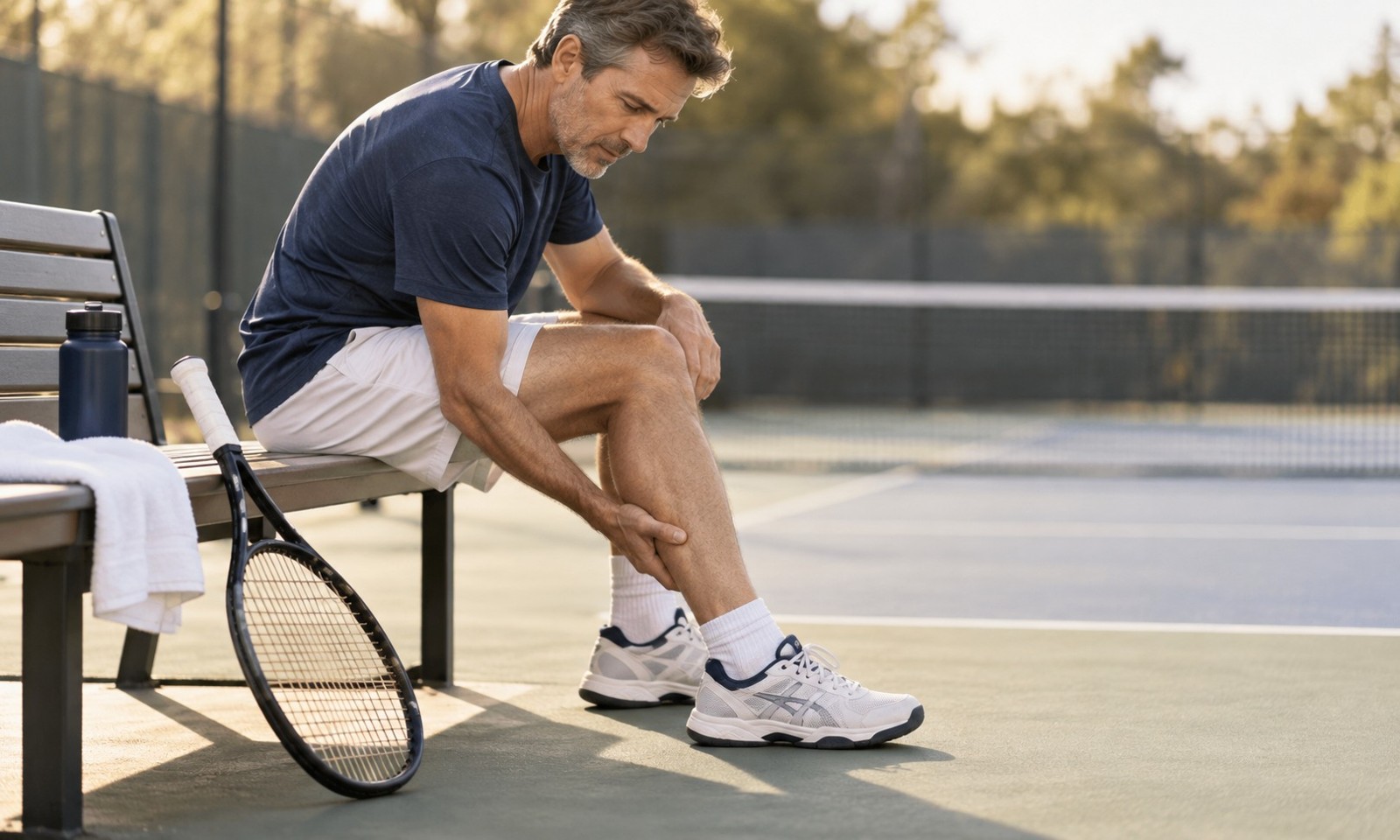
Which muscle is injured matters a great deal for your recovery. Gastrocnemius injuries — including the pattern often called "tennis leg", typically seen in middle-aged recreational players — tend to be dramatic at the moment of injury but often settle more quickly. Soleus injuries are frequently more subtle, presenting as a gradual tightening rather than a sudden pop, yet they take longer to resolve and account for the great majority of re-injuries (Green et al., Scandinavian Journal of Medicine and Science in Sports, 2020).
Calf strain is among the most common running-related injuries, and it is one of the most stubborn. Research in elite sport has found recurrence rates in the region of 13 to 16 per cent, with the majority of repeat gastrocnemius injuries occurring within six months of the first (Green et al., Journal of Orthopaedic and Sports Physical Therapy, 2025). This is why a structured, criteria-based return to running matters far more than simply waiting for the pain to stop.
Do You Experience These Symptoms?
✓ A sudden sharp pain, snap or pulling sensation at the back of your lower leg, often during running, sprinting or a quick push-off
✓ Difficulty walking normally, particularly when pushing off or rising onto your toes
✓ Swelling, and sometimes bruising that tracks down towards the ankle over the following days
✓ Tenderness when you press into the calf muscle, often at one specific point
✓ Tightness or cramping that returns each time you try to run again
✓ Weakness or pain when performing a single-leg heel raise compared with your other side
✓ Pain on stretching the calf, such as standing with your heel dropped over a step
These symptoms can be treated.
The sooner you begin, the better your chances of a smoother recovery.
What Causes Calf Strain and Tears?
• Explosive push-off and sudden acceleration
Most calf strains occur during rapid acceleration, sprinting, jumping or a sharp change of direction, when the muscle is contracting while being lengthened. This eccentric demand places very high force through the muscle-tendon junction, which is where tissue most often gives way.
• Fatigue and rapid increases in training load
A tired calf absorbs load less efficiently, and injuries frequently happen late in a run, match or training session. Sharp jumps in mileage, a sudden return to sport after a break, or new hill and speed work are common triggers.
• Reduced calf strength and endurance
The calf must tolerate forces of several times body weight with every running stride, so a calf that fatigues early is far more vulnerable. Limited ankle mobility and weakness through the hip and foot can also shift additional demand onto the calf.
• Age-related changes in muscle and tendon tissue
From around the fourth decade onwards, muscle and tendon tissue becomes less elastic and slower to adapt to sudden load. This is why the "tennis leg" pattern is seen so often in middle-aged recreational players returning to intermittent sport.
• Previous calf injury and incomplete rehabilitation
A previous calf strain is the single strongest predictor of another one, particularly when strength work stopped as soon as the pain settled. Returning to sport before the calf can tolerate repeated single-leg loading leaves a strength deficit that the muscle cannot hide under fatigue.
How We Treat Calf Strain and Tears at J&J Therapy
Hands-On Manual Therapy
Our physiotherapists begin with a thorough assessment to confirm which calf muscle is involved, gauge the severity of the injury, and rule out other causes of calf pain that need different management. Hands-on treatment then focuses on settling pain and protective muscle guarding, restoring ankle and calf flexibility, and improving the way the calf, ankle and foot work together. We use soft tissue techniques, graded mobilisation and targeted work on any residual tightness or scar tissue in the healing muscle, always paired with the loading programme that drives the actual tissue recovery.
Shockwave Therapy*
Swiss Storz Medical MASTERPULS radial shockwave may complement your manual therapy and exercise programme in persistent or recurrent calf problems, when your physiotherapist identifies specific indications during assessment. It is never a first-line treatment for calf injury: direct research in calf muscle strain is currently limited to small case reports, with the wider rationale drawn from related lower-leg conditions such as chronic tendinopathy and shin pain, so we are careful not to overstate what it can offer. Where we do consider it, this is only after conditions such as deep vein thrombosis and acute tearing have been excluded, and always alongside continued progressive loading rather than in place of it. Non-invasive, and reviewed at each stage against your response.
Targeted Exercise Programme
Progressive loading is the treatment that genuinely rebuilds an injured calf, and it forms the core of your programme. We typically begin with gentle isometric holds to settle pain, then progress into heavy, slow calf raise work targeting both the gastrocnemius with a straight knee and the soleus with a bent knee, since the soleus is so often the muscle involved in repeat injuries. From there we add speed, hopping and energy-storage work that prepares the calf for running loads. Your return to running is guided by clear criteria rather than the calendar — pain-free walking, a full pain-free single-leg heel raise, comfortable single-leg hopping and no pain on stretch or palpation — and we build strength work into your longer-term routine to reduce the risk of the injury returning.
When to Seek Urgent Medical Help
While most symptoms are not serious, urgent medical attention is required if you experience any of the following:
Calf pain with swelling, warmth, redness or a heavy ache that came on without a clear injury — this can indicate a deep vein thrombosis and needs same-day medical assessment
Calf pain together with chest pain, coughing or breathlessness — call 999 immediately
A loud snap at the back of the ankle with an inability to push off, stand on tiptoe or walk — this may indicate an Achilles tendon rupture
Severe swelling, extensive bruising, or a calf that feels increasingly tight, numb, cold or painful at rest
FAQs About Calf Strain and Tears
How long does a calf strain take to heal?
It depends on which muscle is injured and how much tissue is involved. A mild strain often settles within one to two weeks, a moderate injury commonly takes four to eight weeks, and a severe tear can take several months. Soleus injuries generally take longer to return to sport than gastrocnemius injuries, so your physiotherapist will give you a timeframe once the injury has been properly assessed.
When can I start running again?
We use criteria rather than a fixed number of weeks. Before returning to running we would normally want to see pain-free walking, a full single-leg heel raise with good repetitions compared with your other side, comfortable single-leg hopping, and no pain on stretching or pressing the muscle. Returning while a strength deficit remains is one of the most common reasons calf injuries come back.
Should I stretch a strained calf muscle?
Aggressive stretching in the early days can irritate healing tissue and is best avoided. Gentle movement within a comfortable range is usually helpful, but strengthening rather than stretching is what restores the calf, so we prioritise graded loading and add flexibility work where the assessment shows it is needed.
Could my calf pain be a blood clot rather than a strain?
It can be, and this is important. A deep vein thrombosis can produce calf pain, swelling, warmth and redness, and it sometimes mimics a calf muscle injury closely. Calf pain that begins without a clear injury, or that is accompanied by breathlessness or chest pain, needs urgent medical assessment rather than physiotherapy. We screen for this at your first appointment.
Do you use shockwave therapy for calf strains?
Only selectively, and never as a first step. Progressive loading is the treatment with the strongest evidence for calf muscle injury, and it remains the foundation of our care. Where symptoms are persistent or recurrent and have not responded to a well-executed loading programme, our physiotherapists may discuss shockwave therapy as an adjunct. We are open with patients that direct research in calf muscle injury is limited, and it would only be considered once deep vein thrombosis and acute tearing have been ruled out.
This page is for general information only and does not replace professional medical advice.
Reviewed by Lavya Arigalayan, MSc, HCPC Registered Physiotherapist.
Last reviewed: