top of page
Physiotherapist assessing a patient with plantar fasciitis heel pain at J&J Therapy clinic in New Malden

Plantar Fasciitis

300+ Reviews 5.0

Open 7 Days

10+ Years' Experience

HCPC Physio On Team

Insurance Accepted

85% Return Rate

PHYSIOTHERAPY & THERAPEUTIC MASSAGE IN NEW MALDEN

Quick Summary

Plantar fasciitis — described in current research as plantar fasciopathy — is a load-related condition affecting the thick band of tissue that runs along the sole of your foot from your heel to your toes. It causes sharp, stabbing heel pain that is characteristically at its worst with your first few steps in the morning or after sitting for a while, and research suggests around one in ten people experience it at some point in their lives.


Our physiotherapists in New Malden combine hands-on manual therapy, a progressive loading programme, and Swiss Storz Medical MASTERPULS shockwave therapy — typically 3–6 sessions — to settle your pain and rebuild the capacity of the tissue.

What Is Plantar Fasciitis?

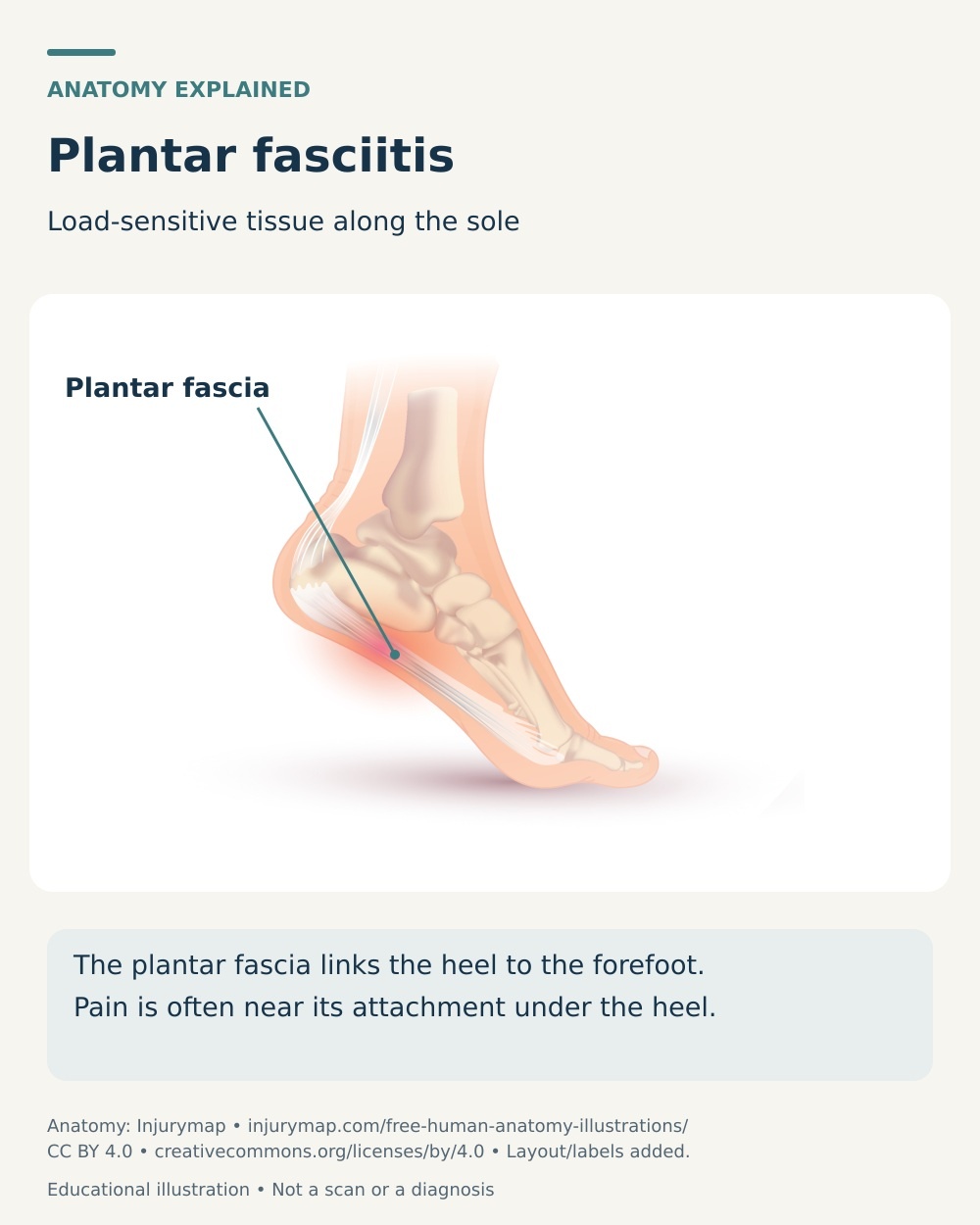
Diagram of the plantar fascia running from the heel bone to the toes, showing the painful area at the inside of the heel

Plantar fasciitis — known medically as plantar fasciopathy or plantar heel pain — affects the plantar fascia, a strong band of connective tissue that originates at the inside of your heel bone (the medial calcaneal tuberosity) and fans forward towards the base of your toes.


This band supports the arch of your foot and works like a rope-and-pulley system: as you push off and your toes bend upwards, the fascia tightens and raises the arch. This is known as the windlass mechanism, and it explains why the tissue is placed under such high repetitive load with every step you take.


It is a degenerative condition rather than an inflammatory one

Despite the name ending in "-itis", tissue studies have shown that persistent plantar heel pain involves collagen degeneration and disorganised tissue repair rather than classic inflammation (Lemont et al., Journal of the American Podiatric Medical Association, 2003). This is why the modern term plantar fasciopathy is increasingly preferred — and why treatment focuses on gradually restoring the tissue’s tolerance to load rather than simply resting or reducing inflammation.


How the condition typically progresses

Acute stage (under 6 weeks): Sharp first-step pain that often eases once you are warmed up. Symptoms usually respond well to early load management, stretching and hands-on treatment.

Subacute stage (6 weeks to 3 months): Pain becomes more predictable and begins to limit standing, walking and exercise. Calf tightness and reduced ankle movement are commonly found on assessment.

Chronic or recalcitrant stage (beyond 3–6 months): Degenerative changes and thickening of the fascia are often visible on ultrasound scanning. This is the stage at which research most strongly supports adding shockwave therapy alongside a loading programme.


What about heel spurs?

Many people are told an X-ray has shown a heel spur and assume this is the source of their pain. Research indicates heel spurs are frequently an incidental finding — they are present in a substantial proportion of people who have no heel pain at all, and symptoms commonly resolve while the spur remains unchanged on imaging (Menz et al., Journal of Foot and Ankle Research, 2008).


The outlook is generally positive. Evidence suggests the majority of people improve within around twelve months with appropriate conservative management (Trojian and Tucker, American Family Physician, 2019), although recovery can be slower than patients expect and a minority develop persistent symptoms — which is why structured, progressive treatment matters.

Do You Experience These Symptoms?

✓  Sharp or stabbing pain under your heel with your first few steps in the morning, or after sitting or resting

✓  Tenderness when you press on the inside of your heel, where the tissue attaches to the heel bone

✓  Pain that eases as you warm up and move about, then returns and worsens towards the end of the day

✓  Aching heel or arch pain after prolonged standing, walking, or a long shift on your feet

✓  Pain that flares after running, a sudden increase in training, or a change of footwear

✓  Discomfort reproduced when your big toe is pulled back and the sole of your foot is stretched

✓  Symptoms in one foot in most cases, although around a third of people experience pain in both heels

These symptoms can be treated.
The sooner you begin, the better your chances of a smoother recovery.

What Causes Plantar Fasciitis?

•  Reduced ankle movement and calf tightness

Limited ankle bending and tightness through the calf muscles are among the most consistently identified risk factors for plantar heel pain.

When your ankle cannot move freely, more strain is transferred through the plantar fascia with every step you take.


•  A sudden increase in load or activity

Rapidly increasing your running distance, starting a new exercise routine, or moving into a job that involves prolonged standing frequently triggers symptoms.

The tissue is placed under more load than it has adapted to tolerate, and the repair process cannot keep pace.


•  Raised body weight

Research shows a higher body mass index is associated with an increased likelihood of developing plantar heel pain, particularly in people who are not athletes.

Additional load passes through the heel with every step, increasing cumulative strain on the fascia over the course of a day.


•  Unsupportive or worn footwear

Flat, unsupportive shoes, worn-out trainers, and spending long periods barefoot on hard floors all reduce the cushioning and support your heel receives.

Many patients notice their symptoms began shortly after changing shoes or during a summer spent in flat sandals.


•  Foot posture and age-related changes to the heel pad

Both flatter feet and high, rigid arches can alter how load is distributed through the fascia during walking and running.

The protective fat pad beneath the heel also thins with age, reducing natural shock absorption.

Not sure which condition applies to you?

How We Treat Plantar Fasciitis at J&J Therapy

Hands-On Manual Therapy

Hands-on mobilisation of the ankle, subtalar and big toe joints, combined with soft tissue release of the calf and plantar fascia, to restore movement and reduce pain — supported by a Grade A recommendation in international clinical guidelines.

Shockwave Therapy*

Swiss Storz Medical MASTERPULS
to stimulate blood flow, encourage collagen repair in the plantar fascia, and reduce pain sensitivity at the heel.
Non-invasive, evidence-based. Typically 3–6 sessions.

Targeted Exercise Programme

A progressive loading programme including plantar fascia-specific stretching and high-load calf and foot strengthening, tailored to your symptoms and gradually rebuilt around your running, work or daily walking demands.

When to Seek Urgent Medical Help

While most symptoms are not serious, urgent medical attention is required if you experience any of the following:

  • Sudden, severe heel pain with a tearing or popping sensation, bruising or swelling

  • Numbness, tingling or burning spreading into the sole of your foot or toes

  • Heel pain in both feet in a younger adult, with prolonged morning stiffness or other painful joints

  • Constant or night pain, fever, redness and heat, or unexplained weight loss

FAQs About Plantar Fasciitis

  • How long does plantar fasciitis take to get better?

Evidence suggests most people improve within around twelve months with appropriate conservative treatment, and many notice meaningful change far sooner than that. Recovery is rarely linear — good days and setbacks are normal. Starting structured treatment early, rather than waiting to see whether it settles on its own, tends to shorten the process and reduces the likelihood of symptoms becoming long-standing.


  • Should I stop running or exercising?

Complete rest is rarely the answer. Current best-practice guidance favours load management — reducing the volume or intensity that is currently provoking your symptoms while maintaining activity you can tolerate, then rebuilding gradually. Your physiotherapist will help you work out what to modify and how quickly to progress, so that the tissue is challenged enough to adapt without being overloaded.


  • How does shockwave therapy help plantar fasciitis, and how many sessions will I need?

Our Swiss Storz Medical MASTERPULS device delivers radial pressure waves through the heel. Research suggests this stimulates blood flow and the body’s tissue repair response, while also reducing pain sensitivity in the area. Most patients receive 3–6 sessions at roughly weekly intervals, alongside their exercise programme.

Treatment usually feels like a firm, rapid tapping and can be briefly uncomfortable, but no anaesthetic is required and you can walk out and carry on with your day. Evidence for shockwave in persistent plantar heel pain is promising but not uniform across all studies, so we will discuss honestly whether it is likely to suit your case and review your response as we go.


  • Do I need orthotics or special insoles?

Insoles and orthoses may help as part of a wider treatment plan, particularly for short-term comfort, but evidence does not support relying on them alone as a lasting solution. Supportive, well-cushioned footwear is often the more important starting point. We will advise on whether an insole is worth trialling for you, and always alongside — not instead of — hands-on treatment and progressive loading.


  • Will I need a steroid injection or surgery?

Most people do not. Research shows corticosteroid injection tends to provide only short-term relief with no measurable benefit by six months, and it carries recognised risks including thinning of the protective heel fat pad and, rarely, rupture of the fascia. Surgery is reserved for a small minority of persistent cases. Conservative treatment is the appropriate first step, and shockwave therapy offers a non-invasive option when symptoms have not settled.

Not sure this condition matches your symtoms?
Find your condition and explore related pain areas.

Logo_Navy.png

Ready to start your recovery?
Book your Initial Assessment today.

This page is for general information only and does not replace professional medical advice.

Reviewed by Lavya Arigalayan, MSc, HCPC Registered Physiotherapist.

Last reviewed

bottom of page