top of page
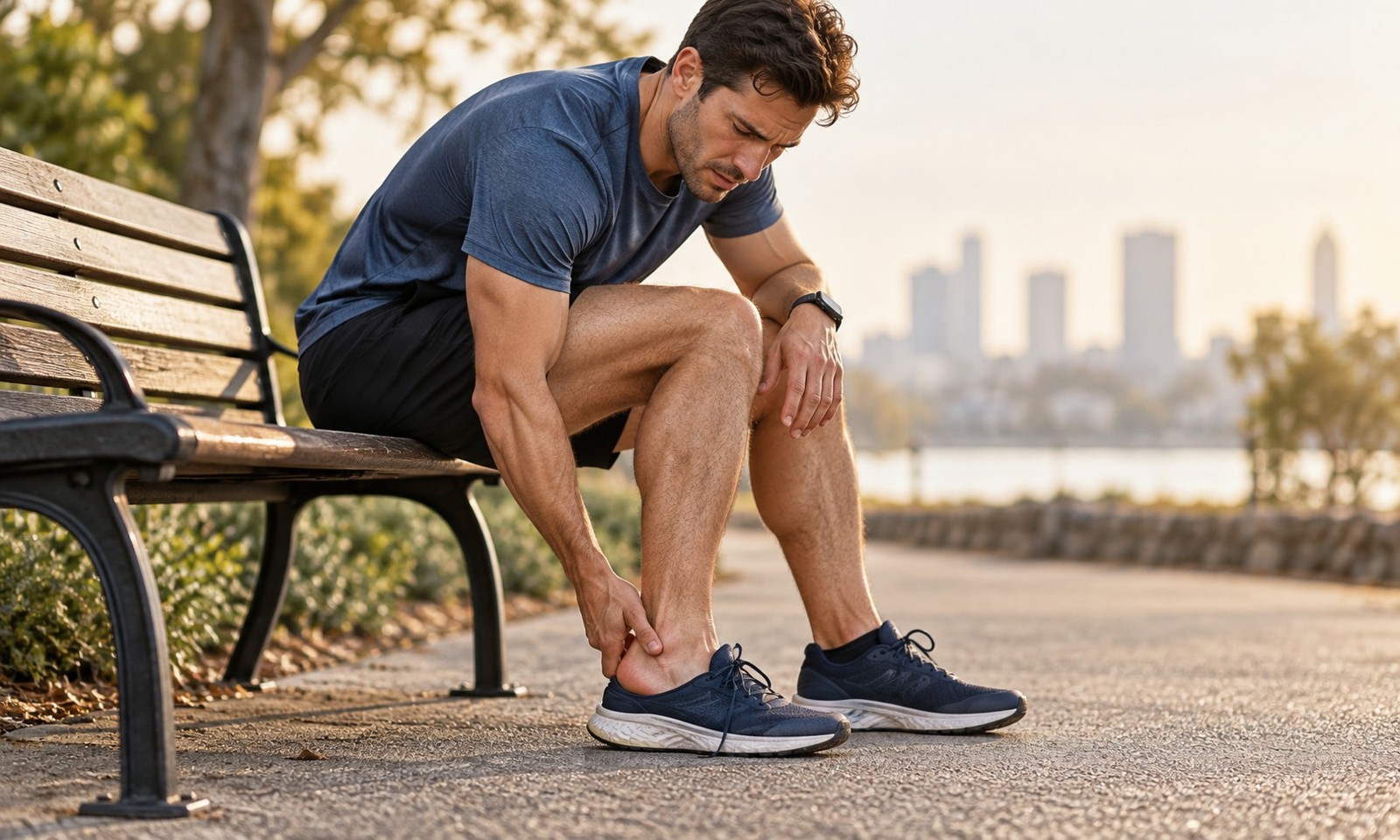
Physiotherapist assessing a patient's Achilles tendon at the back of the ankle in a New Malden clinic

Achilles Tendinopathy

300+ Reviews 5.0

Open 7 Days

10+ Years' Experience

HCPC Physio On Team

Insurance Accepted

85% Return Rate

PHYSIOTHERAPY & THERAPEUTIC MASSAGE IN NEW MALDEN

Quick Summary

Achilles tendinopathy is a common overuse condition of the tendon at the back of your ankle, causing pain, stiffness and thickening that is typically worst with your first steps in the morning. It affects both runners and less active people, most often between the ages of 30 and 50.


At J&J Therapy in New Malden, we combine hands-on manual therapy, a targeted calf-loading programme and Swiss Storz Medical MASTERPULS shockwave therapy. Research suggests shockwave may help stubborn cases when added to loading — typically over 3–6 sessions, with most people noticing meaningful progress within about 12 weeks.

What Is Achilles Tendinopathy?

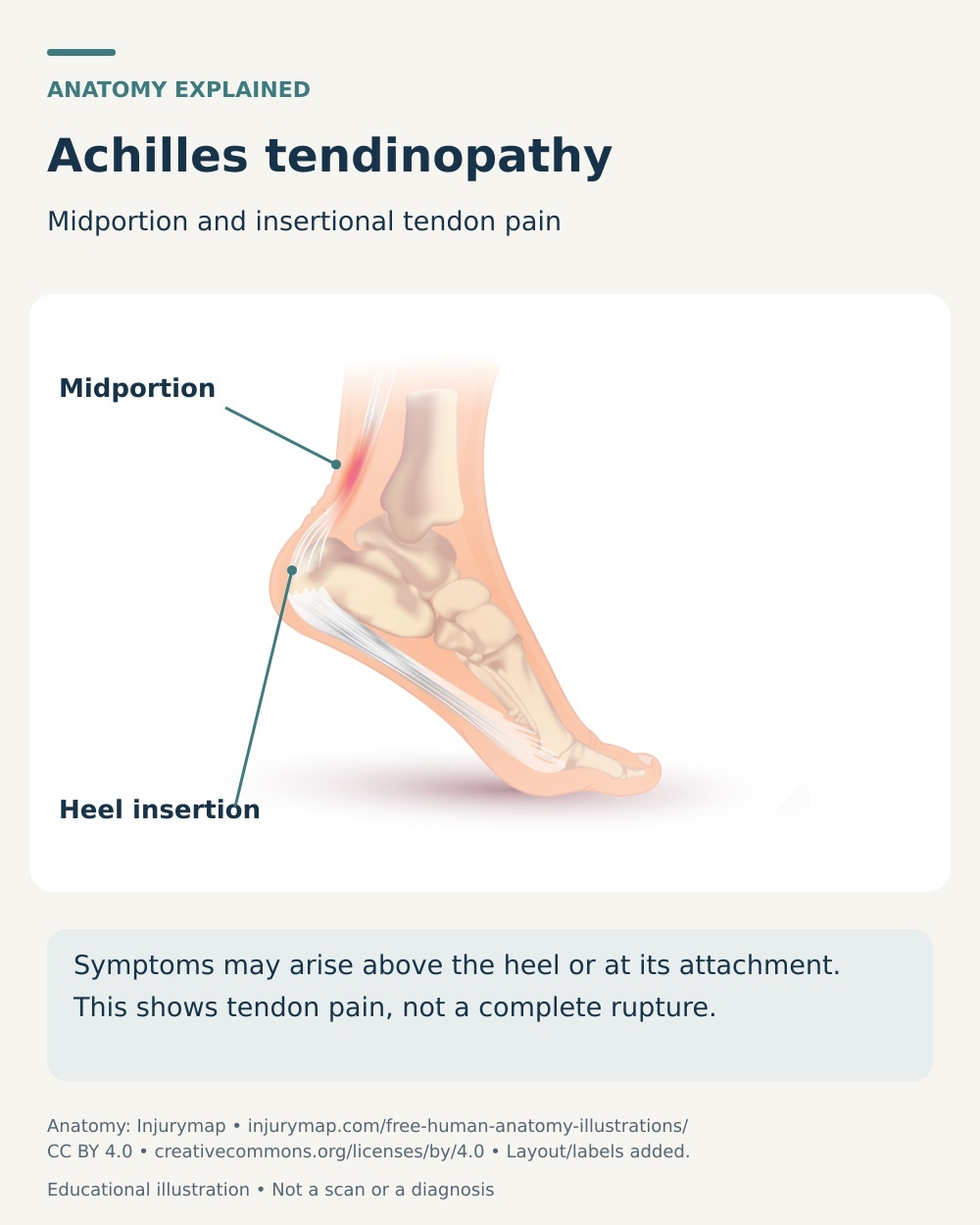
Diagram of the Achilles tendon showing midportion and insertional tendinopathy locations

Achilles tendinopathy is a load-related disorder of the Achilles tendon, the thick band connecting your calf muscles to your heel bone. Although it is still widely called "tendinitis", modern evidence shows the problem is not mainly one of inflammation.

Instead, it reflects a failed healing response — disorganised collagen, changes in the tendon cells, and the in-growth of new blood vessels and nerves. This is why "tendinopathy" is now the more accurate term, and why rest alone rarely resolves it.


Research describes tendon problems as a continuum rather than a single injury (Cook & Purdam, British Journal of Sports Medicine, 2009), progressing through three overlapping stages:


Stage 1 — Reactive tendinopathy: A short-term response to a sudden spike in load, such as a rapid increase in running or a return to sport after a break.

Stage 2 — Tendon dysrepair: The tendon attempts to heal but the internal structure becomes more disorganised, and symptoms tend to persist.

Stage 3 — Degenerative tendinopathy: Areas of the tendon lose their normal structure and load capacity, which is more common in longstanding cases.


Midportion or insertional — the difference matters

Midportion tendinopathy occurs roughly 2–6 cm above your heel bone, in a region with a relatively poor blood supply, and is the more common presentation. Insertional tendinopathy occurs where the tendon attaches to the heel bone itself and involves an additional compressive element, because the tendon is pressed against the bone when your ankle bends upwards.

This distinction directly changes your exercise programme. Movements that help midportion tendinopathy — such as deep heel drops through full range — can aggravate insertional tendinopathy, so our physiotherapists identify exactly where your pain sits before prescribing loading (Chimenti et al., JOSPT, 2024).


Extracorporeal shockwave therapy is a recognised indication for Achilles tendinopathy and evidence suggests it may add benefit when combined with a loading programme, with stronger support for midportion than insertional presentations (Rompe et al., American Journal of Sports Medicine, 2009; Paantjens et al., Sports Medicine – Open, 2022). NICE notes that shockwave raises no major safety concerns, while advising that efficacy evidence remains mixed (NICE, 2016).

Do You Experience These Symptoms?

✓  Pain and stiffness at the back of your ankle that is worst with your first steps in the morning or after sitting for a while

✓  Localised tenderness 2–6 cm above your heel, or directly at the heel bone where the tendon attaches

✓  Visible thickening of the tendon, or a tender lump you can feel along it

✓  Pain that eases as you warm up during activity, then flares afterwards or the following morning

✓  Swelling around the tendon, sometimes with a creaking sensation as you move your ankle

✓  Reduced calf strength, with difficulty performing repeated heel raises on the affected leg

✓  Pain going uphill, climbing stairs, running or jumping

These symptoms can be treated.
The sooner you begin, the better your chances of a smoother recovery.

What Causes Achilles Tendinopathy?

•  Training load errors — the most common trigger

A sudden increase in running volume, intensity, hill work or a change of surface loads the tendon faster than it can adapt.

Tendons respond poorly to rapid change, so spikes in activity after a break or a holiday are a frequent cause.


•  Calf weakness and limited ankle movement

Weak or easily fatigued calf muscles and a stiff ankle shift excess strain onto the tendon during walking and running.

Reduced calf strength and restricted upward ankle movement are well-recognised and modifiable impairments that we assess and address directly.


•  Footwear changes and foot mechanics

A change in heel height, worn-out trainers or a switch to flatter or minimalist shoes alters how load passes through the tendon.

Foot mechanics such as excessive inward rolling of the foot can also increase strain along the tendon.


•  Age and metabolic factors

Risk rises in midlife as tendons adapt and repair more slowly, with most cases occurring between the ages of 30 and 50.

Conditions such as diabetes, raised cholesterol and carrying additional weight are associated with tendinopathy, which helps explain why it also affects less active people.


•  Certain medications

Fluoroquinolone antibiotics such as ciprofloxacin, and corticosteroids, are associated with Achilles tendon damage and, rarely, tendon rupture.

This risk is higher in older adults and when the two are taken together, so new Achilles pain during or shortly after such a course should always be assessed.

Not sure which condition applies to you?

How We Treat Achilles Tendinopathy at J&J Therapy

Hands-On Manual Therapy

Hands-on soft-tissue therapy to your calf and soleus muscles, combined with mobilisation of the ankle and subtalar joints where your assessment shows restricted movement — helping to restore range and reduce the load passing through the tendon. We pair this with gait and training-load advice so your tendon is neither overloaded nor completely unloaded.

Shockwave Therapy*

Swiss Storz Medical MASTERPULS
to stimulate local blood flow and the body's natural repair response along the Achilles tendon, helping to reduce persistent pain. Research suggests it may help stubborn cases, particularly alongside a calf-loading programme.
Non-invasive, evidence-based. Typically 3–6 sessions.

Targeted Exercise Programme

A progressive calf-loading programme is the cornerstone of recovery. We may use heavy-load eccentric heel lowering or heavy slow resistance training — research suggests both are effective, so we choose the approach that best fits your routine. Your programme is tailored to where your pain sits: midportion tendinopathy is loaded through full range, while insertional tendinopathy is usually worked on flat ground with upward ankle movement limited, to reduce compression at the heel bone. Most programmes run over about 12 weeks, progressing you back towards walking, running or sport.

When to Seek Urgent Medical Help

While most symptoms are not serious, urgent medical attention is required if you experience any of the following:

  • A sudden pop or snap, or the feeling of being kicked in the back of the ankle, with an inability to push off or rise onto your toes (possible tendon rupture)

  • New or worsening Achilles pain during or shortly after a course of fluoroquinolone antibiotics such as ciprofloxacin

  • Spreading redness, heat, marked swelling, fever or feeling generally unwell (possible infection)

  • Heel or tendon pain affecting both sides in a younger person, with morning stiffness lasting over an hour or other joint and spinal symptoms

FAQs About Achilles Tendinopathy

  • Is it tendinitis or tendinopathy — and does the difference matter?

"Tendinopathy" is the more accurate term, because the problem is mainly a failed healing response within the tendon rather than simple inflammation. This matters practically: it explains why rest and anti-inflammatory tablets alone rarely resolve the problem, and why progressive loading is the key treatment.


  • How long will it take to get better?

Most structured loading programmes run for around 12 weeks, and many people notice meaningful improvement within that time. Tendons adapt slowly, so full recovery can take several months — consistency with your exercises is the single biggest factor in a good outcome.


  • Should I stop running or exercising completely?

Usually not. Complete rest removes load from the tendon and can leave it less able to cope when you return, so we generally reduce and modify aggravating activity while keeping you moving within acceptable limits, then rebuild your load gradually.


  • Does shockwave therapy help Achilles tendinopathy?

Research suggests radial shockwave therapy may help, particularly for longstanding pain that has not settled with exercise, and evidence indicates it works best alongside a calf-loading programme rather than on its own. Support is stronger for midportion than insertional tendinopathy, and NICE notes the overall efficacy evidence is mixed — so we use it as one part of your plan. It is non-invasive, and we typically recommend 3–6 sessions.


  • Why are my exercises different from someone else with the same diagnosis?

Because midportion and insertional Achilles tendinopathy need different loading. Insertional cases usually avoid deep heel drops and strong calf stretches to limit compression at the heel bone, whereas midportion cases benefit from loading through full range — so we prescribe according to exactly where your pain is.

Not sure this condition matches your symtoms?
Find your condition and explore related pain areas.

Logo_Navy.png

Ready to start your recovery?
Book your Initial Assessment today.

This page is for general information only and does not replace professional medical advice.

Reviewed by Lavya Arigalayan, MSc, HCPC Registered Physiotherapist.

Last reviewed

bottom of page