
Quick Summary
A fingertip that suddenly droops and cannot actively straighten needs prompt medical or hand-service assessment. Mallet finger usually requires a precise protection plan before rehabilitation. We can support later recovery in line with your treating team’s instructions.
Understanding Mallet Finger
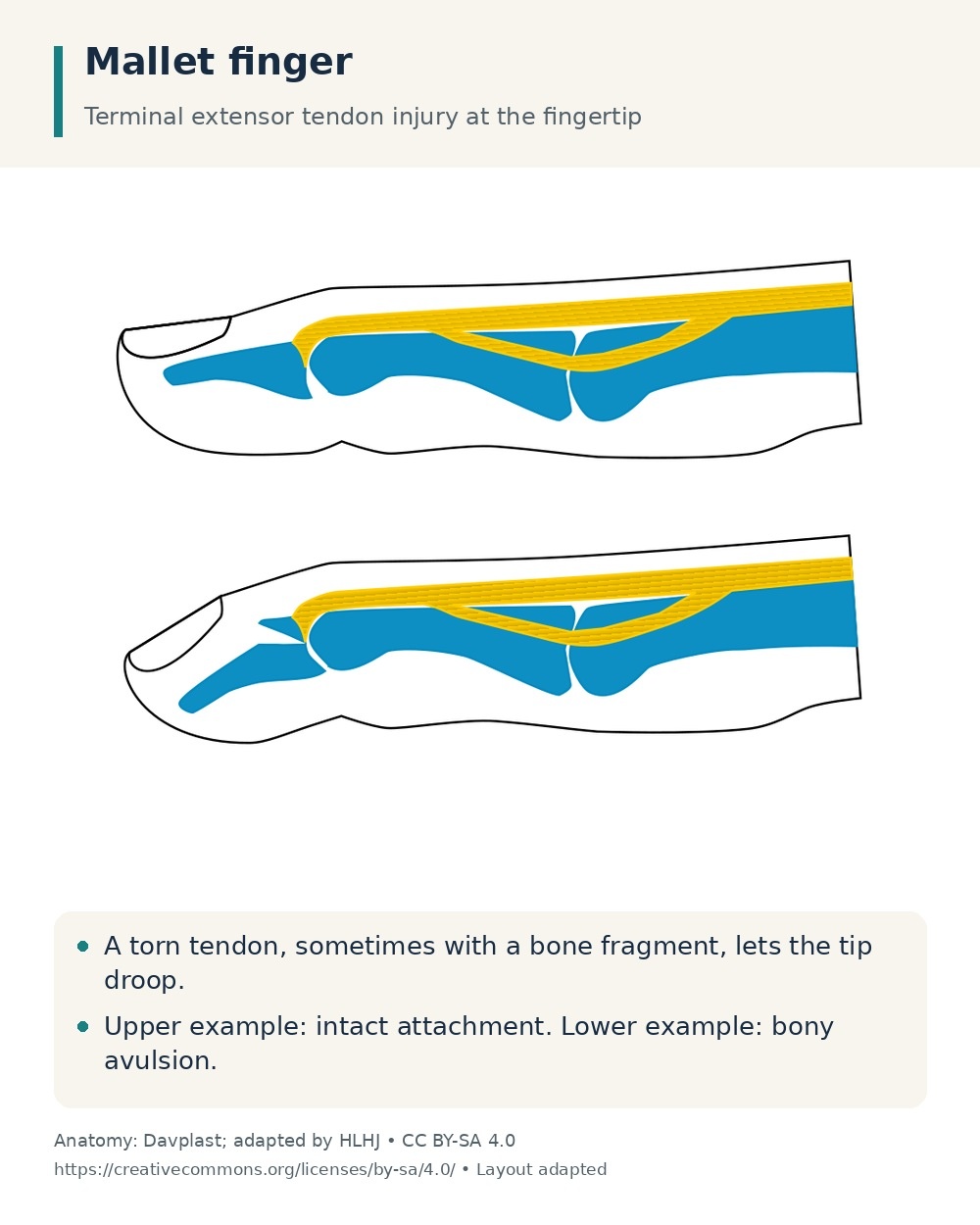
Mallet finger is an injury to the tendon that straightens the last finger joint. Sometimes a small piece of bone is pulled away as well. An X-ray may be needed to identify a fracture or joint alignment problem; the appearance alone does not show the full injury.
How we assess your symptoms
A new injury should be assessed through an appropriate medical or hand service. Once a splint or surgical plan is established, we review any instructions, skin concerns and later movement goals. Do not delay initial assessment while waiting for a routine massage appointment.
Image: Davplast; adapted by HLHJ · CC BY-SA 4.0. Adapted; this image is also licensed CC BY-SA 4.0.
Do You Experience These Symptoms?
- The fingertip rests bent and cannot be actively held straight.
- Swelling or soreness over the last finger joint.
- A recent impact to the fingertip, sometimes from a minor everyday incident.
An assessment helps guide your next step, based on your symptoms, health and goals.
A treatment plan built around you
Hands-On Manual Therapy
We do not massage or bend a newly injured fingertip to restore movement. Any later scar or swelling care must respect the healing tendon and the hand team’s protection period.
Is Shockwave Suitable?
Shockwave is not routinely recommended for mallet finger. Your assessment will guide appropriate rehabilitation, symptom management and whether medical or specialist review is needed. We will explain why each proposed treatment fits your symptoms before you decide whether to proceed.
Targeted Exercise Programme
Continuous splinting may be prescribed for several weeks. The end joint must remain straight as instructed, including during cleaning. Bending and strengthening begin only when the treating clinician says it is safe.
When to Seek Urgent Medical Help
While most symptoms are not serious, urgent medical attention is required if you experience any of the following:
- Seek prompt urgent-care or hand-service assessment for a new drooping fingertip that cannot straighten. An open cut, deformity, loss of sensation or a pale/cold finger requires urgent attention.
- Contact the treating team promptly if the splint causes skin breakdown, increasing pain or circulation changes. Do not change the protection plan without advice.
Your questions answered
Can I take the splint off to exercise?
Not unless your treating team has instructed you to. Allowing the fingertip to bend during the protection period may disrupt healing and require the splinting programme to be extended.
Does every mallet finger need surgery?
Many are treated with a splint, but some fractures, joint alignment problems or open injuries need surgery. Early assessment determines the appropriate approach.
Which appointment should I book?
Arrange medical or hand-service assessment first for a new injury. Once the diagnosis and protection plan are established, physiotherapy can support your prescribed rehabilitation. Contact us with your discharge advice or specialist instructions so we can check suitability.
Visit J&J Therapy on the ground floor of CI Tower, New Malden. Book an assessment or call our reception team on 07935 869938 if you are unsure which service to choose.
Related conditions
Sources and further reading

This page is for general information only and does not replace professional medical advice.
Information updated 15 October 2026. General information to support informed choices; it is not a diagnosis or a personalised treatment plan. Suitability and any need for referral are assessed individually. Seek urgent medical help for the warning signs listed above.