top of page
Physiotherapist assessing a patient's lower back during a back muscle strain consultation at J&J Therapy in New Malden

Back Muscle Spasm / Strain

300+ Reviews 5.0

Open 7 Days

10+ Years' Experience

HCPC Physio On Team

Insurance Accepted

85% Return Rate

PHYSIOTHERAPY & THERAPEUTIC MASSAGE IN NEW MALDEN

Quick Summary

A back muscle spasm or strain happens when the muscles and tendons of your lower back are overloaded — often during lifting, twisting or a sudden unguarded movement — causing them to tighten protectively and making everyday movement painful and difficult.

The outlook is reassuring: research suggests 60–90% of people recover within six weeks and around 95% within twelve weeks, and staying gently active speeds that recovery.

Our physiotherapists in New Malden combine hands-on manual therapy with a targeted exercise programme to settle the spasm, restore movement and reduce the chance of it happening again — typically over 4–6 sessions depending on severity.

What Is a Back Muscle Spasm or Strain?

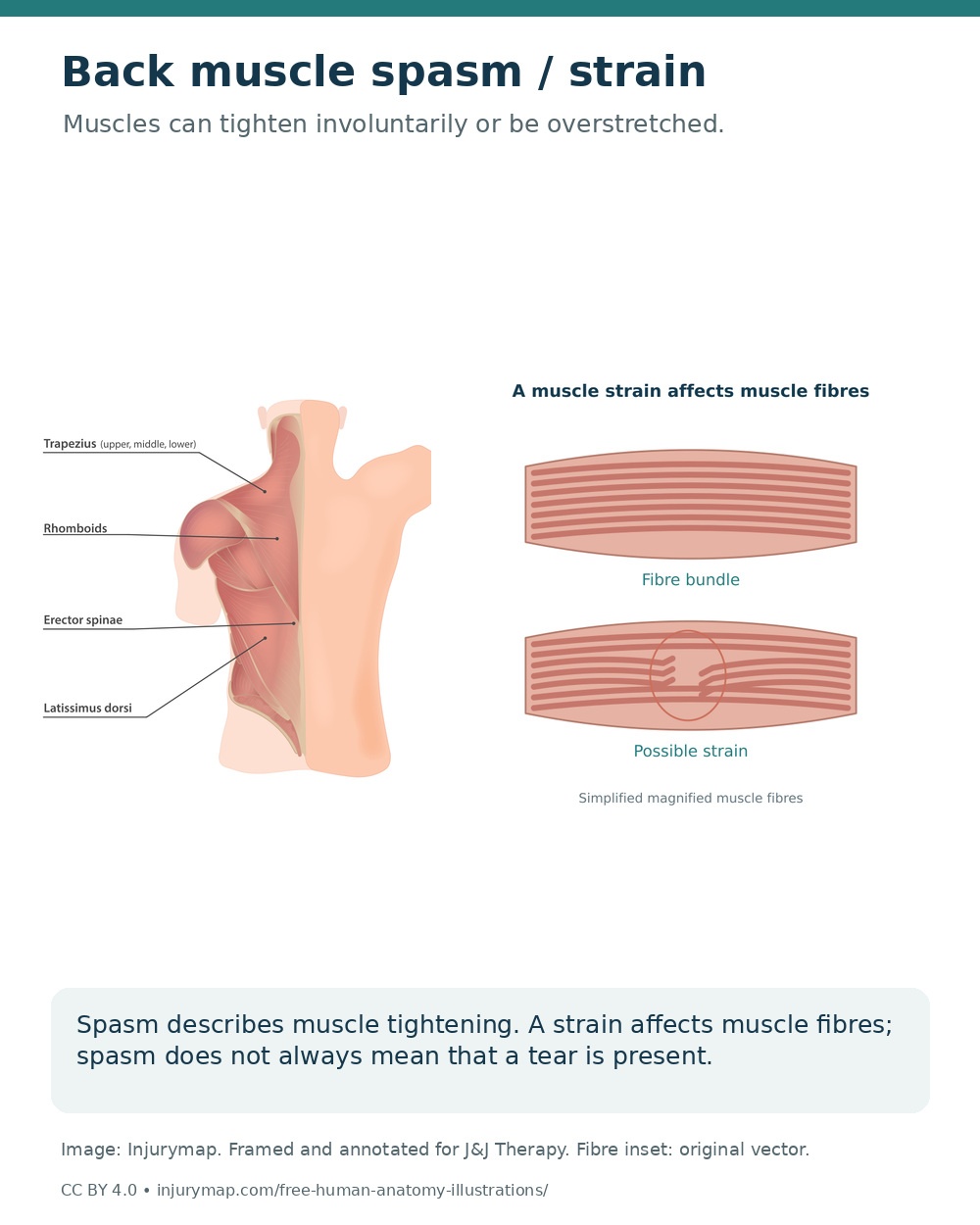
Anatomical illustration of the lumbar paraspinal muscles affected by a back muscle spasm or strain

A lumbar strain is an injury to the muscles, tendons or ligaments of your lower back — most often the paraspinal (erector spinae), quadratus lumborum and multifidus muscles. It occurs when the load placed on these tissues exceeds what they can safely support, for example lifting a heavy object while your spine is bent and twisted.

A muscle spasm is your body’s protective response. The injured muscle contracts involuntarily to splint the area, which limits movement and can itself become a significant source of pain.


How strains are graded

Muscle strains are conventionally graded I to III. Grade I involves microscopic fibre damage with minimal loss of strength; Grade II involves partial tearing with more pain, swelling and functional loss; Grade III involves a complete tear. The great majority of lower back strains are Grade I or II and respond well to conservative physiotherapy.


The phases of recovery

The acute phase covers roughly the first few days to two weeks, when pain, inflammation and protective spasm are at their greatest. The subacute phase, around two to six weeks, is when pain eases and movement returns. Some people go on to a persistent or recurrent phase, where episodes return or symptoms outlast twelve weeks.

This is common rather than exceptional. A systematic review of the prognosis of acute low back pain found rapid early improvement is typical, yet 73% of patients had at least one recurrence within twelve months (Pengel et al., BMJ, 2003). Completing your rehabilitation therefore matters as much as settling the initial episode.


The pain–spasm–pain cycle

Pain from the original injury triggers reflex muscle guarding. Sustained contraction reduces local blood flow and oxygenation, produces metabolic irritants and can generate myofascial trigger points — which in turn generate more pain and more spasm.

Breaking this self-perpetuating loop through movement, manual therapy and graded loading, rather than prolonged rest, is a central aim of physiotherapy. Research on the paraspinal muscles in low back pain shows measurable changes including reduced oxygenation and altered muscle composition (Noonan & Brown, JOR Spine, 2021), which is why restoring normal movement early is so important.

Do You Experience These Symptoms?

✓  Sudden onset of lower back pain, often during or just after lifting, twisting or bending

✓  A tightening, cramping or “locking” sensation in the muscles beside your spine

✓  Pain that is usually well localised to one side and does not travel below your knee

✓  Marked stiffness and difficulty straightening up, standing or changing position

✓  Muscle tenderness to touch, sometimes with visible guarding or a shift in your posture

✓  Pain that eases with gentle movement and worsens with sustained postures or sudden effort

✓  Muscle fatigue or a sensation of weakness through your lower back

These symptoms can be treated.
The sooner you begin, the better your chances of a smoother recovery.

What Causes Back Muscle Spasm and Strain?

•  Sudden overload or awkward lifting

Lifting a load that is too heavy, or lifting while your spine is bent and rotated, can strain the lumbar muscles beyond their capacity.

This is the classic mechanism and is more likely when the movement is unexpected or poorly controlled.


•  Repetitive strain and poor ergonomics

Repeated bending, twisting or prolonged static postures — common in manual jobs, desk work and driving — gradually overload the paraspinal muscles.

Over time this makes the tissue more vulnerable to an acute flare-up from an otherwise ordinary movement.


•  Deconditioning and weak core musculature

When the deep trunk and abdominal muscles are weak, the lumbar muscles take on more load than they are designed for.

A sedentary lifestyle and reduced general fitness are well recognised risk factors for episodes of low back pain.


•  Sudden unaccustomed activity or sport

A burst of activity your body is not used to — a weekend of gardening, a new gym programme or a sporting movement — can trigger a strain.

Fatigue during activity also reduces muscular control and increases the risk of injury.


•  Contributing lifestyle factors

Carrying excess weight, psychological stress and poor sleep can all increase muscle tension and the likelihood of an episode.

Stress in particular is associated with heightened muscle guarding that can feed the pain–spasm–pain cycle.


Not sure which condition applies to you?

How We Treat Back Muscle Spasm and Strain at J&J Therapy

Hands-On Manual Therapy

Hands-on soft-tissue release, lumbar joint mobilisation and targeted trigger point work to settle protective spasm, ease pain and restore comfortable movement from your very first session.

Shockwave Therapy*

Swiss Storz Medical MASTERPULS
is not used during the acute stage of a back muscle spasm or strain, and is never our first-line approach for this condition.
Where symptoms persist or keep returning and your physiotherapist identifies specific myofascial trigger points during assessment, it may be considered as a second-line addition to your manual therapy and exercise programme.
Research in this area is still developing, so we only suggest it when your assessment indicates it may help. Non-invasive, evidence-based.

Targeted Exercise Programme

A personalised programme of graded mobility work, core and trunk strengthening and functional retraining to rebuild capacity, support your return to normal activity and reduce the risk of recurrence.

When to Seek Urgent Medical Help

While most symptoms are not serious, urgent medical attention is required if you experience any of the following:

  • Difficulty passing or controlling urine, loss of bowel control, or numbness around your genitals, buttocks or inner thighs — call 999 or go to A&E

  • New severe weakness or numbness in both legs, or worsening difficulty walking

  • Back pain following significant trauma such as a fall or road accident, or sudden severe pain if you have osteoporosis or take long-term steroids

  • Back pain with fever, chills or unexplained weight loss, or new back pain if you have a history of cancer

FAQs About Back Muscle Spasm and Strain

  • How long does a back muscle spasm or strain take to heal?

The outlook is very good. Research suggests roughly 30–60% of people recover within one week, 60–90% within six weeks and around 95% within twelve weeks. Staying gently active tends to speed recovery, while prolonged rest tends to slow it down.

Recurrences are common, so completing your rehabilitation programme matters just as much as settling the initial episode.


  • Should I rest or keep moving?

Keep moving as much as your pain allows. NHS and NICE guidance is clear that staying active and continuing your daily activities is one of the most effective ways to recover, whereas bed rest can prolong stiffness and pain.

Our physiotherapists will help you pace activity safely and show you which movements are helpful in the early days.


  • Should I use heat or ice?

Both can help in the early days. A heat pack may relax muscle spasm and ease stiffness, while a cold pack may give short-term pain relief. Always wrap either in a towel and never apply them directly to your skin.

Use whichever you find more comfortable — there is no single right answer, and comfort is a reasonable guide.


  • Can shockwave therapy help my back muscle spasm or strain?

Not in the early, acute stage. For a sudden strain or spasm the evidence and clinical guidelines support hands-on manual therapy, staying active and a graded exercise programme, and we would not apply shockwave to a freshly injured, inflamed muscle.

If your symptoms persist or keep returning and our physiotherapists identify specific myofascial trigger points during assessment, we may then consider Swiss Storz Medical MASTERPULS radial shockwave as a second-line addition to your programme. Research suggests it may help persistent myofascial and long-standing low back pain, though the evidence is still developing, so we only recommend it when your assessment indicates it is appropriate.


  • When should I worry that my back pain is something more serious?

Serious causes are rare. However, seek urgent medical help if you develop bladder or bowel problems, numbness around the saddle area, worsening weakness in both legs, back pain after major trauma, or back pain alongside fever, unexplained weight loss or a history of cancer.

If you are unsure, contact your GP or NHS 111. Our physiotherapists also screen for these signs at your initial assessment.

Not sure this condition matches your symtoms?
Find your condition and explore related pain areas.

Logo_Navy.png

Ready to start your recovery?
Book your Initial Assessment today.

This page is for general information only and does not replace professional medical advice.

Reviewed by Lavya Arigalayan, MSc, HCPC Registered Physiotherapist.

Last reviewed

20 August 2026

bottom of page