top of page
Physiotherapist assessing a patient with acute lumbago lower back pain at J&J Therapy in New Malden

Acute Lumbago

300+ Reviews 5.0

Open 7 Days

10+ Years' Experience

HCPC Physio On Team

Insurance Accepted

85% Return Rate

PHYSIOTHERAPY & THERAPEUTIC MASSAGE IN NEW MALDEN

Quick Summary

Acute lumbago is sudden-onset, non-specific lower back pain — usually a strain of the muscles, ligaments or joints of the lower back — that makes it difficult to move, bend or stand comfortably.


The outlook is generally very positive: most episodes settle substantially within a few weeks, and staying gently active speeds recovery. Our HCPC-registered physiotherapists combine hands-on manual therapy, clear reassurance and a graded exercise programme.


Many patients notice meaningful improvement within a typical course of around 3–6 sessions, with the goal of restoring comfortable movement and reducing the risk of a further episode.

What Is Acute Lumbago?

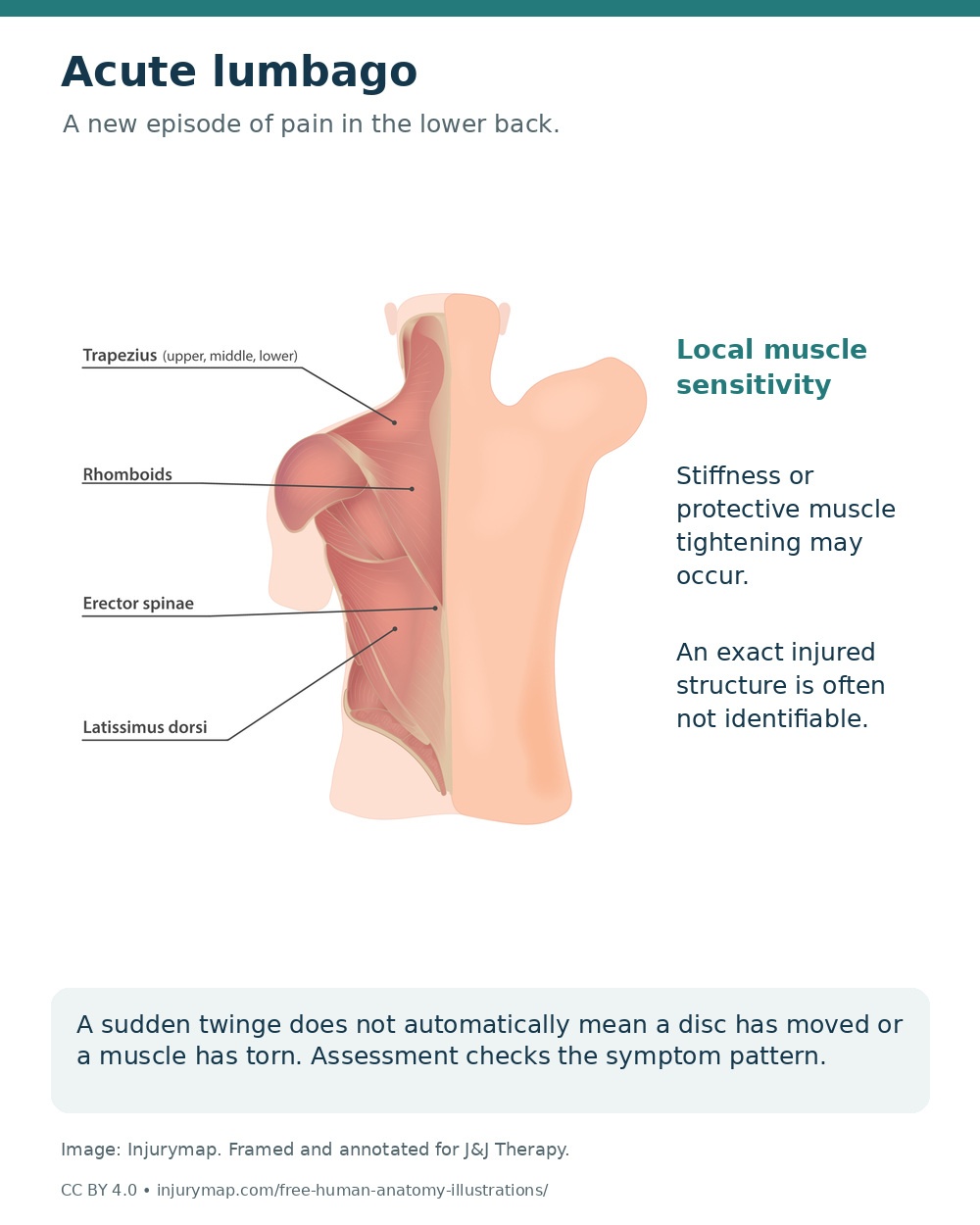
Illustration of the lumbar spine showing the muscles and ligaments involved in acute lower back strain

Acute lumbago is the everyday term for a sudden episode of lower back pain. Clinically it is most often described as acute non-specific low back pain — pain between the lower ribs and the buttock creases that cannot be traced to a single identifiable disease. “Acute” refers to duration: pain lasting less than six weeks.


This distinguishes it from sub-acute pain (six to twelve weeks) and chronic pain (twelve weeks or longer). The word “non-specific” is important. Non-specific low back pain accounts for the large majority of cases, meaning the pain arises from the normal structures of the back — muscles, ligaments, discs and facet joints — rather than from serious pathology.


Only a small minority of presentations involve specific pathology such as fracture, infection or malignancy, and roughly five to ten per cent involve nerve-root problems such as radiculopathy or spinal stenosis. In an acute lumbar strain, tissues are stretched beyond their normal capacity, producing micro-injury, local inflammation and protective muscle spasm — which is why the back feels stiff, guarded and difficult to straighten.


The natural history is reassuring. Research suggests a new episode of low back pain has a median duration of around five days, with approximately nine in ten people recovered before six weeks (Campos et al., European Journal of Pain, 2023). A systematic review of prognosis found rapid early improvement, with pain and disability falling substantially within the first month (Pengel et al., BMJ, 2003).


However, recurrence is common. In the same review, a majority of patients experienced at least one recurrence within twelve months, and a proportion go on to develop persistent symptoms. This is why we treat the acute episode not only to relieve pain, but also to reduce the likelihood of it returning.


Low back pain also carries a substantial public health burden — it is the leading global cause of years lived with disability, and affects over ten million adults in the UK each year (Hartvigsen et al., Lancet, 2018).

Do You Experience These Symptoms?

✓  Sudden, sharp or intense pain in the lower back, often triggered by lifting, bending or twisting

✓  Stiffness and a feeling that your back is “locked” or difficult to straighten

✓  Muscle spasm or tightness in the muscles either side of your spine

✓  Pain that worsens with movement such as bending, sitting or standing up, and eases when you change position

✓  Difficulty with everyday activities such as dressing, getting out of a chair or walking normally

✓  Pain that may spread into your buttocks, but does not typically travel below the knee

✓  Reduced range of movement in your lower back

These symptoms can be treated.
The sooner you begin, the better your chances of a smoother recovery.

What Causes Acute Lumbago?

•  Sudden mechanical overload

Lifting a heavy or awkward load, particularly with poor technique, can overstress the muscles and ligaments of your lower back.

This is one of the most common triggers of an acute lumbar strain and often produces immediate, intense pain.


•  Awkward or unaccustomed movement

A quick twist, an unexpected bend or reaching for something at an odd angle can strain the soft tissues before they are ready.

These seemingly innocent movements often cause disproportionate pain and protective spasm.


•  Repetitive strain and sustained postures

Prolonged sitting, repeated bending or long periods held in one position can gradually fatigue and sensitise the lower back.

When the tissues are already loaded, a small final movement can tip them into an acute episode.


•  Deconditioning and lifestyle factors

Weak trunk muscles, low general fitness, excess body weight and physical inactivity all increase vulnerability to an episode.

Psychological factors such as stress, poor sleep and low mood can also amplify pain and slow recovery.


•  Previous episodes of back pain

A history of low back pain is one of the strongest predictors of a further episode.

Frequent awkward postures and long periods of sitting have been linked to recurrence within twelve months.


Not sure which condition applies to you?

How We Treat Acute Lumbago at J&J Therapy

Hands-On Manual Therapy

Our physiotherapists use hands-on manual therapy — including spinal mobilisation, soft-tissue techniques and gentle manipulation — to ease pain, reduce protective muscle spasm and restore comfortable movement in the early, guarded phase. National guidance recommends that manual therapy is offered as part of a treatment package that also includes exercise, and this is exactly how we deliver it. Every hands-on session is paired with reassurance and advice to stay active, which evidence shows leads to better outcomes than rest.

Shockwave Therapy*

Shockwave therapy is not a first-line treatment for acute lumbago. In the early, painful phase we prioritise manual therapy, reassurance and graded movement, which the current evidence supports most strongly. Where back pain becomes more persistent and is linked to a specific area of localised muscle tension, our physiotherapists may assess whether Swiss Storz Medical MASTERPULS radial shockwave could be a helpful addition to your programme. We will always discuss the evidence honestly with you first, as research into shockwave therapy for lower back pain remains limited and mixed.

Targeted Exercise Programme

A tailored, graded exercise programme is the cornerstone of recovery and, crucially, of preventing recurrence. We design your plan around your presentation — gentle mobility and range-of-movement work first, progressing to trunk strengthening, functional movement and a gradual return to normal activity and work. National guidance recommends exercise as a core component of care and advises against bed rest. We frame movement as a safe, confidence-building way to restore function and lower your risk of future episodes, matching the intensity of support to your individual needs.

When to Seek Urgent Medical Help

While most symptoms are not serious, urgent medical attention is required if you experience any of the following:

  • Signs of cauda equina syndrome (a medical emergency) — difficulty passing or controlling urine, loss of bowel control, numbness or tingling around the genitals, buttocks or inner thighs, altered sensation when wiping after the toilet, or new weakness in one or both legs. Go to A&E immediately.

  • Possible spinal fracture — severe pain following significant trauma such as a fall or road accident, or back pain in someone with osteoporosis or long-term steroid use.

  • Possible infection or cancer — unexplained weight loss, a history of cancer, fever, night sweats, or constant pain that is worse at night and not relieved by rest or a change of position.

  • Progressive neurological loss — worsening leg weakness, foot drop, or numbness that is spreading.

FAQs About Acute Lumbago

  • How long does acute lumbago last?

Most episodes improve markedly within a few weeks. Research suggests a new episode of low back pain has a median duration of around five days, with approximately nine in ten people recovered before six weeks (Campos et al., European Journal of Pain, 2023).

Staying gently active, rather than resting in bed, tends to speed recovery.


  • Should I rest or keep moving?

Keep moving, within comfort. NHS and national guidance advise staying active and avoiding prolonged bed rest, because movement helps your back recover and prevents stiffness and deconditioning.

Short walks, regular changes of position and gentle exercise are ideal in the first few days. Hurt does not necessarily mean harm.


  • Do I need an X-ray or MRI scan?

Usually not. National guidance recommends against routine imaging for non-specific low back pain, because scans rarely change management and often show harmless age-related changes.

Imaging is reserved for cases where warning symptoms suggest a specific serious cause. Our physiotherapists will screen for these during your assessment and refer you on if needed.


  • Can shockwave therapy help my acute lumbago?

We are honest about the limits of the evidence. Radial shockwave therapy is not a first-line treatment for acute lumbago, and the best-quality trial to date found it offered no added benefit over placebo for acute lower back pain (Lange et al., Journal of Clinical Medicine, 2021).

Lower back pain is also not listed as an approved indication by the International Society for Medical Shockwave Treatment. For that reason we prioritise manual therapy and exercise first, and consider shockwave only on a case-by-case basis after assessment, as an adjunct, if your pain becomes more persistent and localised.


  • How can I stop acute lumbago coming back?

Recurrence is common, so prevention matters. The most effective steps are staying physically active, building trunk and general strength, using good lifting technique, avoiding long periods in one position, and addressing stress and sleep.

Our physiotherapists will give you a personalised exercise and self-management plan designed to lower your risk of a further episode.


Not sure this condition matches your symtoms?
Find your condition and explore related pain areas.

Logo_Navy.png

Ready to start your recovery?
Book your Initial Assessment today.

This page is for general information only and does not replace professional medical advice.

Reviewed by Lavya Arigalayan, MSc, HCPC Registered Physiotherapist.

Last reviewed

20 August 2026

bottom of page