
Quick Summary
Pain a little below the inner knee can come from the pes anserine tendons or bursa. Assessment helps separate this from joint, ligament or bone pain. Our physiotherapists in New Malden can assess your symptoms and help you choose appropriate next steps for your goals.
Understanding Pes Anserine Bursitis
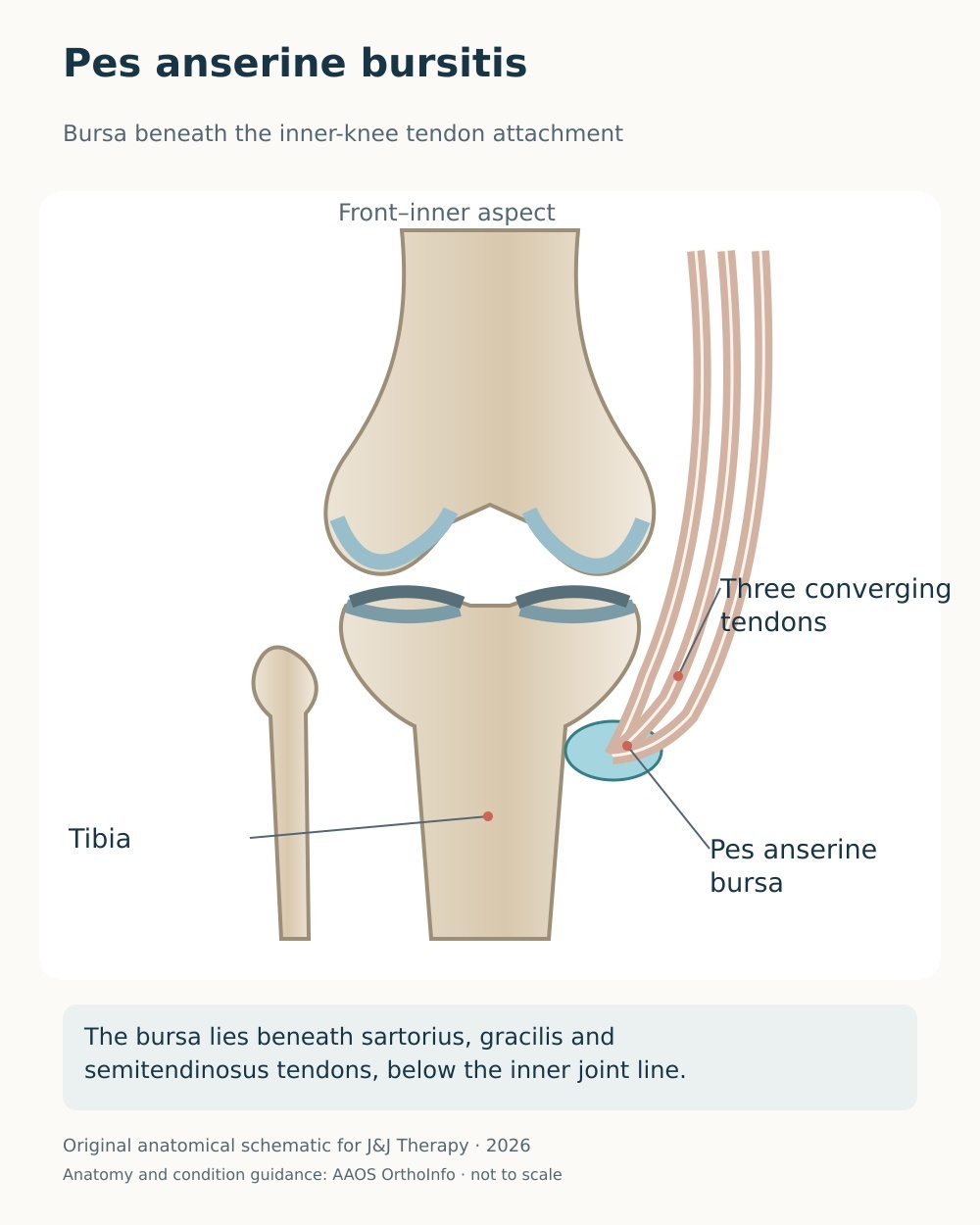
The pes anserine region is where three tendons attach near the upper inner shin. A small bursa cushions this area. Irritation may cause local pain, but similar symptoms can arise from the nearby tendons, an MCL injury or knee osteoarthritis. The exact source should be assessed before treatment.
Assessment at J&J Therapy
We examine the location of tenderness, knee movement and leg strength and ask about training or work changes. Significant warmth, redness, fever or marked swelling needs medical assessment rather than a routine massage appointment.
Do You Experience These Symptoms?
- Tenderness below the inner knee rather than directly over the kneecap.
- Pain with stairs, repeated bending or getting up from a chair.
- An ache after activity, occasionally with local puffiness.
An assessment helps guide your next step, based on your symptoms, health and goals.
Treatment and rehabilitation options
Hands-On Manual Therapy
Gentle treatment of surrounding muscles may help comfort when muscle tension is relevant. We avoid firm direct pressure over a painful bursa. Hands-on care is paired with activity changes and strengthening if it provides a useful response. We explain the purpose and check your comfort and response throughout treatment.
Is Shockwave Suitable?
Shockwave is not a standard first-line treatment for suspected pes anserine bursitis. Persistent inner-knee pain should first prompt a review of the diagnosis and rehabilitation plan. Your physiotherapist can explain the more suitable options and how their effect will be reviewed during your ongoing rehabilitation.
Targeted Exercise Programme
We reduce provocative loading temporarily, then build suitable thigh and hip strength and comfortable flexibility. Stair practice and a gradual return to walking or sport are matched to symptom response. Persistent symptoms may warrant GP or specialist input. Your home plan is adapted as your function and confidence improve.
When to Seek Urgent Medical Help
While most symptoms are not serious, urgent medical attention is required if you experience any of the following:
- Seek urgent GP or NHS 111 advice if you cannot move the knee, bear weight, or straighten a knee that is locked.
- A hot swollen knee with fever or feeling unwell needs urgent medical assessment.
- Go to A&E for a deformed leg after injury or a foot that becomes cold, pale or numb.
Your questions answered
Is inner-knee pain always bursitis?
No. Tendons, the MCL, the meniscus and the joint itself can produce pain in this region. A clinical examination helps decide the next step.
Should I keep stretching the sore area?
Gentle movement may help, but strong stretching or direct pressure can aggravate symptoms. We choose movements based on your response rather than treating soreness as something to force through.
Which appointment should I book?
Start with a Physiotherapy Initial Assessment for new, persistent or recurring symptoms. We can assess the problem and agree a plan linked to your daily activities. If you have already had medical care or surgery, bring the relevant instructions.
Soft Tissue Therapy may be a supporting option for associated muscle discomfort once the condition has been assessed. It is not a substitute for diagnosis or the rehabilitation needed for the underlying problem.
Book a Physiotherapy Assessment or call our reception team on 07935 869938. Find J&J Therapy at CI Tower, Ground Floor, New Malden.
Related conditions
Knee Osteoarthritis · MCL Injury
Sources and further reading

This page is for general information only and does not replace professional medical advice.
Information updated 15 October 2026. General information only; this page cannot diagnose your symptoms. Treatment is agreed after assessment. For urgent or severe symptoms, use the medical services described above.