Quick Summary
Shoulder (glenohumeral) osteoarthritis is a wear-and-tear condition where the cartilage lining the ball-and-socket joint gradually thins, causing deep aching pain, stiffness and grinding.
The good news is that most people manage well without surgery — national guidance (NICE NG226) confirms that tailored therapeutic exercise, education and staying active are the core treatments, and that exercise is not harmful to arthritic joints.
Our physiotherapists combine hands-on treatment with a progressive exercise programme to help you reduce pain, maintain movement and keep doing what matters to you.
What Is Shoulder Osteoarthritis?
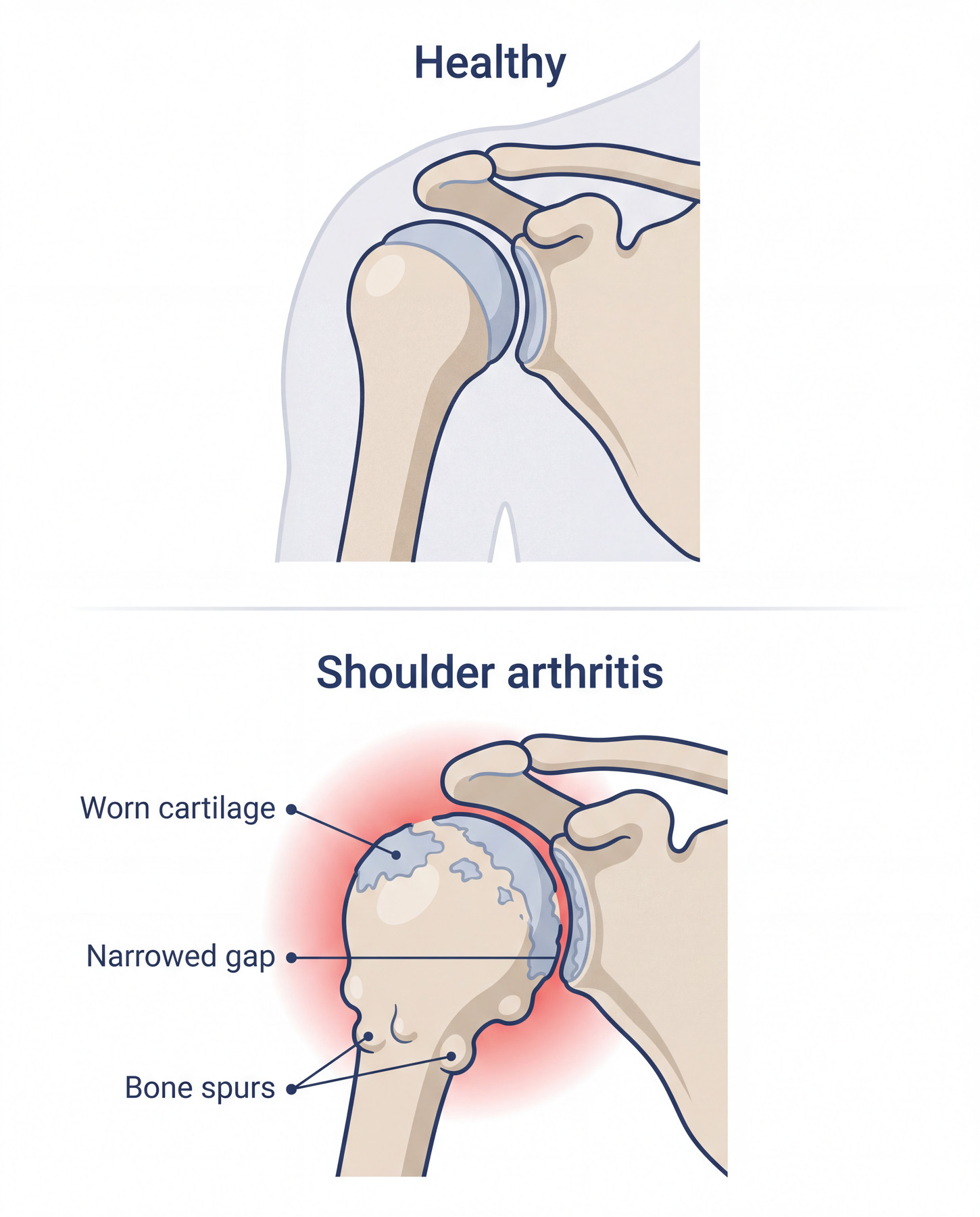
Your shoulder’s main joint — the glenohumeral joint — is where the ball of your upper arm bone (humerus) sits in the shallow socket (glenoid) of your shoulder blade. In osteoarthritis, the smooth cartilage covering these surfaces gradually wears away, the joint space narrows, and the body forms bony spurs called osteophytes. The joint capsule thickens and tightens, which together produce pain, stiffness and a characteristic loss of external rotation — turning your arm outwards.
Shoulder osteoarthritis is often confused with two other conditions. Frozen shoulder causes marked loss of movement due to capsular inflammation rather than cartilage wear, while rotator cuff problems affect the tendons that move and stabilise the joint. A key clue is that osteoarthritis pain is typically felt deep within the joint, with restricted external rotation.
The shoulder is one of the most commonly affected large joints after the knee and hip. Population studies suggest that around 16–20% of adults over 65 show X-ray evidence of glenohumeral osteoarthritis, although many people with these changes have little or no pain (Ibounig et al., Scandinavian Journal of Surgery, 2021). In a UK primary-care shoulder pain population referred for X-rays, the prevalence was around 21%, rising with age (Tran et al., Rheumatology, 2022). It is more common in women and in people over 60.
Do You Experience These Symptoms?
✓ Deep aching pain felt in the back of or deep within your shoulder, often worse with activity
✓ Grinding, clicking or crunching (crepitus) as you move your shoulder
✓ Stiffness that is worse after inactivity, such as first thing in the morning
✓ Reduced range of movement, especially turning your arm outwards (external rotation)
✓ Night pain that disturbs sleep, particularly when lying on the affected side
✓ Weakness and difficulty with everyday tasks such as dressing, washing your hair or reaching a shelf
✓ Catching or a sense of the joint locking as the joint surfaces become irregular
These symptoms can be treated.
The sooner you begin, the better your chances of a smoother recovery.
What Causes Shoulder Osteoarthritis?
• Age-related cartilage wear
The most common form has no single identifiable cause and is strongly linked to age, usually developing after 50–60. Cartilage naturally becomes less resilient over time, gradually thinning and leading to the bone changes characteristic of osteoarthritis.
• Previous injury or surgery
A prior fracture, dislocation or shoulder operation can damage the joint surface and accelerate degeneration. Research suggests the risk of shoulder osteoarthritis after dislocation is substantially higher than in the general population, and post-traumatic arthritis tends to appear earlier in life.
• Long-standing rotator cuff tears
When large rotator cuff tears go untreated, the ball of the joint can migrate upwards and rub abnormally against surrounding bone. This produces a distinct pattern of arthritis known as cuff tear arthropathy, which can influence which treatments are most appropriate.
• Genetics, sex and body weight
Shoulder osteoarthritis is more common in women and there is a recognised hereditary tendency. Higher body weight is also associated with it — notable because the shoulder is not weight-bearing, suggesting wider metabolic factors play a role.
• Occupational and sporting load
Repetitive heavy lifting, overhead work and high-demand sports such as weightlifting and throwing place sustained load on the shoulder. Over many years this is associated with greater cartilage wear.
How We Treat Shoulder Osteoarthritis at J&J Therapy
Hands-On Manual Therapy
Our HCPC-registered physiotherapists use joint mobilisation and soft-tissue techniques to help reduce pain, ease muscle guarding and improve movement — particularly the external rotation that is commonly restricted in shoulder osteoarthritis. Evidence shows manual therapy works best alongside exercise rather than on its own, so we use hands-on treatment to make your exercise programme more comfortable and effective.
Shockwave Therapy*
Swiss Storz Medical MASTERPULS may complement your manual therapy and exercise programme when your physiotherapist identifies specific indications during assessment. Non-invasive, evidence-based.
Targeted Exercise Programme
A progressive, individually tailored exercise programme is the cornerstone of managing shoulder osteoarthritis. NICE guidance (NG226) recommends therapeutic exercise for everyone with osteoarthritis, and reassures that exercise is not harmful to arthritic joints. Our programmes progress through range-of-movement work, rotator cuff and shoulder blade strengthening, and functional retraining for the daily activities that matter to you.
When to Seek Urgent Medical Help
While most symptoms are not serious, urgent medical attention is required if you experience any of the following:
Sudden severe pain, deformity or loss of movement after a significant injury or fall — this could indicate a fracture or dislocation
A hot, red, swollen shoulder with fever or feeling generally unwell — this may suggest joint infection and needs same-day assessment
Unexplained weight loss with constant night pain, or a new lump around the shoulder
Rapidly progressive weakness, numbness or muscle wasting in your arm
FAQs About Shoulder Osteoarthritis
Is exercise safe if I have shoulder arthritis?
Yes. NICE guidance states clearly that exercise is not harmful to osteoarthritic joints and that regular, consistent exercise reduces pain and improves function over the long term. It is normal to feel some discomfort when you start — this does not mean you are causing damage. Our physiotherapists will guide your progression so it feels manageable.
Will I need a shoulder replacement?
Most people with shoulder osteoarthritis do not need surgery. NICE recommends considering joint replacement only when symptoms substantially affect your quality of life and non-surgical management has been tried without success. When surgery is appropriate, outcomes are generally good — research suggests around 90% of patients achieve a clinically meaningful improvement after total shoulder replacement. We can help you try conservative treatment first and support an onward referral if needed.
How many physiotherapy sessions will I need?
This varies depending on your symptoms and goals. Osteoarthritis is a long-term condition, so our focus is on giving you an effective self-management programme rather than open-ended treatment. Many people benefit from an initial block of sessions to establish and progress their programme, followed by review as needed.
Can shockwave therapy treat my shoulder arthritis?
Shockwave therapy is not a first-line treatment for shoulder osteoarthritis, and the direct evidence for using it on the arthritic joint itself is limited. However, shoulder pain often involves more than one structure. If our assessment identifies a coexisting soft-tissue problem — such as calcific rotator cuff tendinopathy, where the evidence for shockwave is stronger — it may complement your manual therapy and exercise programme. We will only suggest it when your assessment indicates it may help.
Can physiotherapy stop the arthritis progressing?
Physiotherapy cannot reverse cartilage that has already worn, and no treatment currently does that apart from joint replacement. What research suggests physiotherapy can do is help you manage symptoms, maintain strength and movement, and stay active and independent. NICE also emphasises that osteoarthritis does not inevitably worsen over time — symptoms often fluctuate, with flare-ups that settle.
This page is for general information only and does not replace professional medical advice.
Reviewed by Lavya Arigalayan, MSc, HCPC Registered Physiotherapist.
Last reviewed:
20 August 2026