top of page
Physiotherapist gently assessing a patient's neck for cervical spinal stenosis at a New Malden clinic

Cervical Spinal Stenosis

300+ Reviews 5.0

Open 7 Days

10+ Years' Experience

HCPC Physio On Team

Insurance Accepted

85% Return Rate

PHYSIOTHERAPY & THERAPEUTIC MASSAGE IN NEW MALDEN

Quick Summary

Cervical spinal stenosis is a narrowing of the spinal canal in your neck that can place pressure on the spinal cord or nerve roots, sometimes causing neck stiffness, arm heaviness, or clumsy hands.


For mild, stable cases without progressive nerve signs, research suggests that carefully graded physiotherapy — hands-on manual therapy and targeted exercise — may help you manage neck pain and maintain function. Our physiotherapists in New Malden assess your symptoms thoroughly and, where signs point to spinal cord involvement, work alongside your GP or a spinal specialist to make sure you receive the right care.

What Is Cervical Spinal Stenosis?

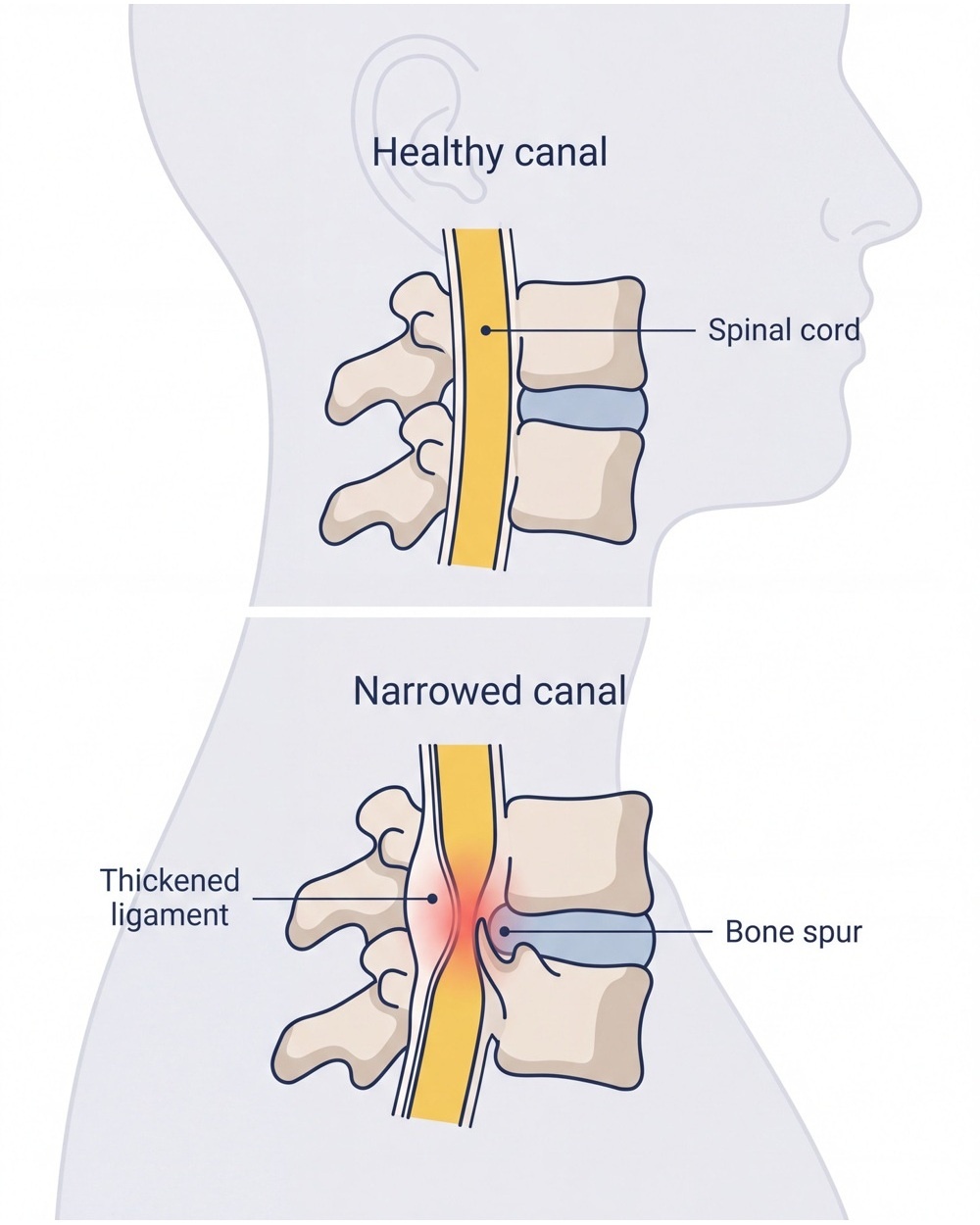
Illustration of a narrowed cervical spinal canal showing disc degeneration, bone spurs, and thickened ligament pressing on the spinal cord

Cervical spinal stenosis is the narrowing of the spinal canal in the neck (the cervical spine). When the canal narrows enough, it can compress the spinal cord, the nerve roots, or both. The narrowing may be congenital — a developmentally narrow canal — or, far more commonly, acquired through age-related degeneration.


The degenerative process usually involves several changes acting together: intervertebral disc degeneration and bulging, bony spurs (osteophytes) from spondylosis, and thickening of the ligamentum flavum at the back of the canal. Together these reduce the space available for the spinal cord and the nerves leaving your neck.


Importantly, narrowing on a scan does not always mean symptoms. Research suggests that around a quarter of healthy adults show some degree of silent spinal cord compression on MRI, rising with age (Smith et al., Global Spine Journal, 2021). Stenosis can, however, irritate a single nerve root (cervical radiculopathy) or, less commonly, compress the spinal cord itself — a condition called degenerative cervical myelopathy, which needs specialist assessment (Fehlings et al., Global Spine Journal, 2017).

Do You Experience These Symptoms?

✓  Neck pain or stiffness, sometimes with reduced range of movement

✓  A feeling of heaviness, aching, or weakness in one or both arms

✓  Clumsiness or loss of dexterity in the hands — difficulty with buttons, zips, or handwriting

✓  Tingling, pins and needles, or numbness in the arms or hands

✓  Changes to balance or a less steady walking pattern

✓  An electric-shock sensation down the spine or limbs when bending the neck forward

These symptoms can be treated.
The sooner you begin, the better your chances of a smoother recovery.

What Causes Cervical Spinal Stenosis?

•  Age-related degeneration (cervical spondylosis)

The commonest cause is the wear-and-tear change that accumulates in the spine over time. These degenerative changes gradually narrow the canal and are more likely to cause symptoms from around the age of 50 onwards.


•  Disc bulging or herniation

As discs lose height and water content with age, they can bulge or herniate backwards into the canal. This reduces the space for the spinal cord or a nerve root and can trigger arm symptoms.


•  Osteophytes (bone spurs)

Degenerating joints and discs prompt the body to lay down extra bone, forming osteophytes. These bony outgrowths encroach on the canal and the openings through which nerves exit.


•  Ligamentum flavum thickening

The ligamentum flavum, a ligament running along the back of the canal, can thicken or buckle as the spine degenerates. This thickening is a major contributor to narrowing behind the spinal cord.


•  A congenitally narrow canal

Some people are simply born with a narrower-than-average spinal canal. This provides less reserve space, so even modest degenerative changes can produce symptoms earlier in life.

Not sure which condition applies to you?

How We Treat Cervical Spinal Stenosis at J&J Therapy

Hands-On Manual Therapy

Our physiotherapists use gentle, low-force mobilisation and soft tissue techniques aimed at easing pain, reducing muscular guarding, and improving comfortable range of movement. Evidence shows mobilisation can provide short-term relief of neck pain. We deliberately avoid high-velocity neck manipulation for this condition, and every session begins with a careful screen for signs of nerve or spinal cord involvement — if anything raises concern, we prioritise prompt onward referral.

Shockwave Therapy*

For conditions involving the spinal canal and direct pressure on the spinal cord or nerves, such as cervical spinal stenosis, our care emphasises specialised manual therapy and targeted exercises rather than shockwave therapy. This is the most appropriate, evidence-based approach for your neck, and it allows us to monitor your symptoms carefully and refer you promptly if specialist input is needed.

Targeted Exercise Programme

A tailored programme may include deep neck flexor strengthening, postural and shoulder blade work, and gentle range-of-movement and nerve mobility exercises where well-tolerated. Research suggests structured exercise may help reduce pain, improve neck conditioning and posture, and keep you active — and we monitor your symptoms closely, adjusting the programme if anything changes.

When to Seek Urgent Medical Help

While most symptoms are not serious, urgent medical attention is required if you experience any of the following:

  • Worsening balance or walking — feeling unsteady, wide-based, or having frequent stumbles or falls

  • Progressive loss of hand function — increasing clumsiness or weakness with buttons, writing, or gripping, especially in both hands

  • New difficulty passing or controlling urine, or loss of bowel control — seek emergency assessment

  • New symptoms in both arms or legs, or repeated electric-shock sensations down the spine when bending the neck

FAQs About Cervical Spinal Stenosis

  • Do I need surgery for cervical spinal stenosis?

Not necessarily. Many people with mild, stable narrowing and no progressive nerve signs are managed without surgery, using physiotherapy, activity modification, and monitoring. Surgery is generally recommended when there is moderate or severe spinal cord compression, or when symptoms are clearly progressing. That decision sits with a spinal specialist, and we are happy to support you through the pathway.


  • Can physiotherapy really help stenosis?

Physiotherapy cannot reverse the physical narrowing of the canal. However, for mild, stable cases, evidence suggests that manual therapy and a targeted exercise programme may help reduce neck pain, improve conditioning and posture, and keep you active. Regular review also helps us spot any change that would need onward referral.


  • Is cervical spinal stenosis the same as a trapped nerve?

Not quite. A trapped nerve in the neck usually means compression of a single nerve root, causing pain or tingling down one arm. Stenosis is the narrowing of the canal itself — it can cause a trapped nerve, but it can also press on the spinal cord, which is a different and potentially more serious problem. Our assessment helps clarify which picture fits your symptoms.


  • Will it get worse over time?

It varies. Many people remain stable for long periods, while in others symptoms slowly progress. Because progression is possible, we teach you the warning signs to watch for and keep your case under review, so that if things change you can be referred promptly.


  • Do you use shockwave therapy for this condition?

No. Shockwave therapy should not be directed near the spinal column or large nerves, so it is not appropriate for cervical spinal stenosis. Instead, our care centres on gentle, specialised manual therapy and a targeted exercise programme, alongside careful monitoring and referral where needed.

Not sure this condition matches your symtoms?
Find your condition and explore related pain areas.

Logo_Navy.png

Ready to start your recovery?
Book your Initial Assessment today.

This page is for general information only and does not replace professional medical advice.

Reviewed by Lavya Arigalayan, MSc, HCPC Registered Physiotherapist.

Last reviewed

20 August 2026

bottom of page