Acute Lower Back Strain: Symptoms, Hip Flexor Causes and 6 Exercises That May Help
- 2 hours ago
- 9 min read
⏱️ Read time: 9 minutes · J&J Therapy, New Malden.

TL;DR: Research shows around 69% of people see their low back pain return within 12 months of recovering (da Silva et al., Journal of Physiotherapy, 2019). ☑️ NICE guidance (NG59) recommends exercise-based treatment, with manual therapy as part of a package that includes exercise. ☑️ You can self-refer to a physiotherapist — no GP referral needed, with same-week appointments available in New Malden.
An acute lower back strain happens when a sudden lift, twist or awkward movement overstretches the muscles and tendons supporting your lower spine — the classic "my back went out" moment. Most strains settle within a few weeks, but that is not the whole story: without addressing the underlying cause, research suggests around two in three people see the pain come back within a year. If long hours of sitting have shortened your hip flexors, your desk may quietly be setting your back up to fail. This guide explains what a back strain is, how to check your symptoms in 30 seconds, and six evidence-informed exercises that may help.
What Is an Acute Lower Back Strain?
An acute lower back strain is an injury in which the muscles or tendons of the lower back are suddenly overstretched or develop small micro-tears — usually from lifting, twisting or an unprepared movement. Think of an old elastic band being yanked sharply: pull it too fast, and some fibres give way.
Back pain is remarkably common. According to UK prevalence data, roughly 6 in 10 UK adults (about 58%) experience back pain at some point in their lives, and about 1 in 3 (around 36%) have it within any given year — more than 10 million people annually. Low back pain is also the leading cause of years lived with disability worldwide (Global Burden of Disease data).
One muscle deserves special attention: the iliopsoas, your deep hip flexor, which runs from the lumbar spine (T12–L5) through the pelvis to the top of the thigh. Because it links your spine directly to your leg, a tight or irritated iliopsoas can drive pain not only in the lower back but also as a deep ache in the front of the hip or groin.

Do I Have a Back Strain? A 30-Second Self-Check
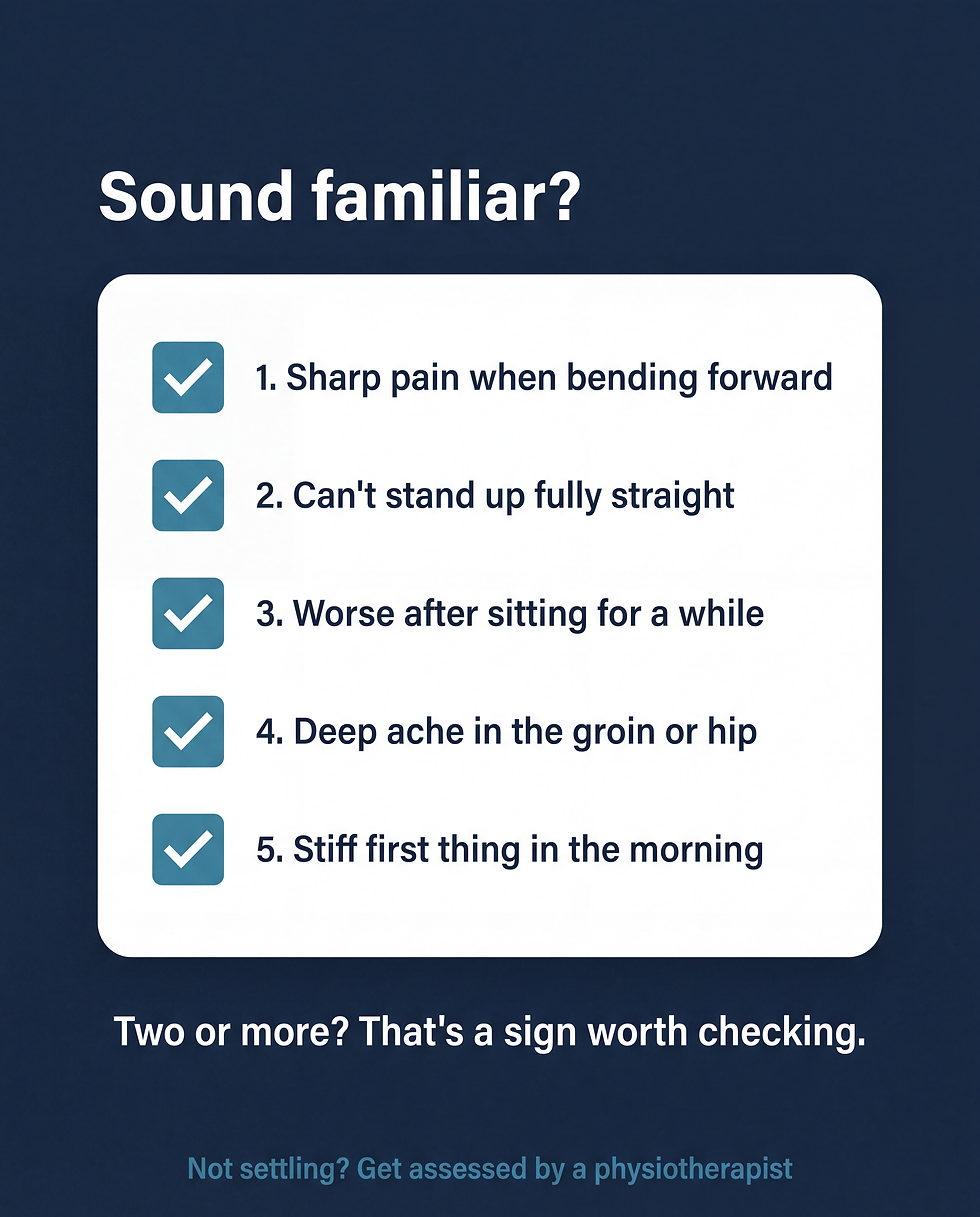
Run through this quick checklist:
☑️ Sharp pain when bending forward.
☑️ Can't stand up fully straight.
☑️ Worse after sitting for a while.
☑️ Deep ache in the groin or hip.
☑️ Stiff first thing in the morning.
If you ticked two or more, that's a sign worth checking with a physiotherapist. In clinic, we go further than a checklist: tests such as the Thomas test (which screens for hip flexor tightness) and the active straight leg raise help identify whether a shortened iliopsoas or lumbopelvic instability is contributing to your pain — and help rule out other causes such as disc-related pain, which typically radiates below the knee.
Can I Just Rest It Off?
The short-term outlook is genuinely reassuring. A systematic review in the BMJ (Pengel et al., 2003) found that within one month, pain and disability improve by an average of 58%, and 82% of people initially off work have returned.
The problem is what happens next. In a prospective cohort of 250 patients, 69% experienced a recurrence within 12 months of recovering (da Silva et al., Journal of Physiotherapy, 2019), and Pengel's review reported recurrence rates as high as 73% within a year. Reported rates vary with how recurrence is defined — from around 40% to 73% — but the pattern is consistent: back strain that isn't addressed at the root tends to come back. Around 5% of acute cases progress to chronic, disabling back pain (BMJ, 2006).
Early treatment also appears to make financial sense. In an analysis of 122,723 patients, those who received guideline-based physiotherapy within 14 days had roughly 60% lower back-pain-related healthcare costs over two years, with significantly less imaging, injections and opioid use (Childs et al., BMC Health Services Research, 2015). Known predictors of recurrence include sitting more than 5 hours a day, two or more previous episodes, and sustained poor posture (da Silva et al., 2019).

Why Does Long Sitting Set Your Back Up to Fail?
For many office workers, the true culprit sits at the front of the body, not the back. Hours of sitting hold the iliopsoas in a shortened position. Over time, the shortened muscle pulls the pelvis into a forward tilt, which deepens the lumbar curve and increases the load on the lower back. Then one unguarded movement — standing up quickly, lifting a bag, a golf swing — and the overworked muscle "goes".
This is why massage or rest alone may not be enough: if the hip flexor stays tight, the mechanics that caused the strain remain in place. Evidence suggests that addressing the root cause early may help reduce the risk of recurrence.

How Can Physiotherapy Help?
NICE guidance for low back pain (NG59) recommends exercise as a first-line treatment, and manual therapy — joint mobilisation and soft tissue techniques — as part of a treatment package that includes exercise. At J&J Therapy in New Malden, treatment for an acute back strain typically combines:
1. Hands-on manual therapy. In the acute phase, gentle joint mobilisation restores movement to stiff lumbar segments — like oiling a rusty hinge — while soft tissue release helps ease muscle spasm and guarding. In line with NG59, this is always paired with exercise rather than used alone.

2. A tailored exercise programme. Evidence supports progressive, individualised exercise for low back pain, and research on stabilisation training suggests the best results at around 3–5 sessions per week of 20–30 minutes. Consistency matters more than the specific style of exercise.
3. Shockwave therapy — for the chronic phase only. If muscular back pain persists beyond about three months, evidence suggests radial shockwave therapy may help: a 2023 meta-analysis of 12 trials (632 patients) reported meaningful short-term pain reduction in chronic low back pain (Liu et al., Journal of Orthopaedic Surgery and Research, 2023), though the certainty of evidence was moderate and study variability was high. To be transparent: NICE has not issued guidance approving shockwave for low back pain, and it is not generally recommended in the first acute weeks — a sham-controlled trial found no benefit over placebo for acute pain. We assess your stage first and only suggest it where the evidence fits. Our practitioners are Storz Medical certified.

Getting seen quickly matters, too. NHS musculoskeletal physiotherapy waiting times vary widely by region — the Chartered Society of Physiotherapy has reported waits of 22–34 weeks in some areas, with cases of up to 50 weeks. At J&J Therapy you can self-refer without a GP letter, and same-week appointments are usually available, seven days a week, with consultations offered in English, Korean, Cantonese and Mandarin.
Which Home Exercises May Help?
The six exercises below follow the phased approach used in NHS back-care resources: gentle movement first, then hip flexor mobility, then core stabilisation to help prevent recurrence. Work within a comfortable range — mild stretching discomfort is acceptable, but stop if pain increases or spreads down your leg.
1. Knee-to-Chest Stretch (acute phase)
Lie on your back with both knees bent and feet flat. Draw one knee towards your chest with both hands, hold at a comfortable point, then slowly return. Keep breathing throughout and let your lower back stay flat on the floor.
Dosage: Hold 20–30 sec × 3 reps · 1–2 sets daily.

2. Half-Kneeling Hip Flexor Stretch (prevent recurrence)
Kneel on one knee with the other foot in front at 90 degrees. Squeeze the back-leg glute and push your whole pelvis forward, keeping your torso tall — you should feel the stretch at the front of the hip, not in your lower back. Add padding under the knee if it's uncomfortable.
Dosage: Hold 20–30 sec × 2–3 reps each side · 1–2 sets daily.

3. Pelvic Tilt
Lie on your back with knees bent. Breathe out and gently flatten your lower back against the floor, drawing your navel towards your spine. Hold, then relax. Avoid lifting your hips.
Dosage: Hold 5 sec × 8–10 reps · 3 times daily.
4. Glute Bridge
Lie on your back with knees bent, feet hip-width apart. Squeeze your glutes and lift your hips until shoulders, hips and knees form a straight line. Hold briefly, then lower slowly. Lead with the glutes, not the lower back — reduce the height if your back complains.
Dosage: 8–12 reps × 3 sets · 3–5 days a week.
5. Bird Dog
Start on all fours, wrists under shoulders and knees under hips. Draw your belly in and extend one arm forward and the opposite leg back, both parallel to the floor. Keep your pelvis level and avoid letting your back sag or twist.
Dosage: Hold 5 sec × 8–10 reps each side · every other day.
6. Dead Bug
Lie on your back with arms reaching to the ceiling and hips and knees bent to 90 degrees. Slowly lower one arm overhead while extending the opposite leg towards the floor, keeping your lower back pressed flat. Return and repeat on the other side. If your back starts to arch, shorten the movement.
Dosage: 8–10 reps each side × 2 sets · 3–5 days a week.
⚠️ A note on going it alone: Exercising without an accurate diagnosis risks missing the real cause — such as a shortened hip flexor, disc involvement or a red flag condition — and poor technique can increase the load on your back. With recurrence rates of 69–73%, professional assessment and guided progression may help reduce the risk of the pain returning.
When Should I Seek Help Right Away?
Back strain is rarely dangerous, but seek urgent medical attention if you notice any of the following:
🚩 Loss of bladder or bowel control, or numbness around the groin or saddle area.
🚩 Numbness, tingling or weakness in both legs.
🚩 Back pain accompanied by fever.
🚩 Unexplained weight loss alongside back pain.
🚩 Pain after significant trauma, or severe pain at night that doesn't ease with rest.
Frequently Asked Questions
Do I need a GP referral to see a physiotherapist?
No. Private physiotherapy operates on a self-referral basis, so you can book directly without seeing your GP first. Your initial assessment at J&J Therapy includes treatment on the same visit.
How many sessions will I need?
It depends on your stage and goals. As a guide, NICE-recommended exercise and manual therapy programmes for low back pain typically run up to around 8 sessions over up to 12 weeks. Many acute strains need fewer — your physiotherapist will give you a realistic plan at your initial assessment.
Will the treatment hurt?
Treatment is adjusted to your acute stage. Gentle mobilisation and soft tissue work may cause mild, short-lived discomfort, but it should not be sharply painful — and your therapist will adapt the pressure based on your feedback throughout.
Should I keep working and moving with a back strain?
In most cases, yes. NICE guidance encourages staying active within your pain limits rather than bed rest. Break up sitting every 30–45 minutes, use cold packs (10–15 minutes) in the first days if it helps, and lift by bending your knees and keeping loads close to your body.
Why does my back pain keep coming back?
Research shows 69% of people have a recurrence within 12 months, and long daily sitting is a known predictor. Often the driver is a shortened hip flexor pulling the pelvis and lower back out of balance — which is why treatment that targets the root cause, not just the sore spot, may help reduce recurrence.
Ready to Get Your Back Moving Again?
If standing up has started to feel like a gamble, don't wait for the next flare-up. Book an assessment this week with an HCPC-registered physiotherapist in New Malden — your first visit includes a full evaluation and same-day treatment.
Book your Initial Assessment (45 min · £70) — same-week appointments available. 📍 J&J Therapy, CI Tower, New Malden, KT3 4TE — 2 min from New Malden station · Free parking. 📍 Open 7 days · 9am–7pm · Consultations in English, Korean, Cantonese and Mandarin. 📍 Also serving Kingston upon Thames, Raynes Park, Wimbledon and Worcester Park. 📞 +44 07935 869938 — Reception · 9am–7pm · call or text. 📞 +44 07882 943540 — 24-hour AI bookings · call, text or WhatsApp anytime. 🌐 www.jjtherapy365.com.[ Book Now ]

About the author: Valton Lam, MSK Physiotherapist — MSci Physiotherapy (Keele University), HCPC-registered (PH148704), member of the Chartered Society of Physiotherapy. Valton specialises in musculoskeletal assessment, progressive loading rehabilitation and manual therapy, and is a Storz Medical certified shockwave practitioner at J&J Therapy, New Malden.
This article is for general information only and is not a substitute for professional medical advice, diagnosis or treatment. Every patient is different — results and recovery times may vary. If you are concerned about your symptoms, please seek advice from a qualified healthcare professional.
Sources: NICE NG59 — Low back pain and sciatica in over 16s: assessment and management · Pengel LHM et al., Acute low back pain: systematic review of its prognosis, BMJ 2003 · da Silva T et al., Recurrence of low back pain is common, Journal of Physiotherapy 2019 · Childs JD et al., Implications of early and guideline adherent physical therapy for low back pain, BMC Health Services Research 2015 · Liu K et al., Efficacy and safety of extracorporeal shockwave therapy in chronic low back pain, Journal of Orthopaedic Surgery and Research 2023 · BMJ 2006 — Diagnosis and treatment of low back pain · NHS inform — Exercises for back pain · Chartered Society of Physiotherapy — NHS waiting times reports · StatPearls — Iliopsoas Muscle anatomy.


