Quick Summary
Sacroiliac (SI) joint dysfunction causes a deep, one-sided ache in the lower back and buttock, where the base of your spine meets your pelvis. Research suggests it accounts for around 15–30% of chronic lower back pain, yet it is frequently overlooked.
At J&J Therapy in New Malden, our physiotherapists confirm the likely source using a cluster of clinical provocation tests, then combine hands-on manual therapy with a targeted exercise programme. Many people notice meaningful improvement over a course of care, although the number of sessions varies with how long your symptoms have been present and how your body responds.
What Is SI Joint Dysfunction?
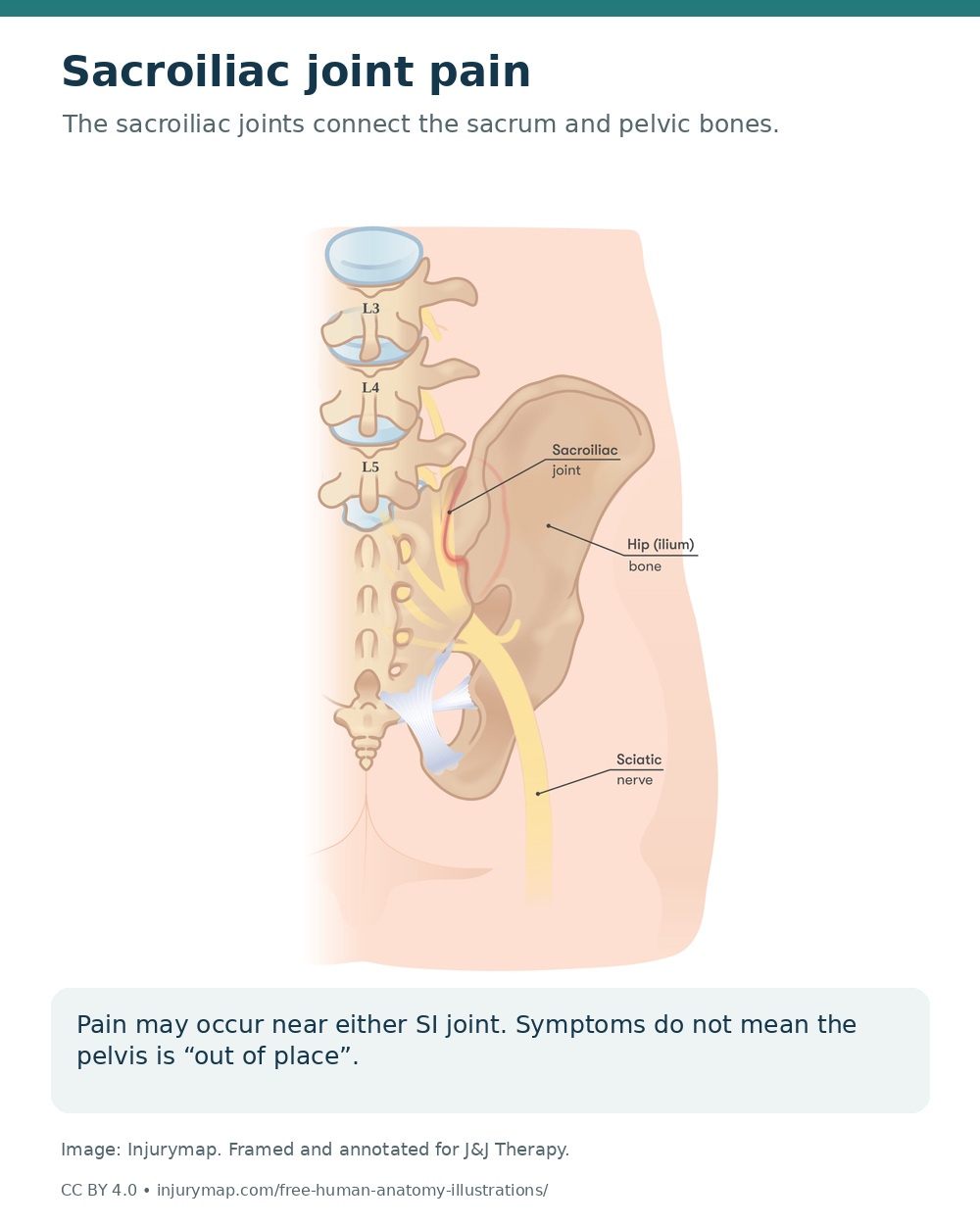
Your sacroiliac joints connect the triangular bone at the base of your spine (the sacrum) to the iliac bones of your pelvis — one on each side. The joint is unusual in design: its front portion is a true synovial joint lined with cartilage, while the back portion is a dense web of some of the strongest ligaments in the body. It moves only a small amount, and its main role is to transfer load between your trunk and your legs while absorbing shock.
Stability of the SI joint is usually explained through two ideas. Form closure is the stability provided by the shape and fit of the bones themselves, as the wedge-shaped sacrum sits between the two iliac bones. Force closure is the extra compression generated by the surrounding muscles, ligaments and fascia — including transversus abdominis, the pelvic floor, gluteus maximus and the thoracolumbar fascia — that actively grip the joint as you move. Pain can arise when this balance is disturbed, whether the joint moves too much, too little, or the surrounding muscles are not coordinating load transfer well (Vleeming et al., PM&R, 2019).
SI joint dysfunction is a common but under-recognised source of mechanical lower back pain. Evidence shows it accounts for approximately 15–30% of chronic, non-radicular lower back pain, and it is reported more often in women than in men (Cohen et al., Expert Review of Neurotherapeutics, 2013; Newman & Soto, American Family Physician, 2022).
Presentations we commonly see
Some people have a joint that moves excessively, described as instability, while others have a restricted, stiff joint — a distinction that influences how we apply manual therapy and exercise. Pregnancy and the post-partum period are common triggers, as hormonal changes soften the pelvic ligaments. SI joint pain is also more common after lumbar spinal fusion, which increases mechanical stress across the joint. Inflammatory sacroiliitis, which can be a feature of axial spondyloarthritis, is a separate and important consideration that we screen for, because it needs medical rather than purely mechanical management.
Do You Experience These Symptoms?
✓ A deep ache or sharp pain low in your back and buttock, usually on one side, close to where your spine meets your pelvis
✓ Pain that may spread into the hip, groin or back of the thigh, but usually does not travel below the knee
✓ Symptoms worse with transitional movements — standing up from sitting, rolling over in bed, or getting out of the car
✓ Pain aggravated by prolonged sitting or standing, climbing stairs, or standing on one leg while dressing
✓ A sense of instability, or the feeling that your leg might give way
✓ Tenderness when pressure is applied over the joint, and difficulty sleeping on the affected side
✓ Occasional numbness, tingling or a feeling of weakness in the leg
These symptoms can be treated.
The sooner you begin, the better your chances of a smoother recovery.
What Causes SI Joint Dysfunction?
• Pregnancy and childbirth
Hormonal changes soften and loosen the pelvic ligaments in preparation for birth, while added weight and a shifted centre of gravity increase the load on your SI joints.
The mechanical demands of labour and delivery can further strain the joint, and for some women symptoms persist into the post-partum period.
• Trauma and sudden loading
A fall onto the buttock, a road traffic accident, or a heavy or awkward lift can injure the SI joint and its supporting ligaments in a single event.
People are often able to pinpoint the specific incident that triggered their pain, which is more typical of SI joint problems than of some other back conditions.
• Repetitive and asymmetrical stress
Repeated shearing and twisting forces from running, golf or repetitive lifting, together with prolonged one-sided postures, can gradually overload the joint.
A true or apparent leg-length difference, or a persistent asymmetry in your walking pattern, may contribute over time.
• Altered biomechanics after spinal surgery
Lumbar fusion changes how load is distributed through the pelvis and concentrates stress at the SI joint.
Research shows higher rates of SI joint degeneration and pain in people who have had a lumbar fusion compared with those who have not.
• Reduced muscular control and de-conditioning
When the deep stabilising muscles that provide force closure — transversus abdominis, the pelvic floor and the gluteals — are weak or poorly coordinated, the joint loses some of its dynamic support.
This is why motor control and strengthening work sits at the centre of your rehabilitation programme.
How We Treat SI Joint Dysfunction at J&J Therapy
Hands-On Manual Therapy
Because no single test reliably confirms the SI joint as the source of pain, our physiotherapists use a cluster of provocation tests — distraction, thigh thrust, compression, sacral thrust and Gaenslen's test — alongside a screen of your lumbar spine and hip. Research shows that when three or more of these tests reproduce your familiar pain, the SI joint is a likely source (Laslett et al., Manual Therapy, 2005).
Treatment may include mobilisation or manipulation of the sacroiliac joint and lumbar spine to restore comfortable movement, together with soft tissue work on the gluteal muscles, piriformis, thoracolumbar fascia and hip flexors.
Hands-on care reduces pain and muscle guarding, creating a window in which you can move and exercise more freely. We always use it as one part of a wider, exercise-based plan.
Shockwave Therapy*
Swiss Storz Medical MASTERPULS
may complement your manual therapy and exercise programme when your physiotherapist identifies specific indications during assessment. The direct evidence in sacroiliac joint pain is limited and mostly short-term, so we never offer it as a first-line or stand-alone treatment.
Non-invasive, evidence-based. Not suitable during pregnancy.
Targeted Exercise Programme
Exercise is the cornerstone of managing SI joint dysfunction, and your programme is built around restoring force closure — the muscular control that stabilises the joint.
Early sessions focus on motor control and lumbopelvic stability, re-educating the deep stabilisers so your pelvis is supported during everyday movements. We then progress to gluteal strengthening, hip mobility and graded load management so the joint tolerates more demand.
We also coach you on posture, sleeping positions and pacing. Progression is individualised, and we review and adjust your programme as you improve.
When to Seek Urgent Medical Help
While most symptoms are not serious, urgent medical attention is required if you experience any of the following:
Numbness around the saddle area, difficulty passing or controlling urine, loss of bowel control, or new leg weakness — go to A&E immediately
Back or buttock pain starting before age 45 with morning stiffness over 30 minutes, night pain and improvement with movement rather than rest
Recent significant trauma such as a fall or road traffic accident
Fever, unexplained weight loss, a history of cancer, or feeling generally unwell alongside your back pain
FAQs About SI Joint Dysfunction
How do you know my pain is coming from the SI joint and not my back or hip?
No single test is conclusive, so our physiotherapists use a cluster of provocation tests together with your history and a screen of your lumbar spine and hip. When several tests reproduce your familiar pain, it points more confidently to the sacroiliac joint. We also check for features that suggest other causes, so your treatment is aimed at the right target.
Is SI joint dysfunction permanent, and will it get better?
For most people it is not permanent. Research suggests that a combination of manual therapy and targeted exercise can improve both pain and function in sacroiliac joint dysfunction. Recovery timelines vary between individuals depending on how long symptoms have been present and what is driving them.
I developed this pain after having a baby — can you help?
Yes. Pregnancy-related and post-partum pelvic and sacroiliac pain is common, driven by ligament laxity and changes in load. Physiotherapy focused on stability and gradual strengthening is a mainstay of care. Please tell us if you are pregnant or have recently given birth, as this affects which treatments are appropriate — in particular, shockwave therapy is not used during pregnancy.
Can shockwave therapy help my SI joint pain?
Shockwave therapy is not a first-line treatment for sacroiliac joint dysfunction, and the direct evidence is limited and mostly short-term. For some persistent cases, our physiotherapists may consider Swiss Storz Medical MASTERPULS radial shockwave therapy as a second-line addition to your manual therapy and exercise programme, but only where specific indications are identified during assessment. It is non-invasive, and it is not suitable during pregnancy.
What can I do at home to ease the pain?
Staying gently active, avoiding prolonged static postures and modifying aggravating activities usually help in the short term, and sleeping with a pillow between your knees can ease night-time discomfort. Most importantly, the home exercise programme your physiotherapist prescribes is designed to build the muscular control that stabilises the joint and helps reduce recurrences.
This page is for general information only and does not replace professional medical advice.
Reviewed by Lavya Arigalayan, MSc, HCPC Registered Physiotherapist.
Last reviewed:
2026년 8월 20일