
Quick Summary
Aching, fatigue or tingling during repetitive work can be frustrating. RSI is a broad description rather than one precise diagnosis. We assess what is provoking your symptoms and help you adjust tasks while rebuilding tolerance for work and hobbies.
Understanding Repetitive Strain Injury (RSI)
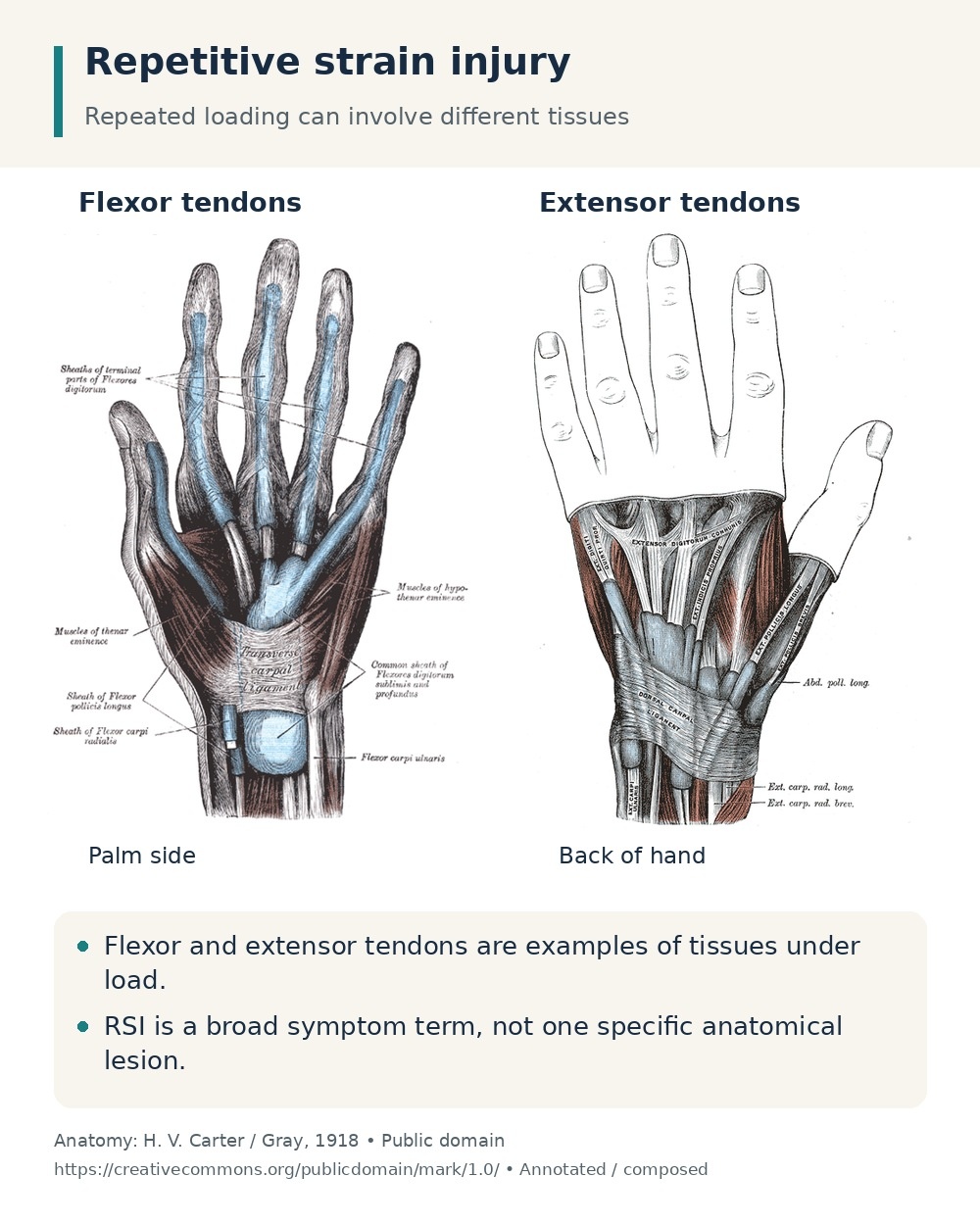
Repetitive strain injury describes symptoms associated with repeated activity, often affecting the forearm, wrist or hand. A more specific problem such as tendinopathy or nerve compression may be present. Identifying that pattern helps avoid treating every ache with the same approach.
How we assess your symptoms
We discuss your working day, breaks, tools and symptom timing, then examine movement, strength and sensation where relevant. Bringing a description or photo of your workstation can help us make realistic recommendations.
Image: H. V. Carter / Gray, 1918 · Public domain. Adapted.
Do You Experience These Symptoms?
- Aching, burning or tiredness that builds during repeated tasks.
- Stiffness or reduced comfortable grip and movement.
- Tingling or numbness, which warrants assessment for nerve involvement.
An assessment helps guide your next step, based on your symptoms, health and goals.
What may contribute?
Repetition, force, sustained positions and a sudden workload increase can contribute. Recovery, sleep and stress may influence symptoms too. People doing similar work can respond differently, so there is no single posture or equipment change that suits everyone.
A treatment plan built around you
Hands-On Manual Therapy
Soft tissue therapy may ease associated muscle tension after assessment. Its role is to support more comfortable activity; repeated massage alone does not address an ongoing workload or nerve problem.
Is Shockwave Suitable?
Shockwave is not routinely recommended for repetitive strain injury (rsi). Your assessment will guide appropriate rehabilitation, symptom management and whether medical or specialist review is needed. We will explain why each proposed treatment fits your symptoms before you decide whether to proceed.
Targeted Exercise Programme
We plan manageable movement breaks and progressive strength or endurance work. Tasks are built up gradually instead of prolonged complete rest. Workplace adjustments may be discussed with your employer or occupational health team.
When to Seek Urgent Medical Help
While most symptoms are not serious, urgent medical attention is required if you experience any of the following:
- Go to A&E immediately after an injury if a joint is deformed or the hand or finger is cold, pale or blue, or has severe loss of sensation. For other severe swelling or inability to use the arm, seek urgent assessment through NHS 111.
- A hot, red, rapidly swollen joint with fever needs urgent medical assessment. Arrange prompt review for persistent numbness, increasing weakness or loss of dexterity.
Your questions answered
Should I rest until all symptoms disappear?
Prolonged complete rest can reduce tolerance. A temporary reduction in aggravating activity, combined with comfortable movement and a gradual build-up, is usually more useful.
Will an ergonomic mouse solve it?
It may help some people, but equipment is only one part of the picture. We consider workload, task variation, symptoms and physical capacity before recommending changes.
Which appointment should I book?
Choose a Physiotherapy Initial Assessment for new, persistent or uncertain symptoms. We will assess what is limiting you, explain the options and agree the next steps. If you already have a diagnosis, bring any relevant scan report or specialist advice. For assessed muscle tension, Soft Tissue Therapy with Brigitte may complement your exercise plan. New weakness or nerve symptoms should be assessed before massage.
Visit J&J Therapy on the ground floor of CI Tower, New Malden. Book an assessment or call our reception team on 07935 869938 if you are unsure which service to choose.
Related conditions
Carpal tunnel syndrome · Wrist tendonitis
Sources and further reading

This page is for general information only and does not replace professional medical advice.
Information updated 15 October 2026. General information to support informed choices; it is not a diagnosis or a personalised treatment plan. Suitability and any need for referral are assessed individually. Seek urgent medical help for the warning signs listed above.