HCPC Registered
300+ Reviews 5.0
Insurance Accepted
85% Patient Return Rate
Quick Summary
Carpal tunnel syndrome causes numbness, tingling and weakness in the thumb, index, middle and radial half of the ring finger, and often wakes you at night. At J&J Therapy in New Malden, our HCPC-registered physiotherapists combine hands-on manual therapy — including carpal bone mobilisation and soft-tissue release of the forearm — with a targeted exercise programme focused on median nerve gliding and tendon gliding. Research suggests most patients with mild-to-moderate cases notice meaningful improvement within 6–12 weeks of consistent conservative care.
What Is Carpal Tunnel Syndrome?
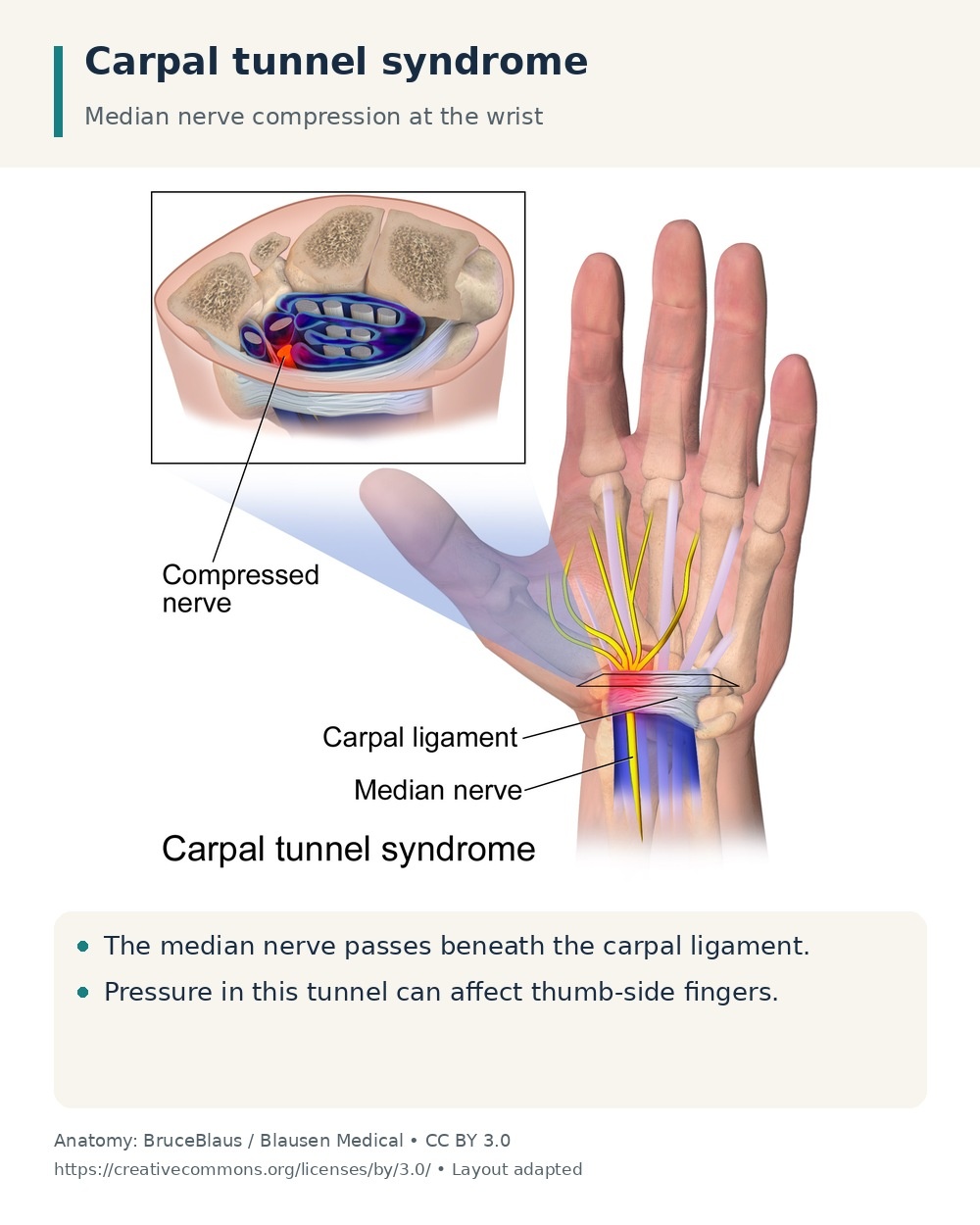
Carpal tunnel syndrome (CTS) is the most common peripheral nerve entrapment neuropathy, caused by compression of the median nerve as it passes through the carpal tunnel at the base of the wrist.
The anatomy. The carpal tunnel is a narrow fibro-osseous passage on the palm side of the wrist. Its floor and walls are formed by the carpal bones, while its roof is a thick fibrous band called the transverse carpal ligament (flexor retinaculum). The tunnel contains ten structures: the median nerve, together with nine flexor tendons (four flexor digitorum superficialis, four flexor digitorum profundus, and flexor pollicis longus). Any swelling of the tendon sheaths, thickening of the ligament, or increase in tissue volume within this confined space can raise pressure on the median nerve.
The pathophysiology. Normal pressure inside the carpal tunnel sits at roughly 2–10 mmHg; in CTS it commonly exceeds 30 mmHg. Raised pressure first compromises the small blood vessels supplying the nerve, producing ischaemia and the familiar intermittent tingling and nocturnal symptoms. Sustained compression then causes focal demyelination (slowed nerve conduction), and — if left unchecked — axonal damage with fixed sensory loss and thenar muscle wasting.
Severity staging. Clinicians usually stage CTS as mild, moderate or severe based on symptoms, examination findings and, where available, nerve conduction studies. The internationally recognised Padua neurophysiological classification grades CTS from minimal/mild through moderate to severe and extreme, guiding treatment intensity.
Who gets it. CTS affects approximately 3–4% of the general adult population, with a female-to-male ratio of around 3:1 and a peak incidence between 40 and 60 years of age. Pregnancy-related CTS — driven by fluid retention in the third trimester — is very common and typically resolves after delivery.
High-quality guidelines support conservative care as first-line for mild-to-moderate CTS. The JOSPT 2019 Clinical Practice Guideline (Erickson et al.) gives Grade A evidence for neutral wrist splinting and Grade B for manual therapy, and landmark trials show manual therapy is clinically equivalent to carpal tunnel release surgery at 6 and 12 months in mild-to-moderate cases (Fernández-de-las-Peñas et al., J Pain, 2015; JOSPT, 2017). Individual results may vary.
Do You Experience These Symptoms?
✓ Numbness, tingling or burning in the thumb, index, middle and radial half of the ring finger (the median nerve distribution) — the little finger is typically spared
✓ Symptoms that wake you at night and are worse in the early morning hours
✓ Relief when you shake your hand out — the classic "flick sign"
✓ Weakness or clumsiness when gripping — dropping cups, struggling with buttons, keys or jar lids
✓ Aching in the wrist that may travel up the forearm, sometimes as far as the shoulder
✓ Symptoms triggered by sustained wrist positions — driving, holding a phone, reading a newspaper or typing
✓ Wasting at the base of the thumb (thenar eminence) in more advanced or long-standing cases
These symptoms are treatable. Specialist physiotherapy can help.
What Causes Carpal Tunnel Syndrome?
• Repetitive wrist movements and occupational factors
Prolonged typing, assembly-line work, checkout scanning and the use of vibrating hand tools are all associated with increased carpal tunnel risk.
Systematic reviews confirm strong links between CTS and repetitive hand use, forceful exertion, hand–arm vibration and awkward wrist postures.
• Pregnancy and hormonal changes
Fluid retention in the third trimester commonly compresses the median nerve inside the already tight tunnel.
Pregnancy-related carpal tunnel is very frequent but usually resolves within weeks to a few months after delivery, making conservative care the appropriate first step.
• Underlying medical conditions
Diabetes, hypothyroidism, rheumatoid arthritis and obesity all increase tunnel pressure or reduce nerve resilience.
Controlling the underlying condition alongside physiotherapy is an important part of long-term management.
• Anatomical predisposition
Some people simply have a smaller carpal tunnel or a thicker transverse carpal ligament.
Wrist anatomy altered by a previous fracture or sprain can also raise baseline pressure on the median nerve.
• Sustained wrist flexion or extension
Sleeping with the wrists curled, or working for long periods with a poorly set-up keyboard or mouse, holds the wrist at a position that sharply increases carpal tunnel pressure.
Modifying these sustained positions is often the single most effective change you can make alongside treatment.
How We Treat Carpal Tunnel Syndrome at J&J Therapy
We go beyond exercise sheets. Your first session is a full 45-minute assessment AND treatment - so you leave feeling the difference.
Hands-On Manual Therapy
Carpal bone mobilisations to gently widen the transverse carpal arch, combined with soft-tissue release of the forearm flexor mass and careful assessment of the cervical spine (double-crush screening) — aimed at reducing pressure on the median nerve from your very first session.
Shockwave Therapy*
For conditions involving direct nerve compression, our care emphasises specialised manual therapy and targeted median nerve mobility exercises — the most appropriate approach for your specific needs.
Targeted Exercise Programme
Median nerve gliding and tendon gliding exercises, wrist and forearm stretches, plus grip and intrinsic hand strengthening. Personalised ergonomic advice and a neutral-position night-splinting regimen to protect the carpal tunnel during daily activities and maintain your progress.
Shockwave Therapy
.jpg)

Chronic neck tension and trigger points in the upper trapezius and surrounding muscles can be difficult to resolve with exercise alone. Our Swiss-manufactured Storz Medical MASTERPULS shockwave system delivers precise acoustic waves to break down muscle knots, improve blood flow, and support the body's natural healing response.
Swiss Storz Medical MASTERPULS - clinical-grade precision
Non-invasive — no needles, no medication
Stimulates natural tissue repair and blood flow
Typically 3-6 sessions for lasting improvement
Results may vary. Your physiotherapist will recommend the best plan for your specific condition.
When to Seek Urgent Medical Help
While most symptoms are not serious, urgent medical attention is required if you experience any of the following:
Persistent numbness combined with visible wasting of the fleshy base of the thumb
Sudden, severe wrist pain or swelling after trauma (possible acute carpal tunnel syndrome — a surgical emergency)
Complete loss of sensation or inability to move the hand normally
Rapidly worsening weakness, especially if both hands are affected or with accompanying neck and arm symptoms
FAQs About Carpal Tunnel Syndrome
Can carpal tunnel syndrome be treated without surgery?
Yes. For mild-to-moderate carpal tunnel syndrome, conservative care is first-line according to NICE Clinical Knowledge Summaries and the JOSPT 2019 Clinical Practice Guideline. Splinting, targeted physiotherapy, manual therapy and nerve and tendon gliding exercises help many patients avoid surgery. Surgical release is reserved for severe cases or those that do not respond after a fair trial of conservative care.
How long does physiotherapy take to work for carpal tunnel?
Most patients with mild-to-moderate carpal tunnel syndrome notice meaningful improvement within 6 to 12 weeks (typically 6–10 sessions), though the timeline varies with severity and underlying factors. Randomised trial evidence shows continued gains up to 12 months with a structured conservative programme.
Should I have shockwave therapy for my carpal tunnel?
For nerve compression conditions like carpal tunnel syndrome, our treatment emphasises specialised manual therapy and median nerve mobility exercises, which are best suited to your specific needs. Shockwave is a valuable tool in our clinic for tendon and soft-tissue conditions such as plantar fasciitis and tennis elbow, but it is not endorsed by current UK or international physiotherapy guidelines as a standard treatment for carpal tunnel, and application over a peripheral nerve trunk requires particular caution. We are happy to discuss this in more detail at your assessment.
When should I consider carpal tunnel surgery?
NICE guidance advises considering referral for carpal tunnel release when symptoms are severe, when there is thenar muscle wasting or fixed sensory loss, when nerve conduction studies show significant nerve damage, or when conservative care has failed after roughly 3 to 6 months. Your GP or hand specialist will make this decision with you.
Will wearing a wrist splint help?
Yes — particularly at night. The Cochrane Review on splinting for carpal tunnel syndrome and the JOSPT 2019 Grade A recommendation both support wearing a neutral-position wrist splint overnight for at least 4 weeks. Many patients find splinting alone significantly reduces night-time waking and morning symptoms; we combine it with manual therapy and exercise for best effect.
This page is for general information only and does not replace professional medical advice.
Reviewed by Lavya Arigalayan, MSc, HCPC Registered Physiotherapist.
Last reviewed:
17 April 2026