Quick Summary
Postural low back pain is a common form of non-specific mechanical back pain linked to prolonged sitting, desk work and inactivity — an ache that typically builds when you stay still and eases when you move. Reassuringly, it is not a sign that your spine is damaged or fragile, and the strongest evidence supports staying active, with a targeted exercise programme at the centre of your recovery and manual therapy as a helpful addition. Most people improve within weeks, and we typically plan an initial block of around 4–6 sessions, reassessing as we go so you leave with the tools to manage flare-ups yourself.
What Is Postural Low Back Pain?
Postural low back pain belongs to the broad group clinicians call non-specific low back pain — discomfort between your lower ribs and buttock creases that is not caused by a specific problem such as a fracture, infection or a trapped nerve. It is extremely common. Low back pain is the leading cause of years lived with disability worldwide, affecting an estimated 619 million people in 2020 (GBD 2021 Low Back Pain Collaborators, The Lancet Rheumatology, 2023).
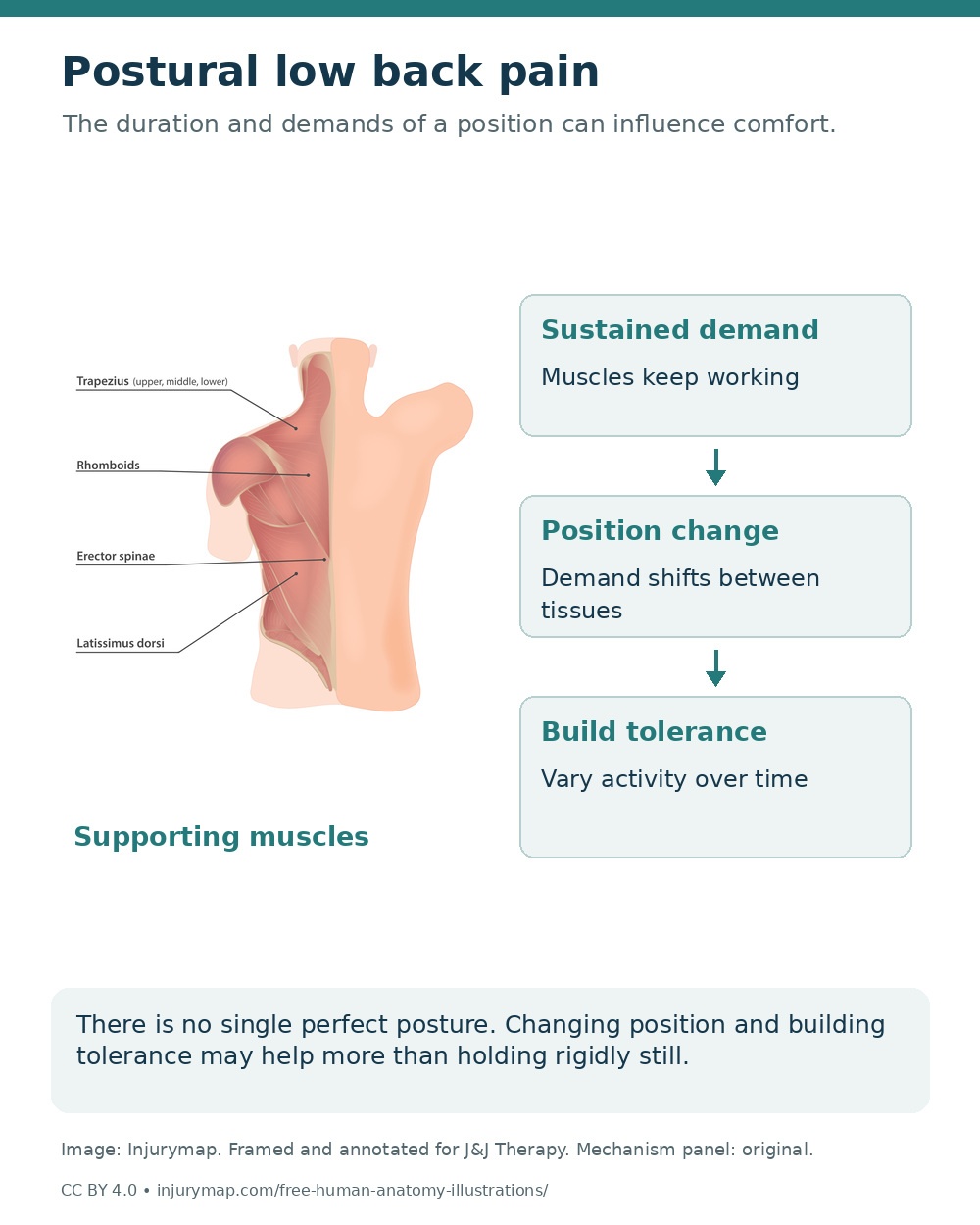
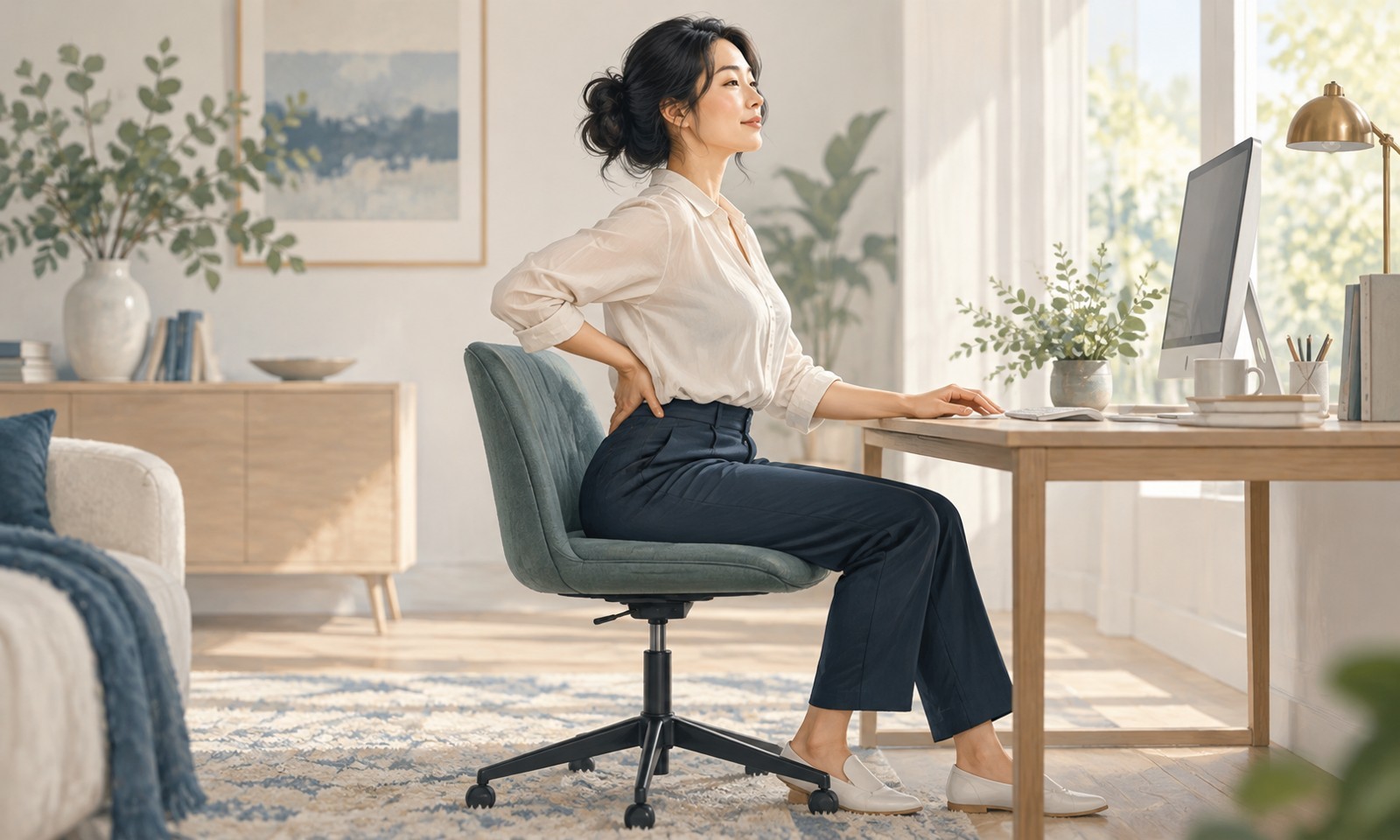
The word "postural" reflects the pattern most patients describe: an ache that builds through long periods of static sitting or standing and settles once you get moving. Sustained positions increase steady loading on the structures of your lower back and fatigue the muscles that support it. Research suggests this matters — a systematic review and meta-analysis found prolonged sitting time and a sedentary lifestyle were both significant risk factors for low back pain in adults (Alzahrani et al., systematic review and meta-analysis, 2022).
We want to be honest about one popular idea, though. The belief that "bad posture" directly causes back pain is not well supported by current evidence. Studies show the relationship between spinal posture and pain is weak and highly individual, and there is no single correct posture you should be holding. How long you stay in one position, and how little you vary it, appears to matter far more than precise alignment. The practical message is a reassuring one: your spine is a robust, adaptable structure, and the usual problem is too much sustained stillness rather than a fragile or misaligned back.
The outlook is good. Most episodes settle substantially within about six weeks. Repeat episodes are common, however — one cohort study found around four in ten people experienced a further episode within a year (Medeiros et al., JOSPT, 2022). That is precisely why our care focuses on building lasting capacity and self-management rather than short-term relief alone.
Do You Experience These Symptoms?
✓ A dull ache or stiffness in your lower back that builds during prolonged sitting, standing or desk work
✓ Noticeable relief when you change position, stand up, walk or move around
✓ Morning stiffness, or stiffness after long static periods, that eases once you get going
✓ A sense of muscular fatigue or tightness across your lower back and around your pelvis
✓ Pain generally confined to your lower back, without pain travelling below the knee
✓ Discomfort that worsens towards the end of a long working day at a desk or screen
✓ No leg weakness, numbness or changes to bladder or bowel control (these would point elsewhere — see below)
These symptoms can be treated.
The sooner you begin, the better your chances of a smoother recovery.
What Causes Postural Low Back Pain?
• Prolonged sitting and sedentary desk work
Extended, unbroken periods of static sitting load the lower back and fatigue the muscles that support it. Office workers who sit for most of the working day are among the most commonly affected, particularly when sitting is combined with awkward positions.
• Lack of movement and postural variation
Evidence suggests how long you hold a position matters more than the position itself — your back is built to move and dislikes staying still. Long spells without changing posture reduce local circulation and increase muscular fatigue, which can trigger aching.
• Physical deconditioning and low activity levels
Reduced general fitness and limited strength through your trunk and hips lower your tolerance for sustained postural loading. A sedentary lifestyle is itself a recognised risk factor, and deconditioning can make recovery slower and repeat episodes more likely.
• Stress, sleep and other lifestyle factors
Stress, low mood, poor sleep, smoking and excess body weight are all associated with a higher likelihood of low back pain and a slower recovery. These factors influence how pain is experienced and maintained, which is why modern physiotherapy looks beyond posture alone.
• Aggravating loads and habits
Whole-body vibration such as prolonged driving, carrying loads in awkward positions, and sudden increases in activity after a long inactive spell can all provoke a flare-up. Prolonged driving time in particular has been identified as a significant risk factor in the research on sedentary behaviour.
How We Treat Postural Low Back Pain at J&J Therapy
Hands-On Manual Therapy
Our physiotherapists may use spinal mobilisation and soft-tissue techniques to ease pain, settle muscular guarding and help you move more comfortably in the short term. Evidence shows manual therapy can produce small improvements in pain and function for persistent low back pain, broadly comparable to other active treatments (Rubinstein et al., BMJ, 2019). In line with NICE guidance, we always deliver manual therapy as part of a wider package built around exercise and self-management — it creates a comfortable window in which to get you moving well again.
Shockwave Therapy*
Swiss Storz Medical MASTERPULS radial shockwave therapy is not a first-line treatment for postural low back pain and is not part of everyone's plan. Where our physiotherapists identify a specific myofascial or soft-tissue component during your assessment, it may complement your manual therapy and exercise programme. Non-invasive and well tolerated — though we will be clear that the evidence in non-specific low back pain remains limited, and exercise stays the priority.
Targeted Exercise Programme
A targeted, progressive exercise programme is the heart of your care and the most strongly evidence-based element. A large Cochrane review found moderate-certainty evidence that exercise improves pain compared with no treatment, usual care or placebo (Hayden et al., Cochrane Database of Systematic Reviews, 2021), and no single type of exercise has proved superior — so we choose movements that suit your preferences, ability and goals, because the programme you will actually keep doing is the one that works. Alongside strengthening and general activity, we give you practical guidance on breaking up sitting, varying your position and moving regularly through the working day.
When to Seek Urgent Medical Help
While most symptoms are not serious, urgent medical attention is required if you experience any of the following:
Loss of bladder or bowel control, difficulty passing urine, or numbness around your groin, buttocks or inner thighs
Progressive weakness, numbness or tingling in one or both legs, or difficulty walking
Severe back pain following significant trauma such as a fall or road accident
Back pain alongside fever, unexplained weight loss, night pain, or a history of cancer
These features are uncommon, but recognising them early matters. If any apply to you, attend A&E or call 999 for the first two, and contact your GP or NHS 111 promptly for the others.
FAQs About Postural Low Back Pain
Is my bad posture the cause of my back pain?
Not exactly. Current evidence shows the link between spinal posture and back pain is weak, and there is no single correct posture to aim for. The bigger issue is usually staying in one position too long with too little movement. Rather than worrying about sitting perfectly, we help you move more, vary your position and build tolerance.
Should I rest until the pain settles?
No. The evidence and NICE guidance are clear that staying active and continuing your normal activities as much as possible leads to better outcomes than rest. Gentle movement is safe and helpful — your back is robust, not fragile.
Do I need an X-ray or MRI scan?
Usually not. NICE advises against routine imaging for non-specific low back pain, because scans rarely change management and often show age-related changes that are equally common in people with no pain at all. Imaging is reserved for cases where warning signs or specific concerns are present.
How long will it take to improve, and will it come back?
Most episodes improve substantially within about six weeks. Repeat episodes are common — research suggests around four in ten people have another within a year — which is exactly why we prioritise building strength, activity habits and self-management strategies to reduce that risk.
Can shockwave therapy treat my postural back pain?
Shockwave is not a first-line treatment for postural low back pain and is not recommended by NICE for this condition. The research evidence in non-specific low back pain is limited and of modest quality, and we would rather tell you that plainly. We only consider our Swiss Storz Medical MASTERPULS radial shockwave as an optional addition if your assessment identifies a specific myofascial or soft-tissue component that may respond — always alongside, never instead of, exercise and activity.
This page is for general information only and does not replace professional medical advice.
Reviewed by Lavya Arigalayan, MSc, HCPC Registered Physiotherapist.
Last reviewed:
2026년 8월 20일