Quick Summary
An anterior cruciate ligament (ACL) injury is a partial or complete tear of one of the main stabilising ligaments deep inside your knee, most often caused by a sudden twist, pivot, awkward landing or rapid change of direction during sport. Many people feel or hear a "pop", the knee swells quickly within the first few hours, and it can feel unstable or give way when turning.
At J&J Therapy in New Malden, our physiotherapists provide thorough assessment, hands-on manual therapy and a progressive, individualised exercise programme to help settle swelling, restore movement and rebuild strength — whether you are managing your knee without surgery, preparing for an operation (prehabilitation) or recovering afterwards. Surgical decisions are made with an orthopaedic consultant; our role is to guide your rehabilitation at every stage.
What Is an ACL Injury?
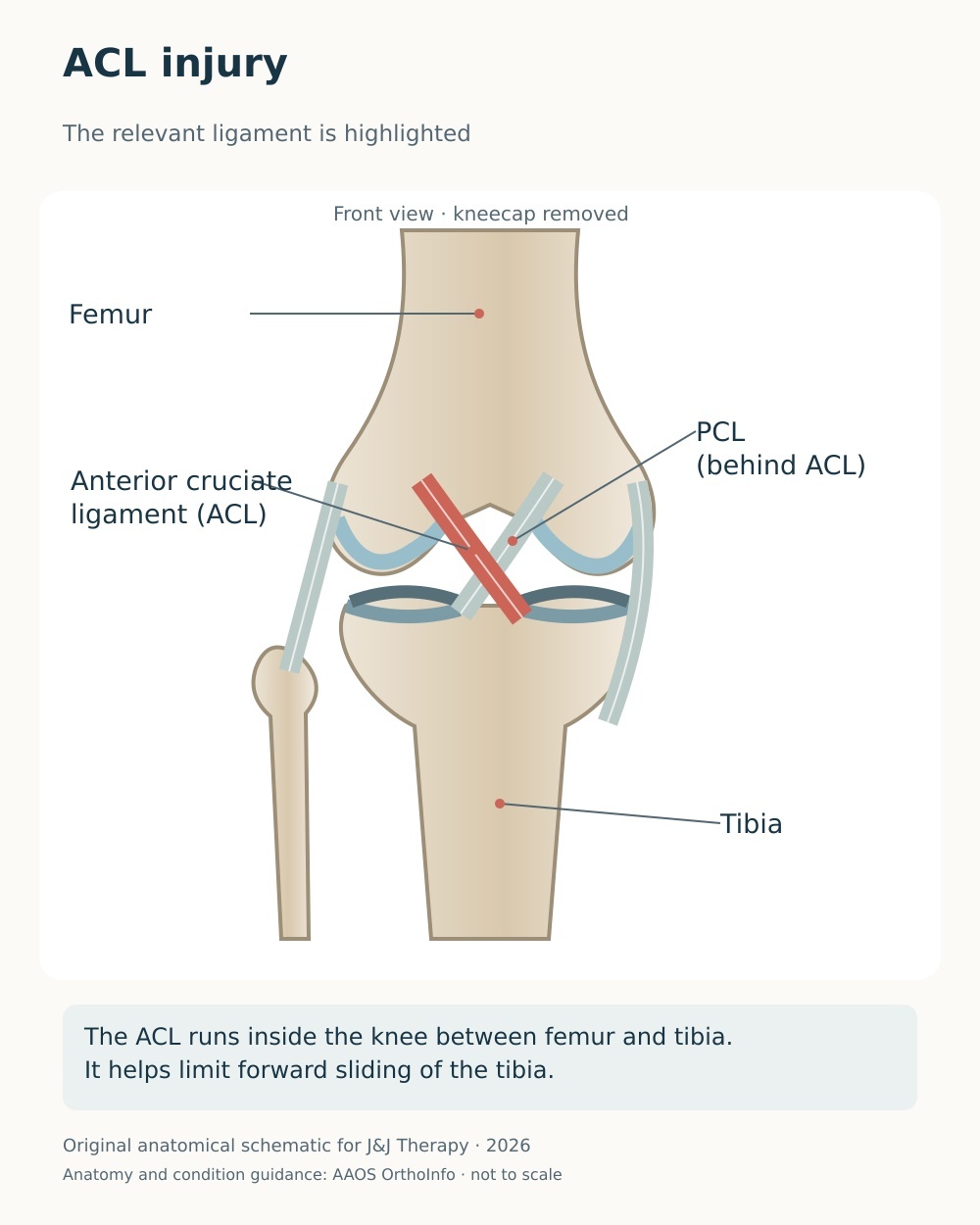
The anterior cruciate ligament runs diagonally through the centre of your knee, connecting the thigh bone (femur) to the shin bone (tibia). Its main job is to restrain the shin bone from sliding too far forwards relative to the thigh bone, and to control rotation — giving your knee stability when you pivot, cut and land.
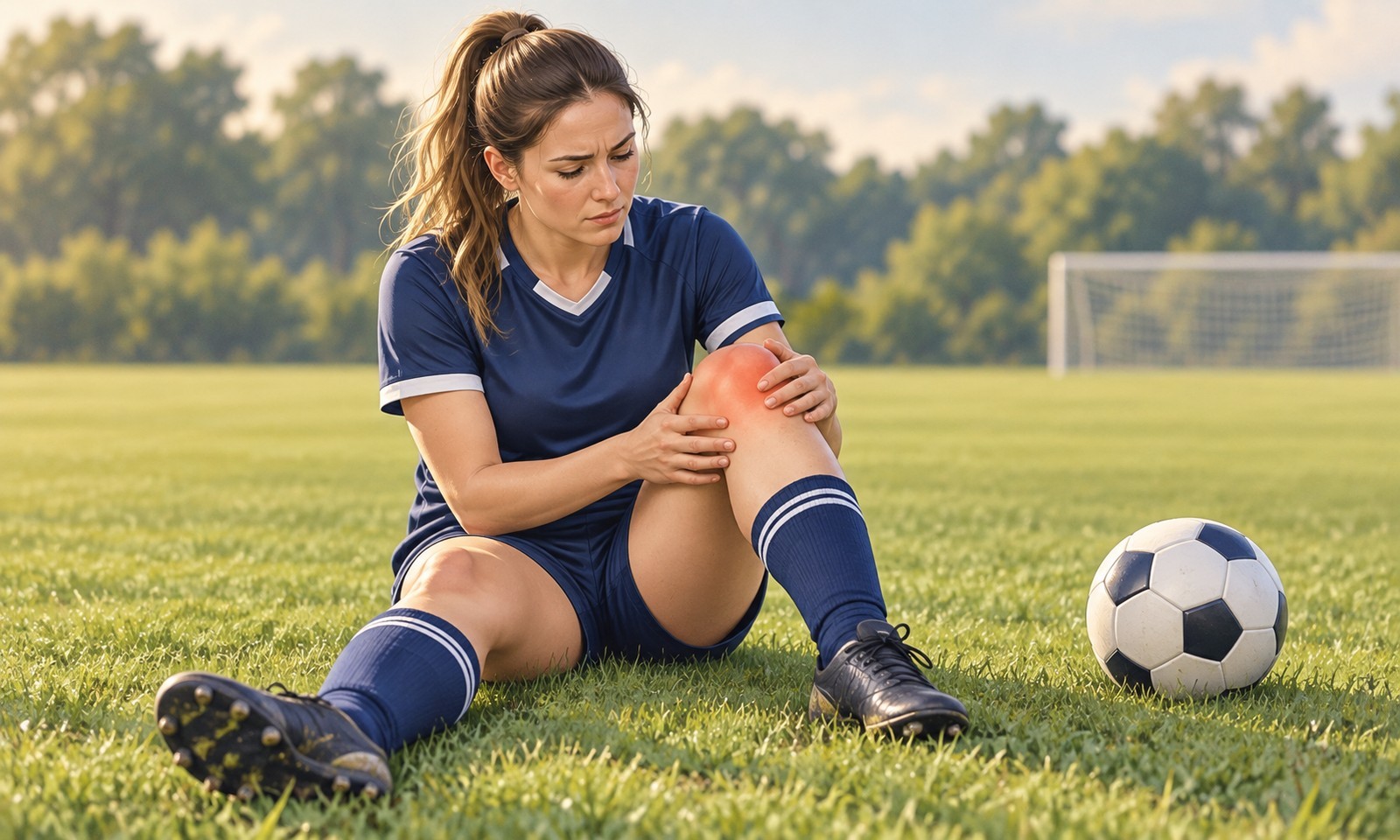
Most ACL injuries happen through a non-contact mechanism: decelerating suddenly, pivoting on a planted foot, or landing from a jump with the knee collapsing inwards (dynamic valgus). A 2022 meta-analysis of team ball sports found that non-contact injuries made up around 55% of all ACL injuries, rising to 63% in women compared with 50% in men. A direct blow to the outside of the knee can also cause a tear. At the moment of injury, many people report a "pop", followed by rapid swelling (haemarthrosis) caused by bleeding inside the joint.
ACL tears are often graded from partial to complete rupture, and they frequently occur alongside other injuries — the medial collateral ligament (MCL), the meniscus (cartilage) and bone bruising. The combination of ACL, MCL and meniscal injury is historically called the "unhappy triad".
A torn ACL does not typically heal back to full mechanical strength on its own, which is why rehabilitation focuses on restoring stability, strength and neuromuscular control around the joint. Left unaddressed, an ACL-deficient knee can experience repeated episodes of giving way, which may lead to further meniscal and cartilage damage over time. Research also suggests an ACL injury raises the long-term risk of knee osteoarthritis, which is why quality rehabilitation matters well beyond the first few months.
Do You Experience These Symptoms?
✓ A sudden "pop" or snapping sensation in your knee at the moment of injury
✓ Rapid swelling, usually within the first few hours — a sign of bleeding inside the joint
✓ A feeling that your knee is unstable, buckling or giving way, especially when turning
✓ Pain, often felt deep inside the knee, that stops you continuing your activity
✓ Reduced range of movement, with difficulty fully straightening or bending your knee
✓ Difficulty weight-bearing, walking normally or returning to sport
✓ A sense that your knee is not trustworthy on stairs, slopes or uneven ground
These symptoms can be treated.
The sooner you begin, the better your chances of a smoother recovery.
What Causes an ACL Injury?
• Non-contact pivoting and cutting
The most common cause is a sudden change of direction with your foot planted, twisting the shin bone against the thigh bone.
This places the ACL under load beyond its tensile strength and is typical of football, netball, basketball and skiing.
• Deceleration and awkward landing
Rapidly slowing down from a sprint, or landing from a jump with the knee relatively straight, can overload the ligament.
Flat-footed landings and poor control of the trunk and hip contribute to this risk.
• Dynamic knee valgus — the knee collapsing inwards
When your knee falls inward over your foot during landing or cutting, combined rotational and valgus forces strain the ACL.
Weakness or poor timing of the hip and thigh muscles increases this vulnerability.
• Direct contact or collision
A blow to the outside of the knee — for example a tackle in rugby or football — can force the knee inward and rupture the ligament.
This mechanism often damages the MCL and meniscus at the same time.
• Higher risk in female athletes
Evidence suggests the relative risk of ACL injury in women is several times greater than in men playing the same sport.
This is attributed to a combination of anatomical, hormonal, biomechanical and neuromuscular factors, some of which may be addressed through targeted training.
How We Treat ACL Injuries at J&J Therapy
Hands-On Manual Therapy
Hands-on techniques including soft tissue work, patellar (kneecap) mobilisation and mobilisation of the knee, hip and ankle to settle swelling, ease pain and restore movement — with full knee extension as an early priority.
Manual therapy cannot repair a torn ligament, but it prepares your knee for the active rehabilitation that rebuilds stability.
Shockwave Therapy*
Swiss Storz Medical MASTERPULS
is not a routine treatment for an ACL injury, but may complement your manual therapy and exercise programme when your physiotherapist identifies specific indications during assessment — for example persistent tendon-related pain following surgery.
Non-invasive, evidence-based.
Targeted Exercise Programme
A progressive, criteria-based exercise programme is the core of ACL rehabilitation and is strongly supported by evidence.
We begin by restoring full extension, reducing swelling and re-activating the quadriceps, then build strength, single-leg control, balance and proprioception before sport-specific agility, hopping and landing drills.
Progression is guided by objective criteria such as limb symmetry and hop testing rather than time alone, and we include neuromuscular principles drawn from established injury-prevention programmes.
When to Seek Urgent Medical Help
While most symptoms are not serious, urgent medical attention is required if you experience any of the following:
A knee that locks or cannot straighten or bend at all — this may indicate a displaced meniscal tear or loose body
Rapid, severe swelling immediately after injury together with an inability to bear weight
A knee that feels grossly unstable, gives way repeatedly, or looks deformed
Loss of sensation, coldness or severe pins and needles below the knee, or a suspected fracture
FAQs About ACL Injuries
Does an ACL tear always need surgery?
No. Both UK and international evidence show that many people do well with structured rehabilitation, and a substantial proportion avoid surgery altogether. In the landmark KANON trial, around 61% of those randomised to rehabilitation with the option of later surgery had avoided reconstruction at two years.
The NHS position is that not all ACL injuries need surgery and that physiotherapy is often tried first. The decision depends on your symptoms — particularly ongoing instability — your activity goals and any associated injuries, and is made with an orthopaedic consultant. Our role is to guide your rehabilitation whichever path you take.
How long is recovery from an ACL injury?
It varies. Early swelling and movement usually improve over several weeks with rehabilitation. If you have a reconstruction, returning to pivoting sport typically takes around nine to twelve months and is guided by objective strength and function tests rather than time alone — research shows re-injury risk continues to fall for each month that return is delayed, up to about nine months. Non-surgical rehabilitation timelines are individual and depend on your goals and progress.
Can physiotherapy heal my torn ACL?
Physiotherapy cannot repair the torn ligament itself, and we will always be honest with you about that. What it can do is very valuable: settle swelling, restore full movement, rebuild strength and neuromuscular control, and help stabilise your knee so you can return to the activities that matter to you — with or without surgery.
Will my knee develop arthritis later?
An ACL injury does raise the long-term risk of knee osteoarthritis, and this risk is influenced by any associated meniscal and cartilage damage. Research suggests a meaningful proportion of people who injure their ACL develop post-traumatic osteoarthritis in the decades that follow. Good rehabilitation, maintaining strength and healthy activity, and avoiding repeated giving-way episodes are all sensible ways to look after your knee over time, and we can advise you on long-term knee health.
Can shockwave therapy treat my ACL injury?
Shockwave therapy is not a first-line or standard treatment for an ACL injury, and the evidence for it in this condition is limited. The research that exists relates mainly to the rehabilitation period after ACL reconstruction surgery rather than to the torn ligament itself — a 2025 systematic review pooling five small trials at higher risk of bias found improvements in knee scores that did not exceed the level considered clinically meaningful.
In narrow circumstances, such as persistent tendon-related pain after graft surgery, your physiotherapist may consider it as an adjunct alongside your main rehabilitation. We will only recommend it after assessment if it is genuinely appropriate for you.
This page is for general information only and does not replace professional medical advice.
Reviewed by Lavya Arigalayan, MSc, HCPC Registered Physiotherapist.
Last reviewed:
2026년 8월 20일