top of page
Physiotherapist assessing a patient’s knee for a suspected meniscus tear at J&J Therapy in New Malden

Meniscus Tear

300+ Reviews 5.0

Open 7 Days

10+ Years' Experience

HCPC Physio On Team

Insurance Accepted

85% Return Rate

PHYSIOTHERAPY & THERAPEUTIC MASSAGE IN NEW MALDEN

Quick Summary

A meniscus tear is damage to one of the two crescent-shaped cartilage cushions inside your knee, causing pain, swelling, stiffness and sometimes catching or locking.


Research shows that for most degenerative tears — and many traumatic ones — a structured programme of physiotherapy and targeted exercise achieves outcomes comparable to keyhole surgery, so conservative care is an appropriate first-line choice for the majority of patients.


Most patients attend for a course of approximately 6-12 sessions over 8-12 weeks, with progress reviewed at every stage.

What Is a Meniscus Tear?

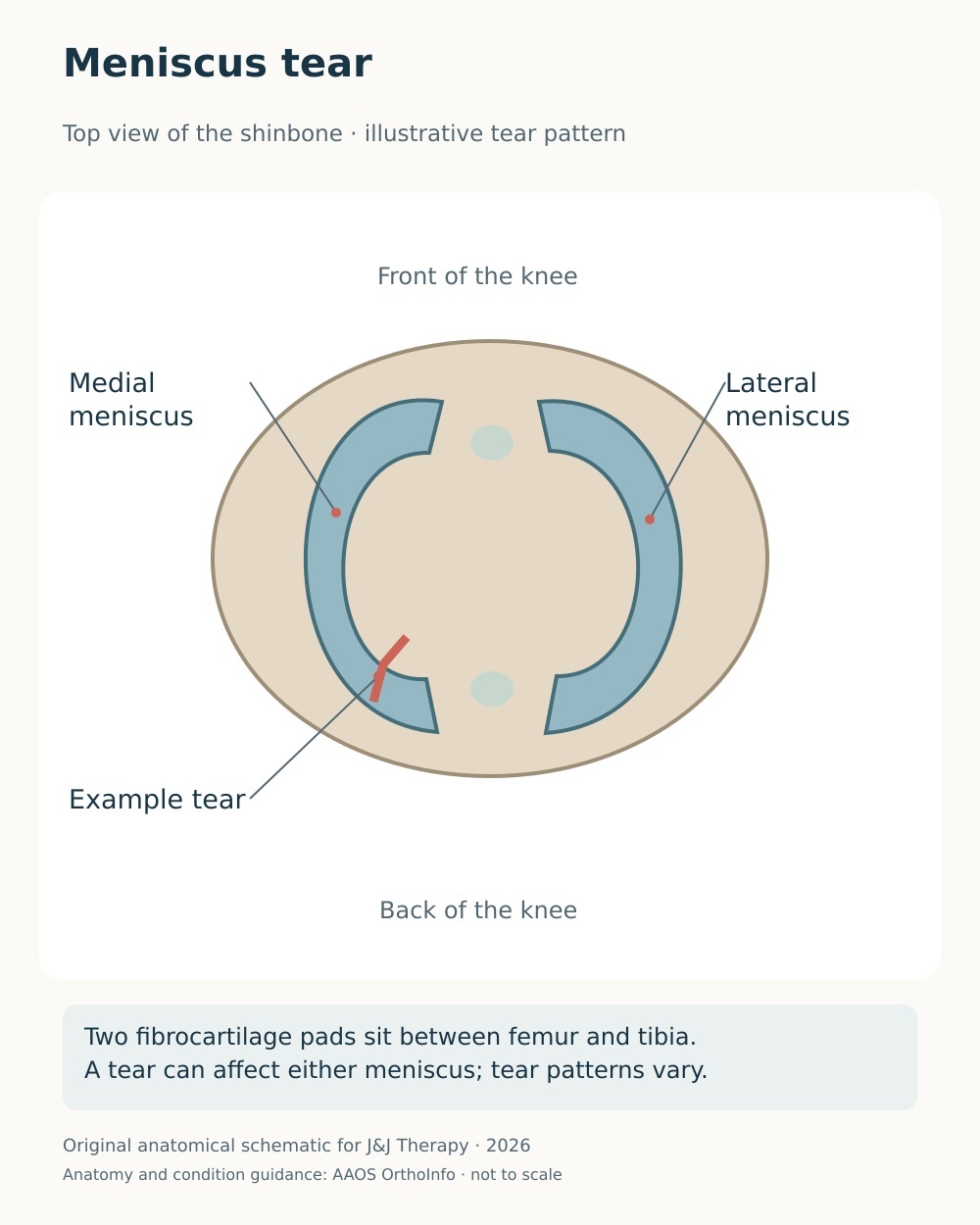
Anatomical illustration of the knee showing the medial and lateral menisci and their blood supply zones

Each knee contains two menisci — a medial (inner) and a lateral (outer) meniscus — which are wedge-shaped fibrocartilage structures sitting between your thigh bone and shin bone. They act as shock absorbers, improve the fit of the joint surfaces, contribute to stability and help protect the articular cartilage underneath.


Blood supply and healing potential

The blood supply to the meniscus reduces from the outer rim inwards, which is why the location of a tear largely governs whether it can heal. The outer third is well supplied (the "red" zone), the middle is transitional, and the inner third is avascular (the "white" zone) and receives nutrition only by diffusion from the joint fluid (Arnoczky and Warren, American Journal of Sports Medicine, 1982). Tears in the outer zone have the greatest capacity to heal or be repaired; inner-zone tears rarely heal.


Types of tear

Tears are described by their pattern: longitudinal, bucket-handle (where the inner fragment displaces into the joint), radial, horizontal cleavage, flap and complex degenerative tears, as well as root tears where the meniscal attachment pulls away. Longitudinal, bucket-handle and radial patterns are more often traumatic and affect younger, active people, while horizontal, flap and complex patterns are typically degenerative and more common after the age of 40.


Traumatic and degenerative tears

These are two distinct clinical situations. A traumatic tear usually follows a twisting injury on a loaded, bent knee, whereas a degenerative tear develops as the tissue weakens with age and may occur with little or no trauma. Importantly, meniscal tears seen on scans are very common and are often painless: in one population study, tear prevalence on MRI ranged from 19% in women aged 50-59 to 56% in men aged 70-90, and 61% of those with a tear reported no knee symptoms in the previous month (Englund et al., New England Journal of Medicine, 2008).


This distinction matters because the evidence for conservative care is strong. A landmark randomised trial found no significant difference between arthroscopic partial meniscectomy and sham surgery at 12 months in patients with degenerative tears (Sihvonen et al., New England Journal of Medicine, 2013), and trials in younger adults with traumatic tears have found no clear benefit of early surgery over exercise and education at 12 months (Skou et al., NEJM Evidence, 2022).

Do You Experience These Symptoms?

✓  Pain along the joint line of your knee, often worse with twisting, squatting or deep bending

✓  Swelling that develops gradually over several hours to a couple of days after the injury

✓  Catching, clicking or a sensation that your knee may give way

✓  Locking — an inability to fully straighten your knee

✓  Stiffness and reduced range of movement

✓  Difficulty with stairs, kneeling or pivoting activities

✓  Tenderness when the joint line is pressed

These symptoms can be treated.
The sooner you begin, the better your chances of a smoother recovery.

What Causes a Meniscus Tear?

•  Twisting injury on a loaded knee

Traumatic tears most often happen when your foot is planted and the knee twists under load, such as during football, rugby or netball.

This is the classic mechanism in younger, active people and can occur alongside a ligament injury.


•  Age-related degeneration

With age the meniscus loses elasticity and becomes more fragile, so tears can develop with little or no trauma.

Degenerative tears are common after the age of 40 and frequently coexist with early osteoarthritic change.


•  Repetitive loading and occupational strain

Repeated deep squatting, kneeling or heavy lifting can gradually overload the meniscus.

Over time this contributes to the horizontal and complex tear patterns typical of degenerative disease.


•  Minor movements in a susceptible knee

In an older or already degenerate knee, an everyday action such as rising awkwardly from a chair can be enough to tear the tissue.

The trigger may seem trivial even though the resulting symptoms are significant.


•  Associated ligament injury

Meniscal tears often accompany anterior cruciate ligament injuries, because the same twisting forces load both structures.

Where both are involved, your rehabilitation programme will be adapted accordingly.

Not sure which condition applies to you?

How We Treat a Meniscus Tear at J&J Therapy

Hands-On Manual Therapy

Our physiotherapists use hands-on techniques — including soft-tissue work and graded joint mobilisation — to help reduce pain, ease muscle guarding and restore movement in your knee. We combine manual therapy with education and activity modification so you can move more comfortably in the early phase. Evidence shows manual therapy works best as an adjunct alongside targeted exercise rather than as a treatment on its own.

Shockwave Therapy*

Swiss Storz Medical MASTERPULS radial shockwave therapy is not a treatment for the meniscal tear itself, and we will not present it as one. Where your assessment identifies an associated problem — such as degenerative knee pain or a nearby tendon issue — it may complement your manual therapy and exercise programme. Non-invasive, and offered only when your physiotherapist identifies specific indications. Current evidence for shockwave around the knee is limited, so it is always an optional adjunct and never a first-line treatment.

Targeted Exercise Programme

Targeted exercise is the cornerstone of your care and carries the strongest evidence. Our physiotherapists build a progressive programme centred on quadriceps and hip strengthening, neuromuscular control and graded loading, advanced according to your symptoms rather than a fixed timetable. Randomised trials show exercise therapy achieves knee function outcomes comparable to arthroscopic partial meniscectomy for degenerative tears at two and five years (Kise et al., BMJ, 2016; Noorduyn et al., JAMA Network Open, 2022). Return to sport is guided by strength, control and confidence rather than time alone.

When to Seek Urgent Medical Help

While most symptoms are not serious, urgent medical attention is required if you experience any of the following:

  • A truly locked knee that you cannot fully straighten, which may indicate a displaced fragment and needs urgent orthopaedic assessment

  • A rapidly swollen, tense knee within the first one to two hours of injury, which may indicate bleeding into the joint

  • Inability to bear weight or take four steps, or bony tenderness after trauma, which warrants same-day assessment to exclude a fracture

  • Fever, a hot red joint, or calf pain and swelling, which require immediate medical attention

FAQs About Meniscus Tears

  • Do I need surgery for a meniscus tear?

Usually not. For degenerative tears, and for many traumatic tears, high-quality randomised trials show that a structured exercise programme gives results comparable to keyhole surgery, so most people are advised to try physiotherapy first. Surgery is generally reserved for a locked knee caused by a displaced fragment, certain repairable traumatic tears in younger patients, and cases that do not settle with good rehabilitation.


  • How long does recovery take?

It varies with the type of tear and your goals, but many people improve meaningfully over about 6-12 weeks of consistent rehabilitation, and it is normal for symptoms to take three to six months to settle fully. Our physiotherapists review your progress regularly and adjust the plan as you improve.


  • Will the tear heal on its own?

It depends where the tear is. Tears in the well-supplied outer zone have some capacity to heal, whereas those in the inner avascular zone rarely do — but even when a tear does not close, research shows symptoms and function often improve substantially with exercise, because rehabilitation restores the strength and control around your knee.


  • Can I make it worse with exercise?

A properly graded, supervised programme is safe and is the recommended treatment, because the aim is to load your knee progressively within a comfortable range. You should seek prompt review if your knee locks, gives way repeatedly, or swells rapidly.


  • Could shockwave therapy treat my meniscus tear?

No — shockwave therapy is not a treatment for the tear itself, and we would not present it that way. The meniscus sits deep inside the joint and its inner portion has no blood supply, while our radial device delivers energy to more superficial tissues. The only direct trial in meniscal tears used a different type of device, was very small, and showed no difference in clinical function between groups. If your assessment identifies associated degenerative knee pain or a nearby tendon problem, shockwave may occasionally be offered as an optional adjunct alongside your main exercise and manual therapy programme, but the evidence is limited and it is never first-line.

Not sure this condition matches your symtoms?
Find your condition and explore related pain areas.

Logo_Navy.png

Ready to start your recovery?
Book your Initial Assessment today.

This page is for general information only and does not replace professional medical advice.

Reviewed by Lavya Arigalayan, MSc, HCPC Registered Physiotherapist.

Last reviewed

20 August 2026

bottom of page