Quick Summary
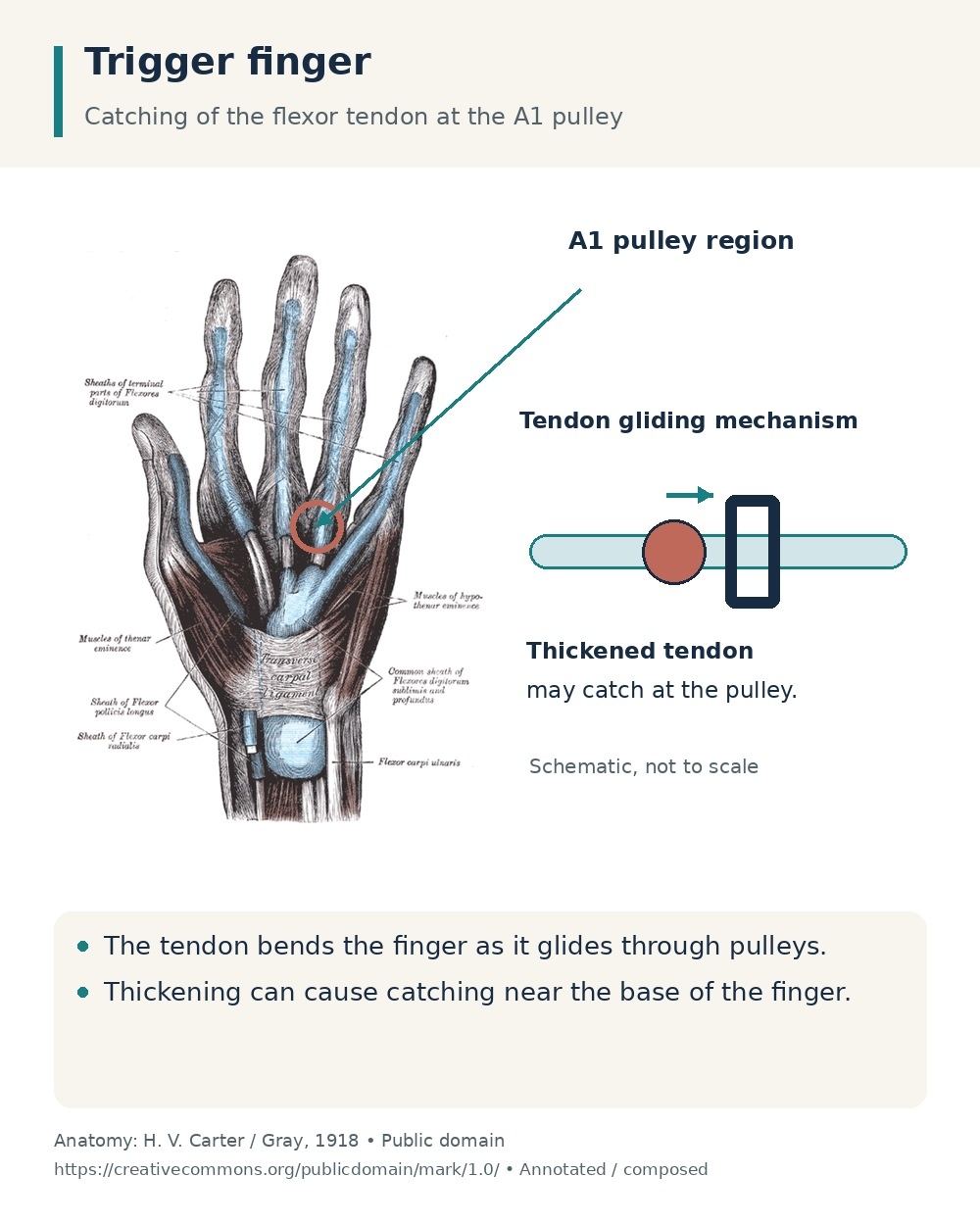
Trigger finger is a common hand condition where a finger or thumb catches, clicks or locks as you bend it — often at its stiffest first thing in the morning. It happens when the flexor tendon at the base of your finger no longer glides smoothly through a snug band of tissue called the A1 pulley.
Our HCPC-registered physiotherapists assess your hand, ease your symptoms with hands-on treatment and splinting guidance, and give you a targeted tendon-gliding programme. Conservative care is typically reviewed over 6–10 weeks, and we will advise you honestly if a steroid injection or surgical opinion is likely to serve you better.
What Is Trigger Finger?
Trigger finger, known medically as stenosing tenosynovitis, occurs when there is a mismatch between the size of a flexor tendon and the tunnel it runs through at the base of your finger. The problem centres on the first annular (A1) pulley — a band of tissue that holds the tendon close to the bone near your knuckle. In trigger finger the A1 pulley thickens and a nodule may form on the tendon, so the tendon snags as it tries to glide, producing the catching, clicking or locking you notice.
Although the name suggests inflammation, the underlying change is better understood as a degenerative, fibrocartilaginous one. Studies of tissue removed at surgery show the A1 pulley undergoes fibrocartilaginous metaplasia and thickening — the pulley wall can become up to three times thicker than normal — while true inflammatory cells are typically not found within the pulley itself (Ryzewicz & Wolf, cited in BSSH BEST guideline, 2016). This helps explain why anti-inflammatory measures alone often have limited effect, and why the condition can be persistent.
Severity is commonly described using the Green or Quinnell grading systems, which run from a painful nodule with no triggering, through triggering you can correct yourself, to a finger that locks in a bent position and must be straightened with your other hand, and finally to a fixed contracture. Higher grades and longer-standing symptoms are associated with less favourable outcomes from conservative care.
Trigger finger is common. It has a reported incidence of around 28 cases per 100,000 people each year and a lifetime risk of about 2.6% in the general population, making it one of the most frequent reasons for referral to a hand clinic (BSSH BEST guideline, 2016). That risk rises to roughly 10% in people living with diabetes (StatPearls, 2024). It most often affects the ring finger and thumb, followed by the middle finger, and usually in the dominant hand.
Do You Experience These Symptoms?
✓ Catching, clicking or snapping as you bend or straighten a finger or thumb
✓ Stiffness and locking that is typically worst first thing in the morning
✓ A tender lump (nodule) in your palm at the base of the affected finger
✓ Pain at the base of the finger, particularly when gripping
✓ The finger locking in a bent position and needing to be gently straightened with your other hand
✓ A sensation of the finger giving way or popping through as it releases
✓ Reduced grip strength, or avoiding tasks such as writing, driving or using tools
These symptoms can be treated.
The sooner you begin, the better your chances of a smoother recovery.
What Causes Trigger Finger?
• Repetitive gripping and hand use
Repeated or forceful gripping places high loads on the A1 pulley where the tendon changes direction.
Occupations and hobbies involving sustained grasping, hand tools or repetitive finger movements are commonly involved.
• Diabetes
Trigger finger is substantially more common in people living with diabetes, with reported prevalence of around 10% compared with roughly 2% in the general population.
The risk relates to how long you have had diabetes and to blood sugar control, and these cases tend to respond less readily to conservative treatment.
• Inflammatory and metabolic conditions
Rheumatoid arthritis, gout, thyroid disease and metabolic syndrome are all associated with trigger finger.
Where one of these is present, we will take it into account when planning your care and when advising on onward referral.
• Age and sex
Trigger finger most often appears between the ages of 40 and 60 and is considerably more common in women.
A separate childhood form affecting the thumb also exists, but it is developmental in origin and managed differently.
• Other hand conditions
Trigger finger frequently occurs alongside carpal tunnel syndrome and De Quervain’s tenosynovitis, and is more common following carpal tunnel release surgery.
If you have had one of these conditions, you may be more prone to the others.
How We Treat Trigger Finger at J&J Therapy
Hands-On Manual Therapy
Our physiotherapists begin with a thorough assessment to confirm the diagnosis, grade your triggering and check for associated conditions such as carpal tunnel syndrome. Hands-on treatment may include soft tissue work around the flexor tendon and palm, gentle mobilisation to maintain finger range of movement, and guided tendon-gliding techniques to encourage smooth gliding through the pulley. We combine this with practical splinting guidance and activity modification, and we will tell you honestly when a steroid injection or surgical opinion is likely to help you more.
Shockwave Therapy*
Swiss Storz Medical MASTERPULS shockwave therapy can be directed at the A1 pulley region, and some small trials suggest it may reduce pain in trigger finger. The evidence is limited and mixed: studies are small and inconsistent, the benefit for hand function is unproven, and shockwave is not recommended for this condition in NHS or UK hand surgery guidance. We do not use it as a first-line treatment, and would only consider it when your assessment indicates it may help, alongside better-established options.
Targeted Exercise Programme
Your targeted programme centres on tendon-gliding exercises, which move the flexor tendons through straight-fist, hook-fist and full-fist positions to encourage smooth gliding beneath the A1 pulley and reduce stiffness. Alongside these, splinting has the strongest supporting evidence in conservative care: reviews recommend wearing an orthosis for 6 to 10 weeks, with consistent day and night wear generally giving better results than night-only use. We fit and review your splint, monitor your skin, and progress your home programme as your symptoms settle.
When to Seek Urgent Medical Help
While most symptoms are not serious, urgent medical attention is required if you experience any of the following:
Your finger is locked and cannot be straightened at all, even gently with your other hand
Signs of infection such as spreading redness, heat, throbbing pain or fever, particularly after an injection or surgery
Sudden loss of hand function, severe pain, or numbness and tingling suggesting nerve involvement
A flare of inflammatory arthritis, with several hot, swollen, painful joints, which needs medical rather than physiotherapy management
FAQs About Trigger Finger
Will trigger finger get better on its own?
Mild cases can settle over a few weeks to months with rest, activity modification and a splint worn overnight. However, symptoms often persist or return, so it is worth having your hand assessed if it is not improving, is locking, or is affecting daily tasks.
Do I need a steroid injection or surgery?
Not necessarily. UK guidance recommends a corticosteroid injection as the usual first-line medical treatment, and surgical release of the A1 pulley is reserved for cases that do not respond to injection or splinting.
Injections tend to be less effective in people with diabetes or long-standing, severe triggering. We will give you an honest view on whether conservative care is worth trying first, or whether you should be referred.
How long does recovery take?
It varies. With conservative treatment such as splinting and activity modification, meaningful improvement is often seen over about 6 to 10 weeks, although it can take longer. Higher-grade triggering, and trigger finger associated with diabetes, tends to take longer and may be less likely to settle without an injection or surgery.
Can shockwave therapy help trigger finger?
Shockwave therapy can be directed at the A1 pulley area, and some small studies suggest it may reduce pain. The evidence is limited and mixed, though: the trials are small and inconsistent, the benefit for hand function is unproven, and shockwave is not recommended for trigger finger in NHS or UK hand surgery guidance.
For that reason we do not offer it as a standard or first-line treatment. If you ask about it, we will assess your hand individually and give you an honest, evidence-based view alongside options with stronger support.
Will wearing a splint help, and how should I wear it?
Splinting is one of the better-supported conservative options, because it stops the tendon repeatedly catching and gives the pulley a chance to settle. Many protocols use consistent wear for at least 6 weeks, and up to 10 weeks. We can advise on the right splint and wear schedule for you and check that it is not irritating your skin.
This page is for general information only and does not replace professional medical advice.
Reviewed by Lavya Arigalayan, MSc, HCPC Registered Physiotherapist.
Last reviewed:
20 August 2026