top of page
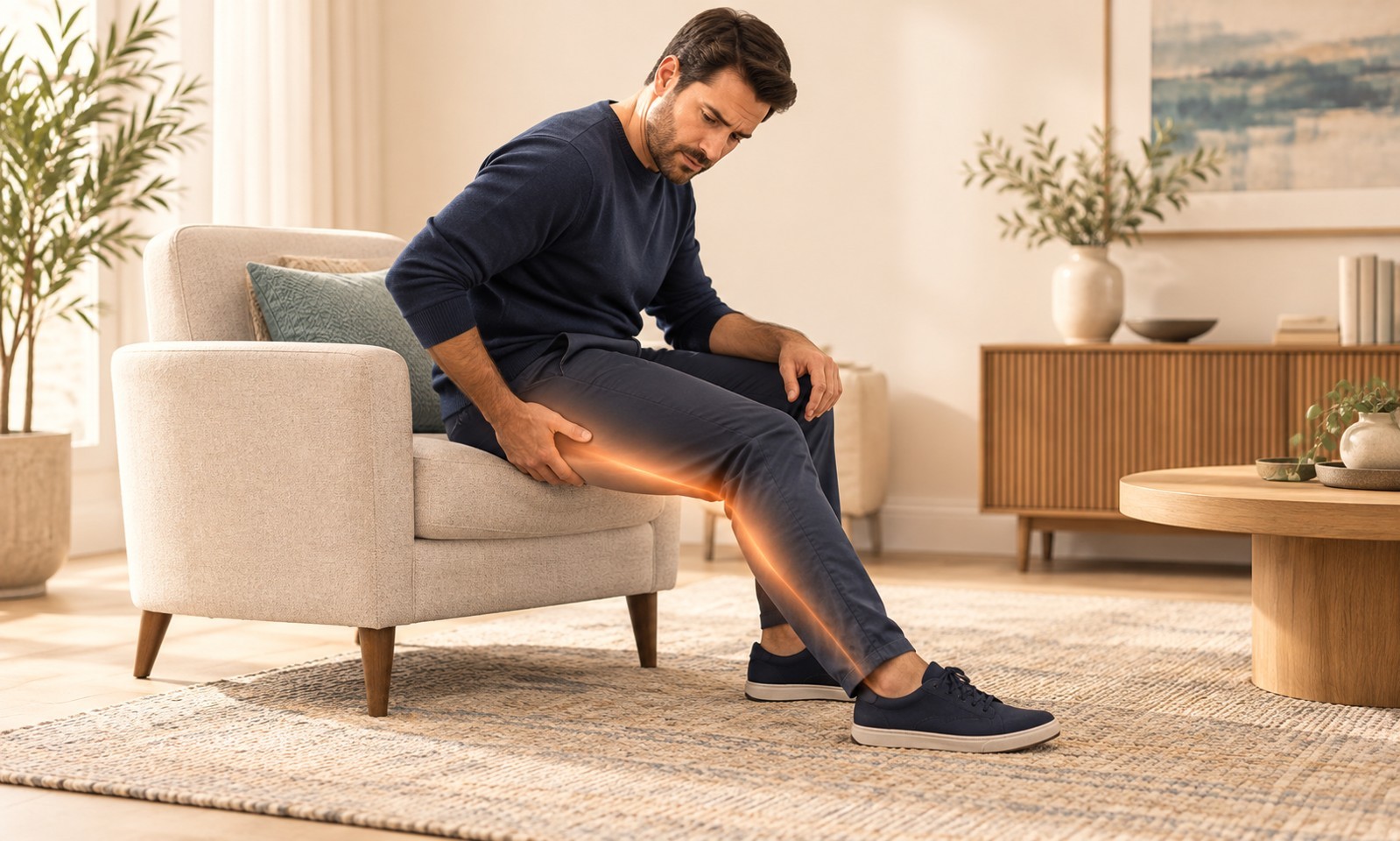
Physiotherapist assessing a patient’s lower back and leg for sciatica at a New Malden clinic

Sciatica

300+ Reviews 5.0

Open 7 Days

10+ Years' Experience

HCPC Physio On Team

Insurance Accepted

85% Return Rate

PHYSIOTHERAPY & THERAPEUTIC MASSAGE IN NEW MALDEN

Quick Summary

Sciatica describes shooting or burning pain that travels from your lower back or buttock down one leg, often with tingling, pins and needles, or numbness. The reassuring news is that most cases settle with active, conservative care, and research suggests the majority of people improve substantially within 6–12 weeks. Our HCPC-registered physiotherapists combine hands-on manual therapy with a graded, individualised exercise programme to help ease your pain and restore confident movement. Most patients attend for a course of around 6–8 sessions, tailored to your assessment findings.

What Is Sciatica?

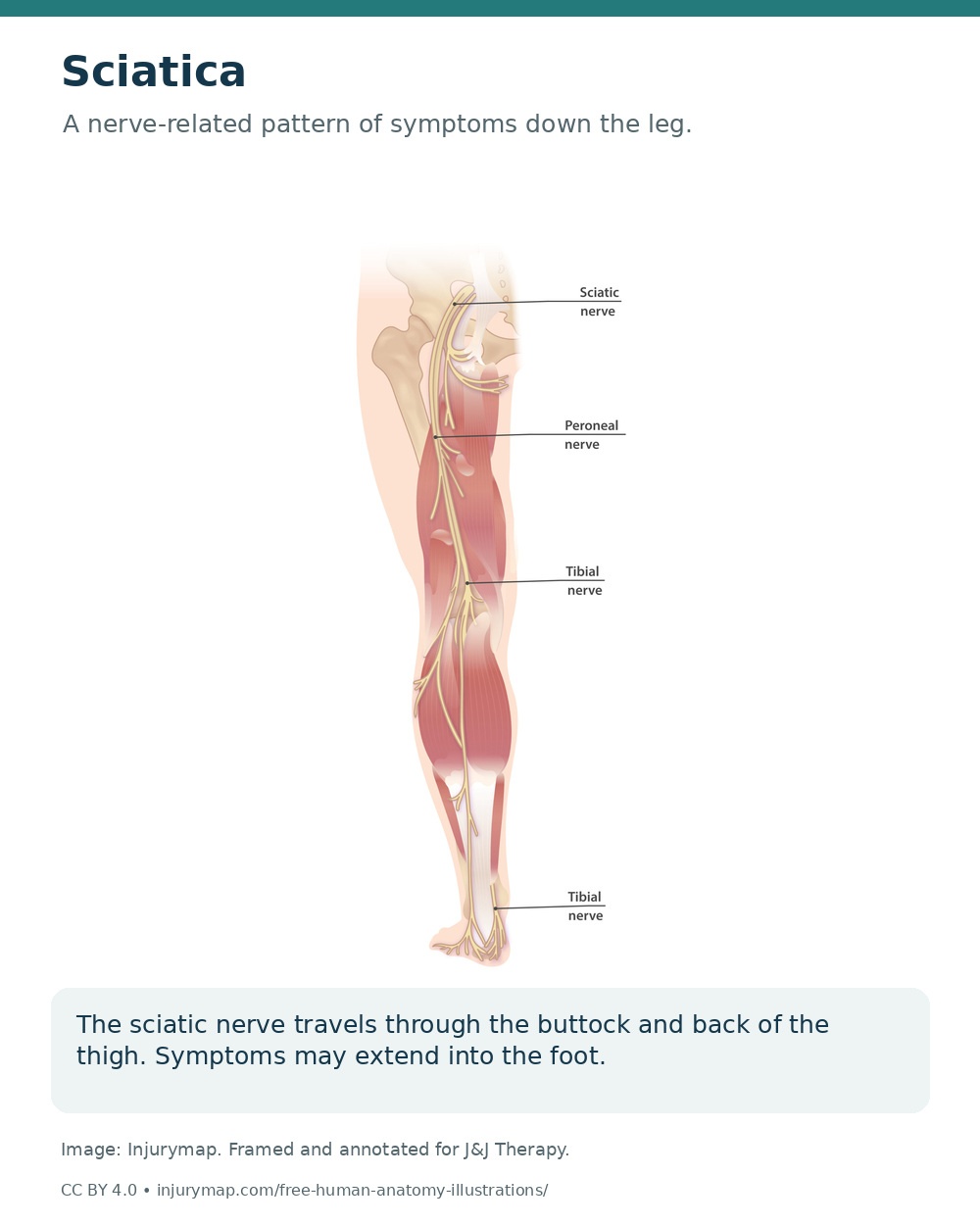
Diagram showing the sciatic nerve running from the lower back through the buttock and down the leg

Sciatica is not a diagnosis in itself but a description of symptoms arising from irritation or compression of the lumbosacral nerve roots — most often L4 to S1 — or the sciatic nerve they form. NICE uses the term sciatica to describe leg pain secondary to lumbosacral nerve root pathology, although radicular pain and radiculopathy are the more precise clinical terms (NICE, NG59, 2016, updated 2020).


An important distinction is between radicular pain and referred pain. Radicular pain is generated by an affected nerve root and is typically sharp, shooting, or burning, radiating below the knee in a dermatomal pattern. Referred pain is a duller ache arising from the joints, discs, or muscles of the back and buttock, and does not usually travel below the knee. This distinction matters, because the two respond to different treatment approaches.


Common underlying causes

A herniated intervertebral disc accounts for roughly 90% of cases, and around 95% of lumbar disc herniations occur at the L4–L5 or L5–S1 levels (NICE CKS, Sciatica, 2025). Lumbar spinal stenosis, a narrowing of the spinal canal, is more common in older adults. Spondylolisthesis and degenerative spinal change can also narrow the space around a nerve root. Less commonly, the sciatic nerve is irritated outside the spine in the buttock itself — for example in piriformis syndrome or deep gluteal syndrome, which together are thought to account for only a small minority of presentations.


What to expect from recovery

The outlook for sciatica is generally favourable. Most acute, disc-related cases improve significantly within 6–12 weeks, partly because herniated disc material tends to shrink naturally over time through a process called resorption. A meta-analysis found that spontaneous resorption occurred in 66.7% of lumbar disc herniations, with larger herniations tending to resorb more completely (Zhong et al., Pain Physician, 2017). A minority of people develop persistent or recurrent symptoms, and this is where structured physiotherapy has most to offer.

Do You Experience These Symptoms?

✓  Shooting, burning, or electric shock-like pain radiating from your lower back or buttock down the back of one leg

✓  Tingling, pins and needles, or numbness in your leg or foot

✓  Pain that is often worse when sitting, bending, coughing, or sneezing

✓  Weakness or a feeling of heaviness in the affected leg

✓  Symptoms that usually affect one side only

✓  Leg pain reproduced when your straight leg is raised while lying on your back

✓  A dull, aching component in your lower back or buttock alongside the leg pain

These symptoms can be treated.
The sooner you begin, the better your chances of a smoother recovery.

What Causes Sciatica?

•  Lumbar disc herniation — the most common cause

Age-related degeneration or, less often, a sudden strain can allow the soft inner disc material to bulge and press on a nearby nerve root.

This is the single most common cause of sciatica and typically affects people in their thirties, forties, and fifties.


•  Lumbar spinal stenosis

Gradual narrowing of the spinal canal, or of the openings where nerves exit the spine, can compress the nerve roots.

It becomes more common with age and tends to cause leg symptoms that worsen with walking or standing and ease with sitting or bending forward.


•  Spondylolisthesis and degenerative change

When one vertebra slips forward on another, or arthritic change narrows the space around a nerve, the nerve root can become irritated.

These structural changes usually develop slowly over many years rather than appearing suddenly.


•  Extraspinal or deep gluteal causes

In some people the sciatic nerve is irritated in the buttock itself — for example by the piriformis muscle or by fibrous bands within the deep gluteal space.

These soft-tissue causes are far less common than disc-related sciatica, but identifying them matters because their management differs.


•  Contributing lifestyle and occupational factors

Prolonged sitting, heavy or repetitive lifting, sudden twisting movements, and long periods of inactivity can all increase the load on your lower back.

These factors rarely cause sciatica on their own, but they often contribute to a first episode or to a recurrence.

Not sure which condition applies to you?

How We Treat Sciatica at J&J Therapy

Hands-On Manual Therapy

Our physiotherapists use hands-on techniques as part of an active, exercise-based plan rather than in isolation, in line with NICE guidance. Depending on your assessment, we may use neural mobilisation — gentle nerve-gliding techniques that help the sciatic nerve move more freely within the surrounding tissues — alongside lumbar and hip joint mobilisation to restore comfortable movement, and soft tissue work to the muscles of the back, buttock, and hip. Research suggests neural mobilisation may reduce pain and disability in lumbar radicular pain (Lin et al., Life, 2023).

Shockwave Therapy*

Swiss Storz Medical MASTERPULS
is not a first-line treatment for sciatica, and we do not apply it over the spine or a compressed nerve.
Where your assessment identifies a muscular or myofascial contribution in the buttock or hip, radial shockwave may be considered as an adjunct to your exercise programme.
Research in these soft tissue conditions suggests it may help, though the evidence base remains limited.

Targeted Exercise Programme

Staying active is one of the most effective things you can do for sciatica, and prolonged bed rest is unhelpful. We design a graded programme that typically begins with gentle nerve-gliding exercises and pain-easing positions guided by your directional preference — the movement direction that reduces or centralises your leg pain. As your symptoms settle, we progress to core, gluteal, and hip strengthening with mobility work for the lumbar spine and hips. The final phase focuses on functional loading, lifting technique, and a confident return to work, sport, and daily activities, with strategies to reduce the risk of recurrence.

When to Seek Urgent Medical Help

While most symptoms are not serious, urgent medical attention is required if you experience any of the following:

  • Loss of bladder or bowel control, difficulty passing urine, or new incontinence

  • Numbness or altered sensation around your inner thighs, buttocks, genitals, or back passage

  • Numbness, tingling, or weakness affecting both legs, or symptoms that are rapidly worsening

  • Progressive or severe leg weakness, including being unable to lift your foot

These symptoms may indicate cauda equina syndrome, a rare but serious compression of the nerves at the base of your spine. Call 999 or go to A&E immediately. Also seek prompt medical advice if your pain follows a significant injury, or is accompanied by fever, unexplained weight loss, or a history of cancer.

FAQs About Sciatica

  • How long does sciatica take to get better?

Most people improve substantially within 6–12 weeks, and many recover without any surgery — partly because herniated disc material tends to shrink naturally over time. Staying active and following a structured exercise programme generally leads to better outcomes than rest. A minority of cases persist for longer, and we will adjust your plan accordingly.


  • Do I need a scan or MRI for sciatica?

Usually not. NICE advises against routine imaging for sciatica in non-specialist settings, because a scan is only helpful when the result would change your management. Disc bulges are commonly seen on scans of people with no pain at all. Your physiotherapist can assess sciatica clinically and will arrange onward referral if imaging is genuinely needed.


  • Can physiotherapy really help sciatica?

Yes. Evidence supports active, exercise-based rehabilitation combined with hands-on manual therapy for sciatica, and techniques such as neural mobilisation may help reduce pain and disability. Our role is to help relieve your symptoms, restore movement and confidence, and reduce the chance of the problem returning.


  • Is shockwave therapy used for sciatica?

Not as a first-line treatment, and never over the spine or a compressed nerve. Where your sciatica is caused by nerve root pressure at the spine, current evidence does not support shockwave, so we rely on manual therapy and exercise. Where assessment identifies a muscular or myofascial contribution in the buttock or hip, radial shockwave with the Swiss Storz Medical MASTERPULS may be considered as an adjunct. The evidence here is still limited, so we only recommend it when it suits your specific presentation.


  • What can I do at home to ease sciatica?

Keep moving within your comfort, avoid prolonged sitting or bed rest, and use the positions and gentle exercises that ease your leg symptoms. Heat can help some people. Your physiotherapist will give you a personalised home programme. If your symptoms are worsening, or you develop any of the urgent warning signs listed above, seek medical help straight away.

Not sure this condition matches your symtoms?
Find your condition and explore related pain areas.

Logo_Navy.png

Ready to start your recovery?
Book your Initial Assessment today.

This page is for general information only and does not replace professional medical advice.

Reviewed by Lavya Arigalayan, MSc, HCPC Registered Physiotherapist.

Last reviewed

20 August 2026

bottom of page