top of page
Physiotherapist in New Malden assessing a patient shoulder blade movement during arm elevation for scapular dyskinesis

Scapular Dyskinesis

300+ Reviews 5.0

Open 7 Days

10+ Years' Experience

HCPC Physio On Team

Insurance Accepted

85% Return Rate

PHYSIOTHERAPY & THERAPEUTIC MASSAGE IN NEW MALDEN

Quick Summary

Scapular dyskinesis describes an altered resting position or movement pattern of your shoulder blade (scapula) — most often seen as the blade winging out, sitting lower, or moving unevenly when you raise your arm. It is best understood as a movement fault or impairment rather than a disease in its own right, and research suggests it responds well to assessment-led physiotherapy centred on targeted exercise and hands-on treatment. Most patients we see need around 6–12 sessions over 8–12 weeks, depending on your goals, how long symptoms have been present, and whether an associated shoulder condition is involved.

What Is Scapular Dyskinesis?

Diagram of the shoulder blade showing serratus anterior, trapezius and pectoralis minor and normal movement during arm raising

Your scapula (shoulder blade) is the foundation of shoulder movement. It is anchored to your trunk almost entirely by muscle, and it must rotate upwards, tilt backwards and rotate outwards in a smooth, coordinated sequence with your arm bone — a partnership known as the scapulohumeral rhythm — so that the shoulder socket stays well positioned as you lift. When the muscles controlling the blade lose their coordination or endurance, this rhythm breaks down and the blade moves abnormally. This is scapular dyskinesis.


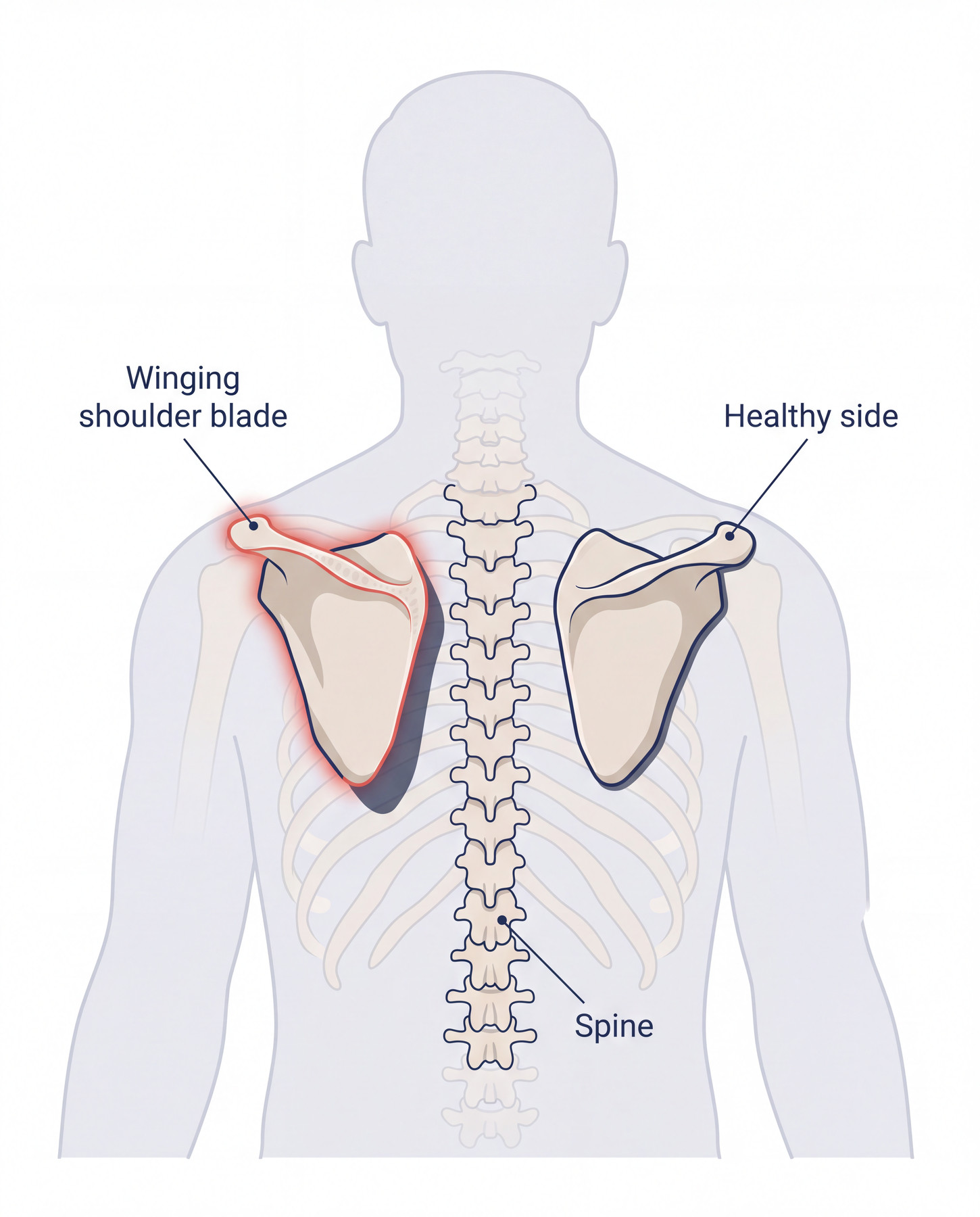
The key muscles involved are the serratus anterior, which holds the inner border of the blade flat against your ribcage, and the lower and middle trapezius, which rotate and steady the blade as your arm rises. A tight pectoralis minor at the front of the chest or a stiff posterior shoulder can pull the blade forward into excessive tilt and protraction (Kibler and Sciascia, British Journal of Sports Medicine, 2010). The visible faults are commonly described as winging, where the inner border or lower tip lifts away from the ribcage; tipping, where the top of the blade tilts forwards; and protraction, where the whole blade slides forwards around the ribcage.


Clinicians once sorted these patterns into three types — lower tip prominence, inner border prominence, and early shrugging with upper border prominence (Kibler et al., Journal of Shoulder and Elbow Surgery, 2002). Because these subtypes proved difficult to tell apart reliably, a simpler approach of judging whether obvious dyskinesis is present or absent is now more widely used (McClure et al., Journal of Athletic Training, 2009). At the more severe end of the spectrum sits SICK scapula syndrome, an overuse presentation described in throwing and overhead athletes (Burkhart et al., Arthroscopy, 2003).


An international consensus concluded that scapular dyskinesis is most appropriately viewed as a potential impairment to shoulder function rather than a diagnosis in itself, and that its exact role in creating or worsening shoulder problems is not clearly defined (Kibler et al., British Journal of Sports Medicine, 2013). We think it is important to be honest about this: abnormal scapular movement is common in people with no pain at all, and it is far more frequent in overhead athletes, at 61%, than in other athletes, at 33% (Burn et al., Orthopaedic Journal of Sports Medicine, 2016). The research is also genuinely divided on whether it predicts future shoulder pain — one meta-analysis found a 43% greater relative risk (Hickey et al., British Journal of Sports Medicine, 2018), while a later, larger analysis of 923 athletes found no significant association (Hogan et al., American Journal of Sports Medicine, 2021). Our physiotherapists therefore treat the scapula where assessment shows it is genuinely relevant to your symptoms, rather than simply because a blade looks asymmetrical.

Do You Experience These Symptoms?

✓  You notice your shoulder blade sticking out, winging, or sitting lower than the other side

✓  Your shoulder aches or feels weak when you lift your arm overhead, throw, or carry heavy loads

✓  You feel catching, snapping or grinding around the shoulder blade as your arm moves

✓  You experience a dead arm, heaviness or early fatigue during repeated overhead activity or sport

✓  You have pain or tenderness at the top or back of the shoulder blade, or at the front of the shoulder

✓  Your shoulder movement feels uneven or effortful, as though you have to shrug to get your arm up

✓  Your symptoms ease when someone gently supports or repositions your shoulder blade for you

These symptoms can be treated.
The sooner you begin, the better your chances of a smoother recovery.

What Causes Scapular Dyskinesis?

•  Muscle weakness and imbalance

Weakness or delayed activation of the serratus anterior and lower trapezius, often paired with an overactive upper trapezius, disrupts the muscular partnerships that steady your shoulder blade.

This imbalance is one of the most consistently observed features in shoulders with dyskinesis (Kibler and Sciascia, British Journal of Sports Medicine, 2010).


•  Soft-tissue tightness

A short, tight pectoralis minor or a stiff posterior shoulder pulls the blade into forward tilt and protraction, reducing the space through which your rotator cuff tendons pass.

People with a short pectoralis minor show altered scapular mechanics similar to those seen in subacromial shoulder pain (Borstad and Ludewig, Journal of Orthopaedic and Sports Physical Therapy, 2005).


•  Overuse in overhead activity

Repetitive throwing, swimming, racquet sport or overhead work fatigues the scapular stabilising muscles and drives compensatory movement patterns.

Reported prevalence is markedly higher in overhead athletes, at 61%, than in non-overhead athletes, at 33% (Burn et al., Orthopaedic Journal of Sports Medicine, 2016).


•  Pain or injury elsewhere in the shoulder

Dyskinesis often arises as a response to another problem such as rotator cuff-related pain, instability or stiffness, because pain inhibits normal muscle activation.

In these cases the abnormal movement is frequently a consequence rather than the root cause of your shoulder trouble (Kibler et al., British Journal of Sports Medicine, 2013).


•  Posture and the kinetic chain

An increased upper back curve, rounded shoulders, or reduced contribution from your trunk and hips alters the resting position of the blade and the base it moves on.

Previous bony injuries such as a healed collarbone fracture or an acromioclavicular joint problem can also change how the shoulder blade moves.


Not sure which condition applies to you?

How We Treat Scapular Dyskinesis at J&J Therapy

Hands-On Manual Therapy

Our HCPC-registered physiotherapists use hands-on techniques to prepare you for your active programme, never as a stand-alone treatment. Where assessment identifies specific restrictions, we use soft-tissue release and stretching of a tight pectoralis minor, upper trapezius and levator scapulae, together with thoracic spine mobilisation to free the base the shoulder blade moves on. We also use scapular assistance and repositioning tests during assessment to check whether correcting the position of your blade actually reduces your symptoms, which helps us target treatment precisely. Evidence suggests manual therapy adds most value when it is combined with exercise rather than delivered alone.

Shockwave Therapy*

Shockwave therapy is not a treatment for scapular dyskinesis itself, which is a movement-control problem best addressed with exercise and manual therapy. Our Swiss Storz Medical MASTERPULS system may complement your manual therapy and exercise programme when your physiotherapist identifies a specific co-existing indication during assessment, such as a rotator cuff tendinopathy or a persistent trigger point. Non-invasive and evidence-based for those specific tendon conditions, although current evidence does not show it changes scapular movement patterns directly. We will only recommend it when your assessment supports it.

Targeted Exercise Programme

Exercise is the primary, evidence-based treatment for scapular dyskinesis and it is where most of your care will focus. Your programme is tailored and progressed by your physiotherapist, and typically includes scapular motor-control retraining using tactile and visual feedback; progressive strengthening of the serratus anterior and lower and middle trapezius; flexibility work for the pectoralis minor and posterior shoulder where genuine tightness is found; thoracic mobility and trunk and hip conditioning, because your shoulder blade depends on a stable, mobile base; and graded, sport-specific loading if you return to overhead sport. We are honest that scapula-specific exercise has not been shown to be clearly superior to well-designed general shoulder exercise — what matters most is a properly loaded, progressive programme you can stick to.

When to Seek Urgent Medical Help

While most symptoms are not serious, urgent medical attention is required if you experience any of the following:

  • Sudden or obvious winging of the shoulder blade after an injury or viral illness, particularly with weakness lifting your arm forwards, which needs medical assessment for a possible nerve injury

  • A drooping shoulder with an uneven neckline and winging, especially after neck surgery, a biopsy or trauma to the back of the neck

  • Significant trauma with loss of active shoulder movement, or a hot, swollen shoulder with fever, or an unexplained lump or swelling

  • Numbness, pins and needles or arm weakness that is spreading or worsening rather than settling

FAQs About Scapular Dyskinesis

  • Is scapular dyskinesis a serious injury?

No — it is a movement fault or impairment rather than an injury or disease in its own right. Many people have it with no symptoms at all, and it is found even in healthy shoulders. It becomes clinically relevant when it is linked to your pain, weakness or loss of function, which is exactly what our assessment is designed to establish.


  • Does an abnormal-looking shoulder blade mean it is causing my pain?

Not necessarily. The relationship between scapular dyskinesis and shoulder pain is genuinely debated: abnormal scapular movement is common in pain-free people, and large studies disagree on whether it predicts future problems. One meta-analysis found a 43% greater relative risk of future pain (Hickey et al., British Journal of Sports Medicine, 2018), while a larger analysis of 923 athletes found no significant association (Hogan et al., American Journal of Sports Medicine, 2021). We use symptom-modification tests to check whether repositioning your shoulder blade actually changes your symptoms before building treatment around it.


  • How reliable is the assessment of scapular dyskinesis?

Visual assessment is useful but imperfect. Simple present-or-absent judgements achieve satisfactory agreement between clinicians, while distinguishing the older subtypes is less reliable (McClure et al., Journal of Athletic Training, 2009). This is why our physiotherapists combine observation with a full clinical assessment of your strength, flexibility and function rather than relying on appearance alone.


  • Can shockwave therapy treat my scapular dyskinesis?

Shockwave does not treat the movement-control problem itself, and there is no evidence that it changes scapular movement patterns. Scapular dyskinesis is best managed with exercise and manual therapy. Our Swiss Storz Medical MASTERPULS shockwave may be offered as a complement only if your assessment reveals a separate condition that responds to it, such as a rotator cuff tendinopathy. We will discuss this with you honestly if it applies.


  • How long will it take to improve?

Many people notice meaningful improvement within a few weeks of consistent, progressive exercise, with fuller strength and control developing over roughly 8–12 weeks. Overhead athletes returning to sport may need longer. Consistency with your home programme matters more than intensity, and we cannot promise a specific outcome — but research suggests exercise-led rehabilitation may help reduce pain and improve function.


Not sure this condition matches your symtoms?
Find your condition and explore related pain areas.

Logo_Navy.png

Ready to start your recovery?
Book your Initial Assessment today.

This page is for general information only and does not replace professional medical advice.

Reviewed by Lavya Arigalayan, MSc, HCPC Registered Physiotherapist.

Last reviewed

20 August 2026

bottom of page