Quick Summary
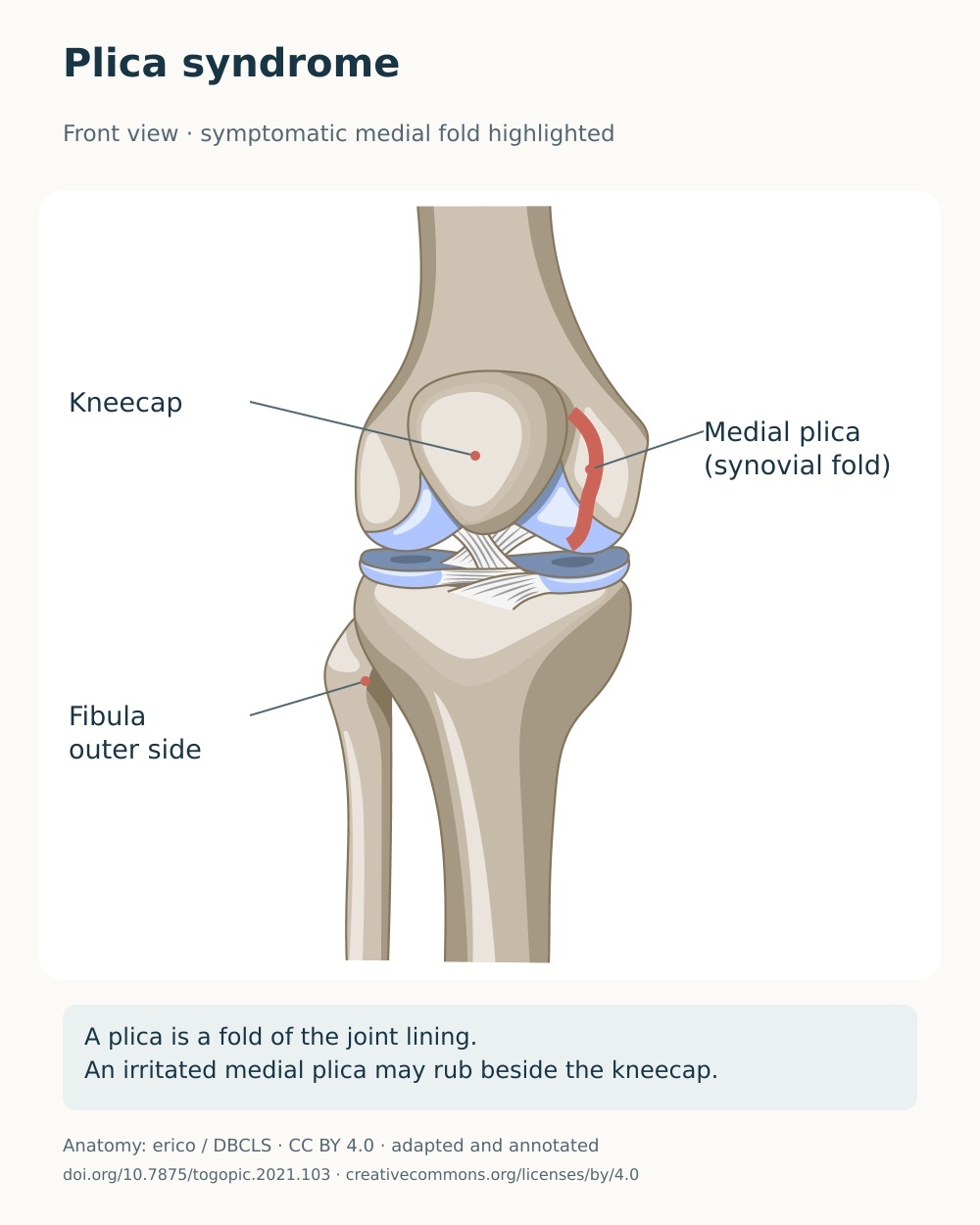
Plica syndrome is anteromedial knee pain caused by a normally harmless fold of joint lining that has become irritated, thickened and inflamed, producing clicking, catching and a dull ache.
It is easily confused with other knee problems, so an accurate assessment matters. With hands-on manual therapy and a targeted exercise programme, many people notice meaningful improvement within approximately six to eight weeks, and we add further adjuncts only where your assessment indicates they may help.
What Is Plica Syndrome?
Synovial plicae are folds of the knee’s joint lining, widely believed to be remnants of the membranous walls that divide the developing knee into separate compartments before birth. Where these membranes are not fully reabsorbed, a plica persists into adult life. Four are described by location: suprapatellar, medial (mediopatellar), infrapatellar and lateral.
Having a plica is entirely normal. A large arthroscopic study of 3,889 knees identified a medial plica in around 80% of them (Nakayama et al., Arthroscopy, 2011), and most cause no trouble at all. We only speak of plica syndrome when a plica becomes symptomatic.
The medial plica is the one most often involved, because it sits where it can be pinched between the inner thigh bone and the edge of the kneecap. Through repetitive microtrauma, a direct blow or overuse, a soft and elastic fold may become thickened, fibrotic and inelastic. Once stiffened, it no longer glides smoothly and instead catches through roughly 30 to 60 degrees of bending, producing pain and a snapping sensation. Where this continues over a long period, research suggests it may contribute to secondary wear of the nearby joint cartilage.
Plica syndrome is essentially a diagnosis of exclusion. Its symptoms overlap closely with patellofemoral pain, medial meniscal tears and chondromalacia patellae, and a plica seen on a scan is not proof that it is causing your pain. Evidence shows both conservative and surgical management improve knee function, with no clear advantage for either approach at 12 to 24 months (Franco et al., Journal of Experimental Orthopaedics, 2025), which is why we begin with physiotherapy.
Do You Experience These Symptoms?
✓ An ache on the inner front of your knee, along the border of the kneecap
✓ Clicking, snapping or catching felt just inside the kneecap as you bend and straighten
✓ Stiffness and soreness after sitting with the knee bent for a long time, such as in a cinema or on a long journey
✓ Pain on stairs, squatting or kneeling
✓ A firm, tender cord that can sometimes be felt rolling under the fingers beside the kneecap
✓ A sensation of the knee briefly catching or giving way
✓ Mild swelling that comes and goes with activity
These symptoms can be treated.
The sooner you begin, the better your chances of a smoother recovery.
What Causes Plica Syndrome?
• Repetitive bending and straightening
Running, cycling and rowing involve repeated knee flexion that creates friction across the plica.
Over time this may inflame and thicken a fold that previously caused no symptoms.
• A direct blow to the front of the knee
Falling onto the knee or taking an impact can acutely irritate the plica.
Blunt trauma to the anterior knee is one of the most commonly reported triggers.
• Scarring after surgery or bleeding into the joint
Previous knee arthroscopy or bleeding within the joint can set off inflammation and scarring.
This process may convert a pliable fold into a stiff, fibrotic and painful one.
• Quadriceps weakness and altered alignment
Weakness of the inner quadriceps and poor kneecap tracking increase abnormal contact between the plica and the thigh bone.
This is a key reason targeted strengthening sits at the centre of your recovery.
• A sudden increase in training load
A rapid rise in mileage, intensity or frequency without adequate adaptation time can tip a quiet plica into a painful one.
Managing load is therefore both a cause to address and a useful treatment lever.
How We Treat Plica Syndrome at J&J Therapy
Hands-On Manual Therapy
Our physiotherapists begin with a careful assessment to distinguish plica syndrome from the conditions it mimics. We then use soft tissue techniques directed at the medial retinaculum and the plica itself, patellar mobilisations to improve how your kneecap tracks, and myofascial release of the quadriceps, iliotibial band and adductors. Gentle joint mobilisation and supportive taping may be added where appropriate; research suggests taping alongside exercise may improve pain and function more than exercise alone.
Shockwave Therapy*
Swiss Storz Medical MASTERPULS radial shockwave therapy may be considered as a second-line adjunct where persistent plica-related pain has not settled with manual therapy and exercise. We are candid that there are currently no clinical trials of shockwave specifically for plica syndrome, so its use here draws on indirect evidence from related knee conditions and on its role in remodelling thickened, fibrotic tissue. Non-invasive, and always combined with your rehabilitation programme rather than used on its own, following assessment.
Targeted Exercise Programme
A structured, progressive exercise programme is the cornerstone of recovery. We typically build a plan around quadriceps and inner-thigh (VMO) strengthening to improve kneecap tracking, hip abductor and external rotator work to control lower limb alignment, and flexibility for the hamstrings and iliotibial band. We introduce gradual loading rather than sudden jumps, pair it with sensible activity modification, and progress you through a staged return to sport as your symptoms allow.
When to Seek Urgent Medical Help
While most symptoms are not serious, urgent medical attention is required if you experience any of the following:
Your knee genuinely locks and you cannot straighten it
Rapid, tense swelling of the knee after an injury
A hot, red, swollen joint, particularly with a fever or feeling unwell
You cannot put weight through the leg, or the knee feels unstable and unsafe
FAQs About Plica Syndrome
How is plica syndrome diagnosed, and how is it told apart from a meniscal tear?
Diagnosis is largely clinical and is essentially one of exclusion, because a plica seen on a scan is not proof that it is causing your pain. We take a careful history and feel for a tender cord beside the kneecap while moving the knee.
Plica pain tends to sit along the inner capsule, often above the joint line, with clicking or catching. A meniscal tear more often follows a twisting injury, causes joint-line tenderness and can produce true locking. Scans help rule out other causes.
How long does it take to get better with physiotherapy?
Many people improve over approximately six to eight weeks of consistent conservative treatment, though this varies with how long you have had symptoms and how irritable your knee is.
A shorter symptom duration tends to predict a better response. Sticking with your exercise programme is the single biggest factor in your recovery.
Will I need surgery, and should I try physiotherapy first?
Most people do not need surgery. Evidence shows that both conservative and surgical management improve knee function, with no clear advantage for either at 12 to 24 months (Franco et al., Journal of Experimental Orthopaedics, 2025).
Arthroscopic resection is generally reserved for cases that have not responded to a proper trial of physiotherapy, usually three to six months, particularly where a thickened fold is catching persistently.
Can I keep running or cycling while I recover?
Often you can continue some activity, though usually at a reduced level and with modifications, because repetitive knee bending is a common driver of the problem.
We will help you adjust your training load, technique and volume rather than stopping altogether where possible. If a particular activity sharply provokes the clicking and pain, that is a signal to ease off it for a while.
Can shockwave therapy treat my plica syndrome?
It may be considered as a second-line option, but we should be honest that the evidence is limited. There are currently no clinical trials of shockwave therapy specifically for plica syndrome, and it does not appear on the international list of recognised shockwave indications.
What we do have is indirect evidence from related knee conditions, together with shockwave’s role in remodelling thickened, fibrotic tissue. We therefore consider our Swiss Storz Medical MASTERPULS device only as an assessment-based adjunct for stubborn cases, always alongside your rehabilitation rather than instead of it.
This page is for general information only and does not replace professional medical advice.
Reviewed by Lavya Arigalayan, MSc, HCPC Registered Physiotherapist.
Last reviewed:
20 August 2026