top of page
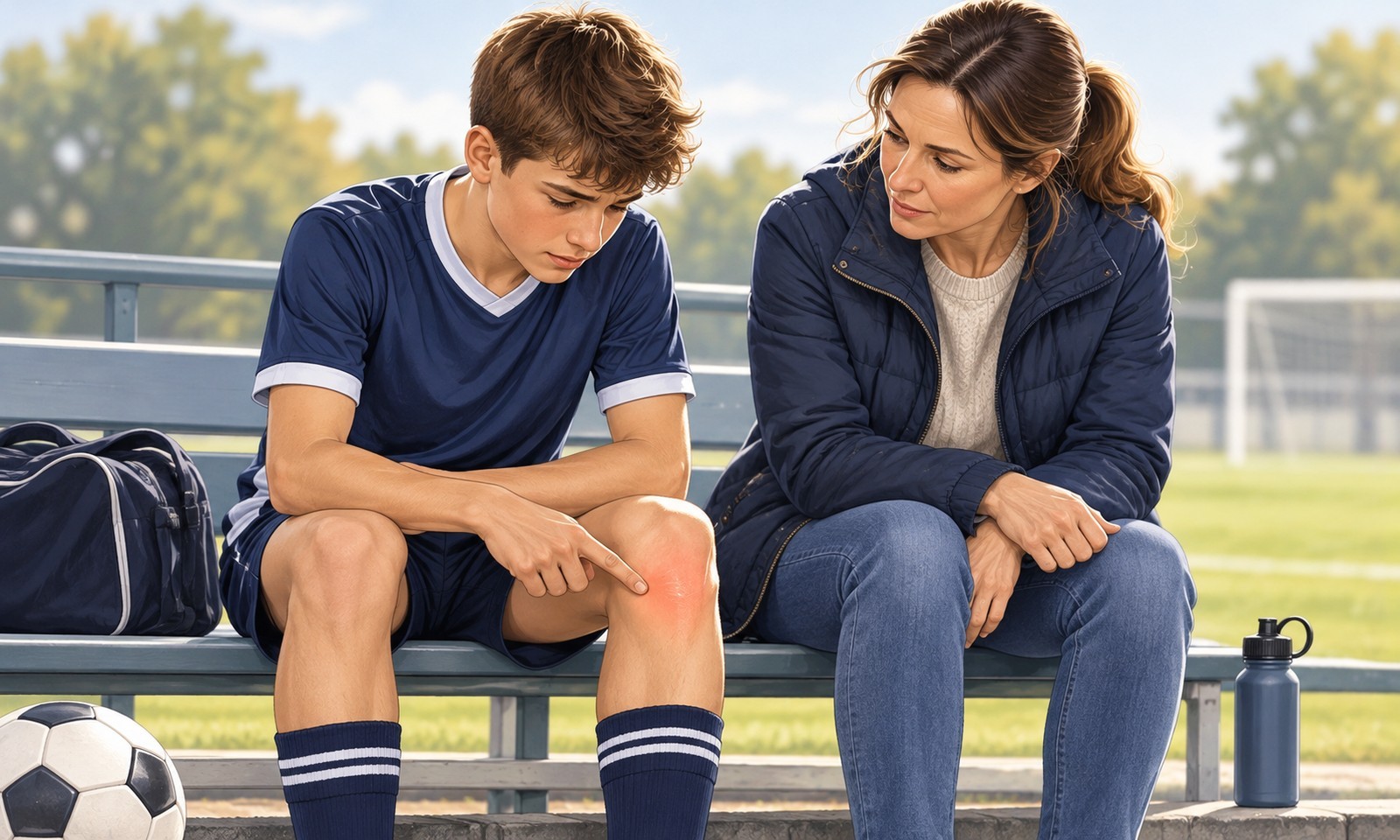
Physiotherapist assessing the knee of a teenage athlete with Osgood-Schlatter disease at J&J Therapy clinic in New Malden

Osgood-Schlatter Disease

300+ Reviews 5.0

Open 7 Days

10+ Years' Experience

HCPC Physio On Team

Insurance Accepted

85% Return Rate

PHYSIOTHERAPY & THERAPEUTIC MASSAGE IN NEW MALDEN

Quick Summary

Osgood-Schlatter disease is one of the most common causes of knee pain in active, growing teenagers, producing a tender bony lump just below the kneecap that flares with running, jumping and kneeling.


The reassuring news is that it responds well to guided, non-invasive care. Our physiotherapists focus on activity and load management, targeted stretching and strengthening, and a structured return to sport.


Most young people notice meaningful improvement over a course of care. We typically recommend an initial programme of around 6–8 sessions across 8–12 weeks, with home exercises reviewed and progressed at each visit.

What Is Osgood-Schlatter Disease?

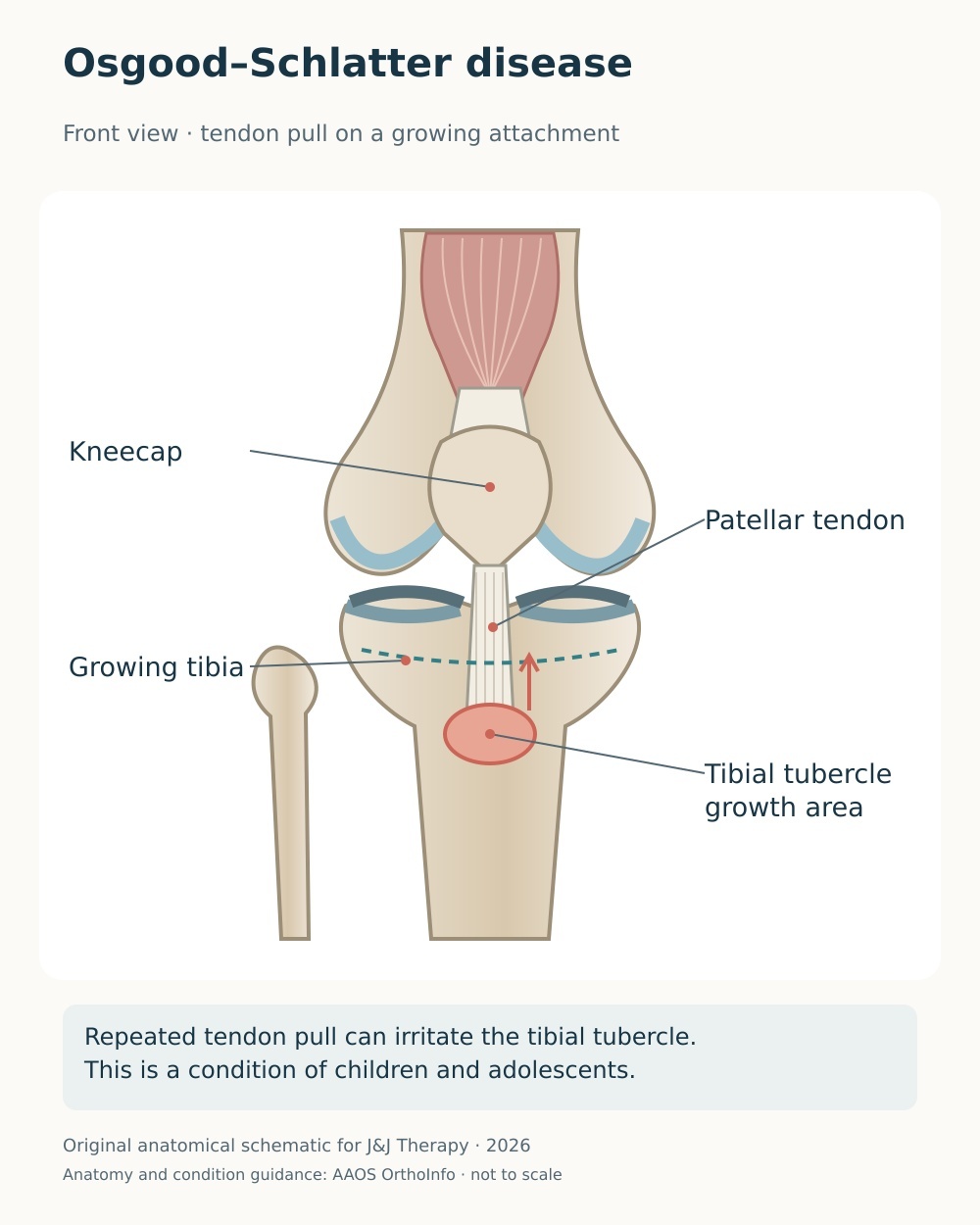
Anatomical diagram showing the patellar tendon attaching to the tibial tuberosity growth plate in an adolescent knee

Osgood-Schlatter disease is a traction apophysitis of the tibial tuberosity — the bony prominence just below the kneecap where the powerful patellar tendon attaches to the shin bone. During the adolescent growth spurt, repeated pulling of the patellar tendon on the still-developing growth centre causes microtrauma, inflammation, pain and swelling at this site (Smith & Varacallo, StatPearls, 2024).


It is essentially an overuse injury of a growing skeleton, provoked by activities that repeatedly load the knee extensor muscles, such as sprinting, jumping and kicking. Symptoms characteristically arise while the tuberosity has not yet hardened enough to resist tendon traction, and usually settle once skeletal maturity is reached and the growth plate closes.


Onset tracks the growth spurt and differs between the sexes, typically occurring at around 8–13 years in girls and 10–15 years in boys. In adolescents aged 12–15 the prevalence is approximately 9.8%, and the condition is more common in athletes than non-athletes, with rates of 7–21% reported in athletic adolescents (Smith & Varacallo, StatPearls, 2024). Football and basketball are the sports most frequently associated with it, and both knees are affected in 20–30% of cases.


Although long regarded as entirely self-limiting, research suggests the picture is not always so straightforward. One study found that 60.5% of patients still reported knee pain a median of almost four years after diagnosis (Guldhammer et al., Orthopaedic Journal of Sports Medicine, 2019). A minority are left with a persistent bony prominence and ongoing symptoms into adulthood, which is why we discuss expectations openly with families rather than simply advising you to wait it out.

Do You Experience These Symptoms?

✓  You feel pain and tenderness over the bony bump just below your kneecap, at the top of the shin

✓  You notice a firm, sometimes enlarging lump over the tibial tuberosity that is sore to press or kneel on

✓  Your pain worsens with running, jumping, squatting, kneeling and going up or down stairs, and eases with rest

✓  You feel tightness in the muscles at the front (quadriceps) and back (hamstrings) of your thigh

✓  Your knee aches after sport or activity, and the area may look mildly swollen

✓  You may have symptoms in both knees, as 20–30% of young people are affected on both sides

✓  Your discomfort comes and goes, flaring during busy training periods and settling during quieter spells

These symptoms can be treated.
The sooner you begin, the better your chances of a smoother recovery.

What Causes Osgood-Schlatter Disease?

•  Adolescent growth spurt

During rapid growth the bones lengthen faster than the surrounding muscles can adapt.

This leaves the quadriceps and patellar tendon relatively tight, increasing traction on the vulnerable tibial tuberosity.


•  Repetitive sporting load

Running, jumping and kicking sports repeatedly contract the quadriceps and tug on the tendon attachment.

This cumulative overload is the main driver of the apophysitis.


•  An immature tibial tuberosity

Before it fully hardens, the tuberosity is a relative weak link in the knee extensor mechanism.

Repeated pulling causes microtrauma and inflammation at the growth centre.


•  Muscle tightness and biomechanics

Reduced quadriceps and hamstring flexibility and altered lower-limb mechanics increase the strain transmitted to the tuberosity.

Addressing these factors is central to reducing symptoms.


•  Rapid increases in training

Sudden rises in training volume, intensity or frequency — often at the start of a season — outpace the tissue capacity to adapt.

Poorly managed loading is a common trigger for a flare.


Not sure which condition applies to you?

How We Treat Osgood-Schlatter Disease at J&J Therapy

Hands-On Manual Therapy

Gentle soft-tissue techniques and targeted mobilisation of the quadriceps, hamstrings and surrounding structures to reduce muscle tension and improve knee flexibility — easing the traction load carried by the tibial tuberosity.

Shockwave Therapy*

For conditions involving open growth plates in young patients, our care emphasises specialised manual therapy and targeted exercises — the most appropriate and safest approach for your specific needs.
We do not use shockwave therapy for Osgood-Schlatter disease.

Targeted Exercise Programme

A progressive programme of activity and load management, quadriceps and hamstring flexibility work, hip and quadriceps strengthening, and staged eccentric loading — guided by a pain-monitored activity ladder for a safe return to sport.

When to Seek Urgent Medical Help

While most symptoms are not serious, urgent medical attention is required if you experience any of the following:

  • Night pain, pain at rest, or fever, weight loss or feeling generally unwell

  • A rapidly enlarging lump, or a mass extending beyond the bony prominence below the kneecap

  • A sudden severe injury with inability to straighten the knee or bear weight after a jump or landing

  • A hot, red, acutely swollen knee that is painful with any movement

  • Pain and swelling that steadily worsen despite rest and appropriate care

FAQs About Osgood-Schlatter Disease

  • Does my child have to stop playing sport completely?

No — in most cases complete rest is neither necessary nor helpful. Current evidence favours activity modification over total rest: we temporarily reduce the most aggravating loads, then use a graded activity ladder to rebuild tolerance, guided by your child’s pain levels (Rathleff et al., Orthopaedic Journal of Sports Medicine, 2020).

Many young athletes are able to keep participating in some form while they recover.


  • Will the lump go away?

The pain and inflammation usually settle as your child reaches skeletal maturity, but the bony prominence itself may not fully disappear.

A firm, painless bump can remain into adulthood in a proportion of people, though it typically causes no functional problem once the symptoms have resolved.


  • How long does Osgood-Schlatter disease last?

It is generally self-limiting and often settles over 12–24 months as the growth plate matures and closes. Symptoms can fluctuate during that time.

Research suggests a well-structured exercise and load-management programme may help reduce pain and keep your child active throughout, with around 80% of adolescents reporting a successful outcome at 12 weeks (Rathleff et al., Orthopaedic Journal of Sports Medicine, 2020).


  • Is it permanent, and will it cause arthritis later?

For most young people it resolves without long-term consequences.

However, some research challenges the idea that it is always entirely benign — one study found that 60.5% of patients still reported knee pain a median of almost four years after diagnosis (Guldhammer et al., Orthopaedic Journal of Sports Medicine, 2019). Good rehabilitation and sensible load management give the best chance of a full, lasting recovery.


  • Do you use shockwave therapy for my child’s Osgood-Schlatter disease?

No — and this is a deliberate safety decision. Osgood-Schlatter disease affects adolescents whose growth plates are still open, and international guidance lists an open growth plate within the treatment area as a contraindication to shockwave therapy (ISMST Consensus Statement).

Instead, we focus on the approaches with the strongest safety and evidence profile for growing teenagers: specialised manual therapy, activity and load management, and a targeted, progressive exercise programme.


Not sure this condition matches your symtoms?
Find your condition and explore related pain areas.

Logo_Navy.png

Ready to start your recovery?
Book your Initial Assessment today.

This page is for general information only and does not replace professional medical advice.

Reviewed by Lavya Arigalayan, MSc, HCPC Registered Physiotherapist.

Last reviewed

20 August 2026

bottom of page