top of page
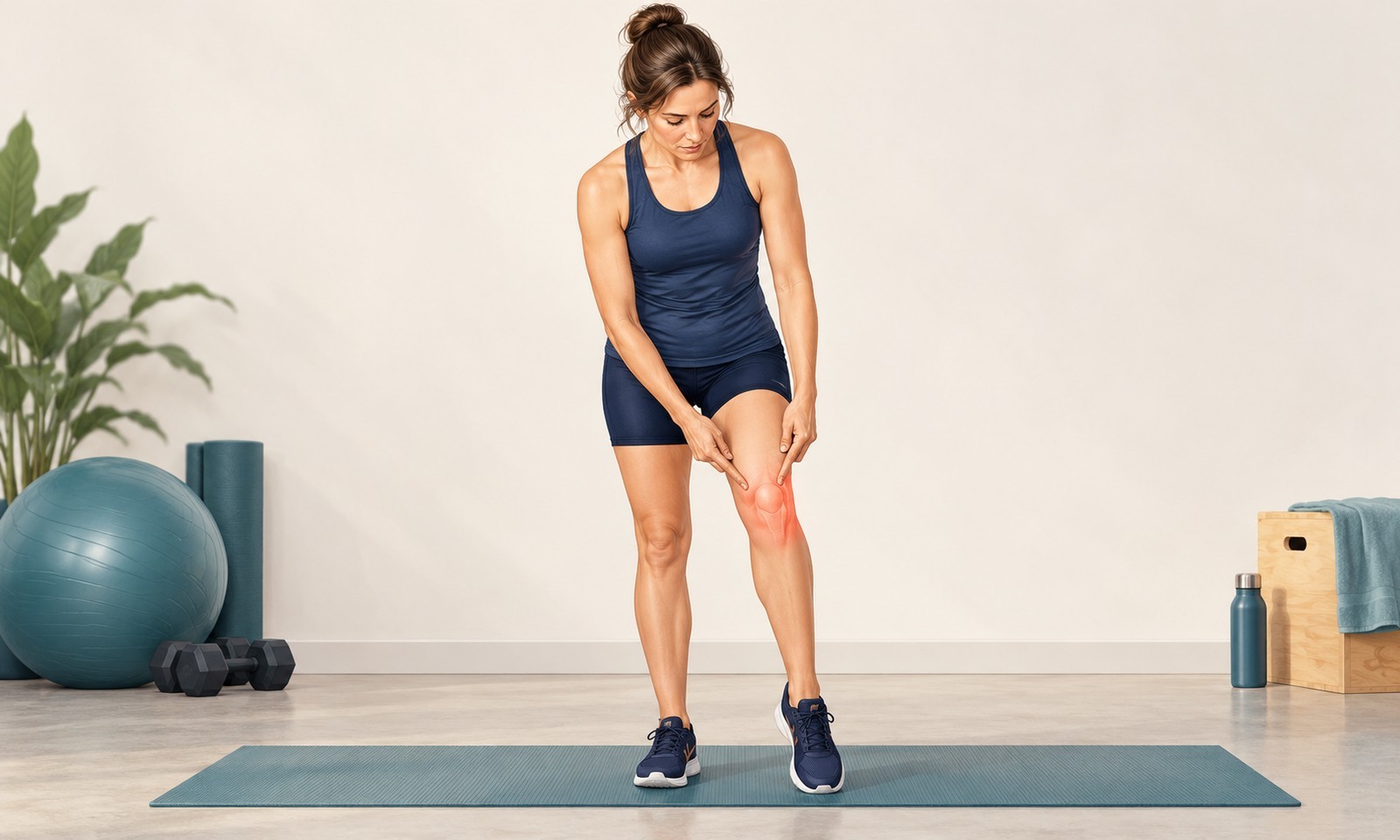
Physiotherapist assessing the front of a patient's knee for Hoffa's fat pad impingement at a New Malden clinic

Hoffa's Fat Pad Impingement

300+ Reviews 5.0

Open 7 Days

10+ Years' Experience

HCPC Physio On Team

Insurance Accepted

85% Return Rate

PHYSIOTHERAPY & THERAPEUTIC MASSAGE IN NEW MALDEN

Quick Summary

Hoffa's fat pad impingement is a common but often-missed cause of sharp pain at the front of the knee. It occurs when the soft, fatty cushion sitting just behind your kneecap tendon becomes pinched, irritated and inflamed.


Because this fat pad is one of the most pain-sensitive structures in the whole knee, the discomfort can feel surprisingly intense — but research suggests the condition usually responds well to non-surgical care. At J&J Therapy in New Malden, our HCPC-registered physiotherapists combine hands-on treatment, de-loading taping and a graded exercise programme, with most people attending a course of sessions over several weeks.

What Is Hoffa's Fat Pad Impingement?

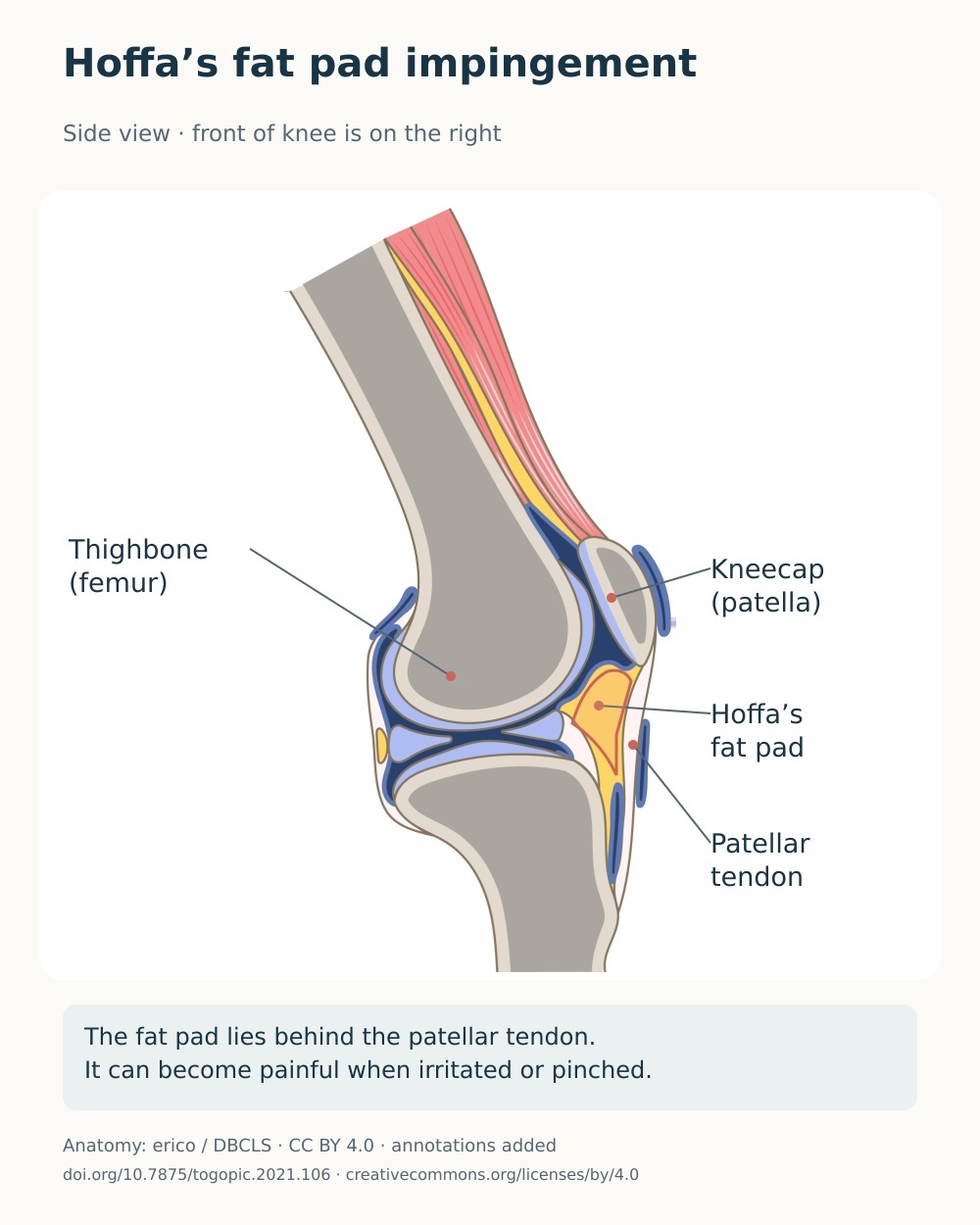
Anatomical illustration of the infrapatellar fat pad sitting behind the patellar tendon in the knee

The infrapatellar fat pad — also known as Hoffa's fat pad — is a soft, fatty structure that fills the space at the front of your knee. It sits deep to the patellar tendon, between your kneecap, the lower end of the thigh bone and the top of the shin bone.


Its role is thought to include acting as a flexible cushion that absorbs shock, helping to distribute joint lubricant and supporting the blood supply to the patellar tendon (Dragoo et al., Sports Medicine, 2012). Importantly, it has a rich blood supply and a very high density of pain-signalling nerve fibres (Bohnsack et al., Archives of Orthopaedic and Trauma Surgery, 2005). This is why it is regarded as one of the most pain-sensitive tissues in the knee, and why irritation here can produce pain that feels out of proportion to the injury.


How impingement happens

Impingement occurs when the fat pad becomes compressed or trapped, most often between the kneecap and the thigh bone, or between the tendon and the underlying bone during movement. Recognised mechanisms include a direct blow to the front of the knee, repetitive forced hyperextension where the knee snaps backwards, poor kneecap tracking, scarring following knee surgery or arthroscopy, and knees that naturally hyperextend (Hannon et al., Sports Health, 2016).


Acute and chronic stages

First described by the surgeon Albert Hoffa in 1904, the condition typically begins as an acute problem with inflammation, swelling and sometimes bleeding within the fat pad. If repeated micro-trauma continues, it may progress to a chronic stage involving fibrosis, or scarring, of the tissue. Early, appropriate management therefore matters.


How it is diagnosed

Diagnosis is primarily clinical, based on your history and a careful examination including a modified Hoffa's test. MRI can show swelling within the fat pad, but evidence shows similar changes are sometimes seen in people with no symptoms at all, so scans must always be interpreted alongside your clinical picture (De Smet et al., American Journal of Roentgenology, 2012). Because many conditions cause pain at the front of the knee, an accurate assessment is essential to distinguish it from patellar tendinopathy, patellofemoral pain, plica syndrome and meniscal problems.

Do You Experience These Symptoms?

✓  Sharp or aching pain at the front of your knee, felt on either side of the tendon just below your kneecap

✓  Pain that worsens with prolonged standing, or when your knee is pushed backwards into full extension

✓  Discomfort going downstairs, or increased pain after sitting for long periods with the knee bent

✓  Puffiness or swelling on either side of the tendon at the front of the knee

✓  A sensation of the knee catching, briefly locking or giving way

✓  Symptoms aggravated by high-heeled shoes or activities that push the knee back

✓  Tenderness when you press either side of the tendon below the kneecap

These symptoms can be treated.
The sooner you begin, the better your chances of a smoother recovery.

What Causes Hoffa's Fat Pad Impingement?

•  Direct trauma or a blow to the front of the knee

A fall onto the knee or a direct impact can bruise and inflame the fat pad, causing swelling and bleeding within it.

This acute injury often starts the cycle of irritation that leads to ongoing impingement.


•  Repetitive hyperextension

Activities that repeatedly force the knee backwards — kicking sports, gymnastics, dance, ballet and running downhill — pinch the fat pad against the surrounding bone.

Over time this repetitive micro-trauma may cause persistent inflammation and eventual scarring.


•  Kneecap maltracking and quadriceps weakness

When your kneecap does not glide smoothly in its groove, often linked to weakness of the inner thigh muscle, the fat pad can be squeezed abnormally.

Research shows poor tracking increases the mechanical pressure placed on the fat pad during everyday movement (De Smet et al., American Journal of Roentgenology, 2012).


•  Scarring after knee surgery or arthroscopy

Previous knee surgery, keyhole portals or ligament reconstruction can leave adhesions in and around the fat pad.

This scarring restricts the fat pad's normal movement and may make it more prone to impingement (Dragoo et al., Sports Medicine, 2012).


•  Hypermobility and prolonged standing

If you have hypermobile joints or knees that naturally bend slightly backwards, the fat pad is placed under repeated end-range compression.

Occupations involving long periods of standing keep the knee locked back, sustaining that pressure and aggravating symptoms.

Not sure which condition applies to you?

How We Treat Hoffa's Fat Pad Impingement at J&J Therapy

Hands-On Manual Therapy

Our physiotherapists begin with a thorough assessment to confirm the fat pad as the source of your pain and to identify the mechanical factors driving it. Because the fat pad sits deep to the patellar tendon, treatment focuses on reducing its irritation indirectly: gentle soft tissue techniques to the quadriceps and surrounding structures, and patellar mobilisation to restore smooth kneecap gliding. A cornerstone of early management is de-loading tape, applied to lift the lower pole of the kneecap away from the fat pad, which evidence suggests helps relieve pressure and reduce pain when weight bearing. We also retrain the hyperextension mechanics that provoke symptoms and assess contributions from your hip and ankle.

Shockwave Therapy*

Swiss Storz Medical MASTERPULS shockwave therapy is not a first-line treatment for Hoffa's fat pad impingement, and we do not apply it over an acutely inflamed fat pad. In selected long-standing cases that have not responded to manual therapy, taping and a structured exercise programme, your physiotherapist may discuss whether it could play a limited supporting role — always following a full clinical assessment.

Targeted Exercise Programme

Your targeted exercise programme is the foundation of long-term recovery and is progressed carefully to avoid provoking the fat pad. In the early stages we favour quadriceps strengthening in inner-range positions and avoid full terminal extension, since exercises such as straight leg raises can pinch and further irritate the tissue. As symptoms settle, we build hip and gluteal strength, which research suggests helps reduce the loads passing through the front of the knee. We add calf and hamstring flexibility work, retrain your standing posture to avoid locking the knee backwards, and then guide a staged return to running, sport or work (Willy et al., JOSPT, 2019).

When to Seek Urgent Medical Help

While most symptoms are not serious, urgent medical attention is required if you experience any of the following:

  • Your knee locks and you cannot fully straighten or bend it, or it repeatedly gives way

  • You cannot put weight through the leg after an injury, or you suspect a fracture

  • The knee becomes hot, red and swollen with a fever or feeling generally unwell

  • Sudden, large or rapidly worsening swelling of the knee, particularly after trauma


If you experience any of these, please seek same-day medical assessment through your GP, NHS 111 or an urgent care service.

FAQs About Hoffa's Fat Pad Impingement

  • How long does Hoffa's fat pad impingement take to recover?

Most people improve steadily with consistent conservative treatment, although this varies with how long you have had symptoms and how irritable the fat pad is. Acute cases caught early tend to settle faster, while long-standing presentations with scarring may take several months. Consistency with your programme matters more than any single treatment.


  • Will it settle on its own without treatment?

Mild cases can improve if you remove the aggravating factor, such as avoiding activities that force the knee backwards. However, because the fat pad is so pain-sensitive and easily re-irritated, symptoms often persist or return without guidance. Physiotherapy addresses the underlying mechanics, which research suggests gives the best chance of a lasting recovery.


  • Will I need an injection or surgery?

The large majority of people never need either. Corticosteroid injections are sometimes considered for stubborn inflammation, and keyhole trimming of the fat pad is reserved as a last resort for cases that have exhausted conservative care. Evidence shows this condition is often managed successfully without surgery, which is always our starting point.


  • Does shockwave therapy help this condition?

Shockwave is not a first-line treatment here, and we would not use it on an acutely inflamed fat pad. There are currently no high-quality trials showing it helps this specific problem, and evidence from related conditions such as tendon injuries does not transfer directly, because the fat pad is a very sensitive, inflamed tissue rather than a chronic tendon. In selected long-standing cases that have not responded to other treatments, our physiotherapists may discuss whether it could play a limited supporting role.


  • Is this the same as patellar tendinopathy or runner's knee?

No, although they can feel similar and sometimes overlap. Patellar tendinopathy affects the tendon itself and usually warms up with activity, while runner's knee is felt more around or behind the kneecap. Hoffa's impingement is typically a sharp pain either side of the tendon that is worse when the knee is pushed backwards, which is why an accurate assessment matters.

Not sure this condition matches your symtoms?
Find your condition and explore related pain areas.

Logo_Navy.png

Ready to start your recovery?
Book your Initial Assessment today.

This page is for general information only and does not replace professional medical advice.

Reviewed by Lavya Arigalayan, MSc, HCPC Registered Physiotherapist.

Last reviewed

20 August 2026

bottom of page