Quick Summary
Facet joint syndrome is pain arising from the small paired joints at the back of your spine, typically felt as lower back pain that is worse when you arch backwards, twist, or stand for a long time. Our HCPC-registered physiotherapists assess your spine carefully and combine hands-on manual therapy with a targeted exercise programme to reduce your pain and restore comfortable movement. Most people need around 6–8 sessions over 6–12 weeks, though this varies with how long symptoms have been present and the degree of underlying joint wear.
What Is Facet Joint Syndrome?
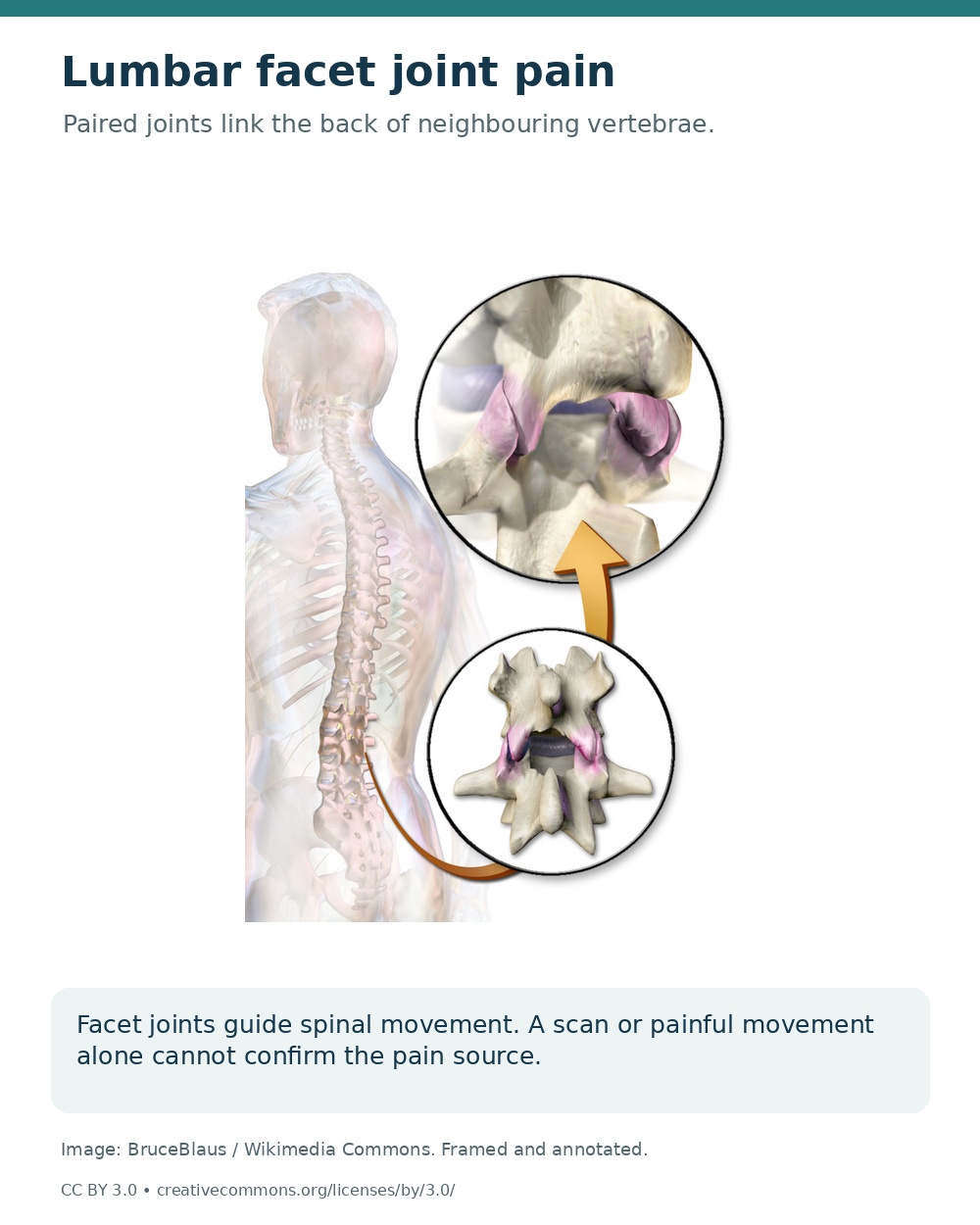
Your spine is stabilised at every level by a "three-joint complex": the intervertebral disc at the front and a pair of facet joints (zygapophyseal joints) at the back. Each facet joint is a true synovial joint, with cartilage surfaces, a synovial lining and a fibrous capsule, formed where the bony processes of one vertebra meet those of the vertebra below. These joints guide and limit movement — particularly resisting rotation — and share the spine’s load, normally carrying around 10–20% of it, which rises when the disc in front loses height.
Each lumbar facet joint receives its nerve supply from two levels, which is why numbing a single nerve is not enough to confirm the diagnosis. When the joint is repeatedly overloaded or worn, the cartilage degenerates, the lining becomes inflamed, the capsule stretches, and bony spurs (osteophytes) may form. Because the disc and the facet joints are mechanically linked, wear in one commonly drives wear in the others through recognised stages of dysfunction, instability and re-stabilisation.
The lumbar facet joints are a major source of persistent lower back pain. Research using controlled diagnostic nerve blocks suggests facet joints are responsible for roughly a third to just over 40% of chronic low back pain presentations, with the lowest two levels of the lumbar spine most commonly affected (Manchikanti et al., Pain Physician; Perolat et al., Insights into Imaging, 2018). Osteoarthritis is the most common underlying change, and excess body weight is a significant risk factor.
The main diagnostic challenge is that no single clinical test or scan finding is definitive, and imaging changes correlate poorly with symptoms — diagnostic nerve blocks remain the medical reference standard. Our physiotherapists therefore build a working diagnosis from your history and a careful movement examination. This page focuses on the lower back, but the same joints exist in the neck, where facet involvement is a recognised source of neck pain, particularly after whiplash.
Do You Experience These Symptoms?
✓ Localised lower back pain, felt on one side or across both sides, close to the spine
✓ Pain that worsens when you arch backwards, twist, or stand for prolonged periods
✓ Morning stiffness, or stiffness after rest, that eases as you start moving
✓ Referred pain into the buttock or back of the thigh that usually stops above the knee
✓ Pain on rising from a chair or after sitting for a long time, often eased by leaning forwards
✓ Tenderness when the muscles beside the affected joints are pressed
✓ Normal leg strength, sensation and reflexes — without true nerve symptoms
These symptoms can be treated.
The sooner you begin, the better your chances of a smoother recovery.
What Causes Facet Joint Syndrome?
• Age-related degeneration and osteoarthritis
The most common cause is gradual wear of the cartilage and capsule with age, leading to facet joint osteoarthritis.
Body weight is a strong and modifiable risk factor, with research suggesting that a raised BMI substantially increases the likelihood of facet joint osteoarthritis.
• Repetitive extension and rotation loading
Jobs and sports that repeatedly arch and twist the lower back — such as cricket, gymnastics and golf — place cumulative stress across the facet joint capsules.
Over time this repeated microtrauma can lead to capsular strain, laxity and degenerative change.
• Disc degeneration and altered load transfer
When the disc at the front of the spine loses height, more load is transferred backwards onto the facet joints.
This shift accelerates facet wear, which is why disc and facet degeneration so often occur together.
• Previous trauma or lifting injury
A single significant strain, a whiplash-type event, or a heavy or awkward lift can injure a facet joint capsule and trigger symptoms.
Acute episodes may then become recurrent if the underlying movement patterns are not addressed.
• Postural and lifestyle factors
Prolonged standing, an exaggerated lower back curve, excess body weight and weak deep trunk muscles all increase the load passing through the facet joints.
These factors are modifiable, which is why they form a central focus of your rehabilitation programme.
How We Treat Facet Joint Syndrome at J&J Therapy
Hands-On Manual Therapy
Our manual therapy is tailored to facet joint dysfunction. Depending on your assessment, our physiotherapists may use lumbar segmental mobilisation, posteroanterior glides over the affected level, and rotational mobilisation or manipulation where clinically indicated, alongside soft tissue work to the lower back muscles and thoracic mobility work to reduce compensatory stiffness. NICE guidance recommends manual therapy for low back pain as part of a package that also includes exercise — which is exactly how we deliver it. Evidence shows manipulation and mobilisation may reduce pain and improve function in persistent low back pain (Coulter et al., The Spine Journal, 2018).
Shockwave Therapy*
Swiss Storz Medical MASTERPULS
may complement your manual therapy and exercise programme when your physiotherapist identifies specific indications during assessment, such as a myofascial component in the muscles beside the spine.
It is not a first-line treatment for facet joint pain itself — the strongest trial evidence to date involves focused rather than radial shockwave — so we use it selectively.
Non-invasive, evidence-based.
Targeted Exercise Programme
Your exercise programme is the core of lasting improvement. We prioritise motor control and deep trunk stability training, targeting the muscles that support each spinal segment and which are commonly inhibited in facet-related back pain. Because facet pain is typically eased by bending forwards and provoked by arching backwards, we often begin with flexion-biased and neutral-spine control work, gradually building your tolerance to extension as symptoms settle. We add hip and thoracic mobility work to reduce load on the lumbar facet joints, then progress through graded loading to functional strengthening so you can return to work, sport and daily activities with confidence. Research suggests motor control exercise reduces pain in persistent low back pain (Saragiotto et al., Cochrane Database of Systematic Reviews, 2016), and works best as one part of a broader progressive programme.
When to Seek Urgent Medical Help
While most symptoms are not serious, urgent medical attention is required if you experience any of the following:
Difficulty passing or controlling urine, loss of bowel control, numbness around the saddle area, or weakness in both legs — go to A&E immediately
Significant new pain after a fall, accident or trauma, or in anyone at risk of osteoporosis
Unexplained weight loss, night pain that disturbs sleep, fever, or a history of cancer
Worsening leg weakness, numbness or reflex changes developing over hours or days
FAQs About Facet Joint Syndrome
How do I know my back pain is coming from the facet joints?
Facet pain has a fairly typical pattern: localised pain beside the spine that is worse when you arch back, twist or stand for long periods, often with morning stiffness that eases as you move, and referred pain into the buttock or thigh that stops above the knee without true numbness or weakness. That said, no single clinical test is definitive and imaging findings correlate poorly with symptoms, so the medical reference standard is a diagnostic nerve block. Our physiotherapists build a working diagnosis from your history and a movement examination, and can refer you on for imaging or diagnostic blocks if needed.
How long does facet joint pain take to settle with physiotherapy?
Many people notice meaningful improvement within a few weeks. We typically expect around 6–8 sessions over 6–12 weeks, combining manual therapy with a progressive exercise programme. Recovery is usually faster for acute episodes driven by posture or muscle weakness, and slower where there is established joint wear — in that case symptoms can often be well controlled even though the underlying wear itself cannot be reversed.
Should I have an injection or radiofrequency ablation?
These are options if conservative care does not settle your symptoms. A diagnostic nerve block is used first to confirm the facet joints as the pain source, and those who get a good but short-lived response may be offered radiofrequency denervation. NICE supports this only in carefully selected patients after a positive diagnostic block, and a Cochrane review found no high-quality evidence that it provides reliable pain relief, so results vary from person to person. We are happy to discuss whether an onward referral is appropriate for you.
Can I keep exercising, and which exercises should I avoid?
Yes — staying active is one of the best things you can do, and appropriate exercise is a core part of treatment. During flare-ups it is sensible to modify movements that repeatedly load the joints into extension, such as heavy overhead lifting, deep back-arching and high-impact twisting, while continuing gentle flexion-based and core stability work. Your physiotherapist will give you a tailored, graded programme so you build strength without provoking symptoms.
Do you use shockwave therapy for facet joint syndrome?
Not as a first-line treatment. The direct evidence is limited: the strongest randomised trial in facet joint pain used focused shockwave, which is a different technology from our radial device, and the researchers noted that radial shockwave reaches more superficial tissue and is less suited to deep facet targets. Our Swiss Storz Medical MASTERPULS radial shockwave is therefore used selectively — only where your assessment shows a myofascial component in the muscles beside the spine that may respond — always alongside manual therapy and exercise, which remain the mainstays of care.
This page is for general information only and does not replace professional medical advice.
Reviewed by Lavya Arigalayan, MSc, HCPC Registered Physiotherapist.
Last reviewed:
20 August 2026