top of page
Physiotherapist assessing a patient's foot and big-toe joint for a bunion at J&J Therapy in New Malden

Bunions (Hallux Valgus)

300+ Reviews 5.0

Open 7 Days

10+ Years' Experience

HCPC Physio On Team

Insurance Accepted

85% Return Rate

PHYSIOTHERAPY & THERAPEUTIC MASSAGE IN NEW MALDEN

Quick Summary

A bunion (hallux valgus) is a progressive change at the joint at the base of your big toe, where the first metatarsal drifts inwards and the big toe angles towards the smaller toes — creating the bony bump you can see and feel. It is common, affecting roughly one in five adults and becoming more frequent with age, and it is around twice as common in women. Our physiotherapists focus on reducing your pain, improving how your foot loads and moves, and helping you stay active in comfortable footwear. Most people benefit from an initial block of around six sessions over six to eight weeks, alongside a home exercise programme.

What Is a Bunion (Hallux Valgus)?

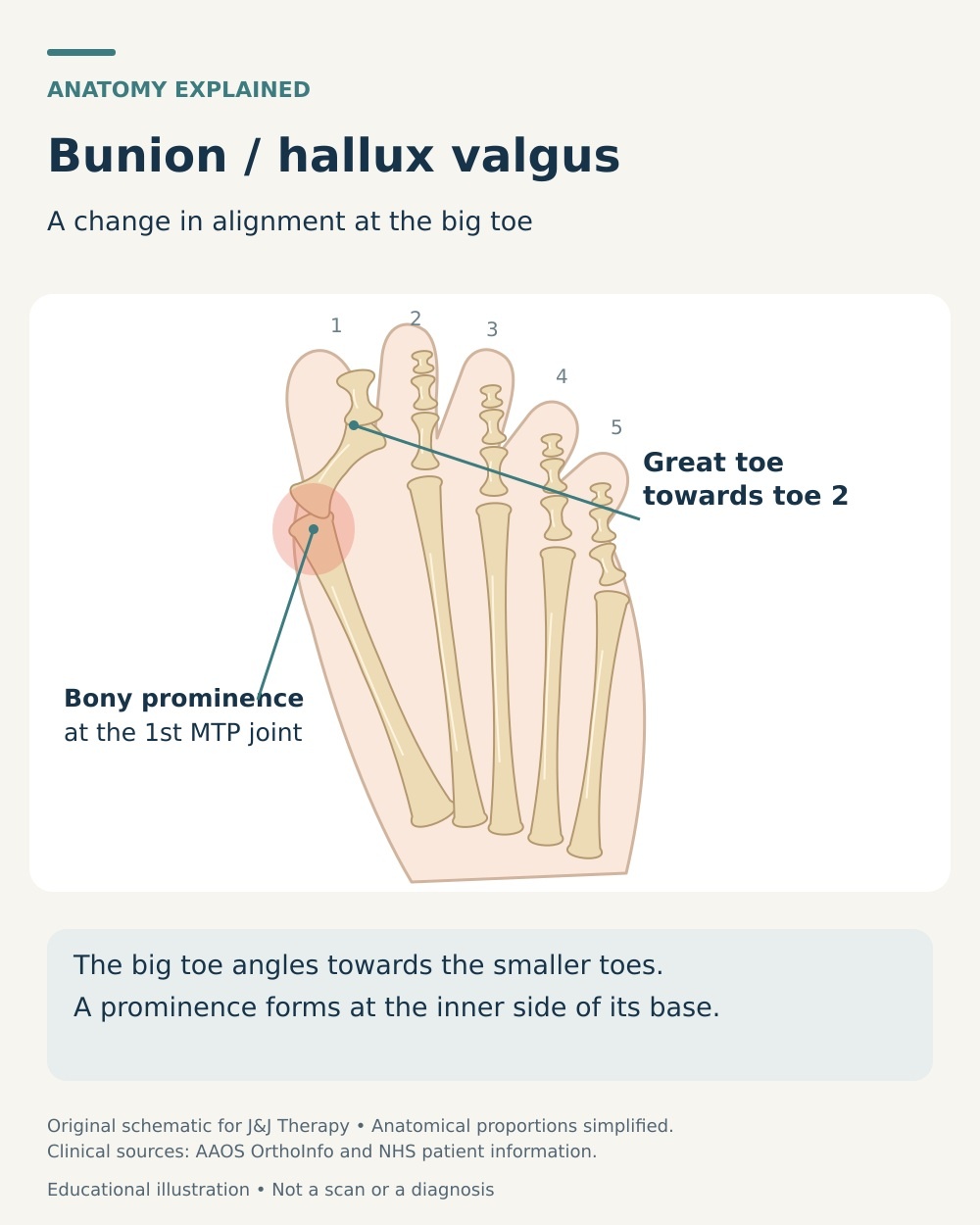
Illustration of a bunion showing the big toe angling towards the smaller toes with a bony bump at the base

Hallux valgus is a three-dimensional deformity of the first metatarsophalangeal (first MTP) joint — the joint at the base of your big toe. It involves the first metatarsal drifting towards the midline of your body while the big toe (hallux) angles outwards towards the smaller toes, often with some rotation of the toe. As the head of the first metatarsal moves inwards it becomes prominent, creating the medial eminence that most people recognise as the bunion. A small fluid-filled sac (bursa) can form over this prominence and become inflamed through friction against footwear.


How severity is measured

Clinicians grade the deformity using two angles measured on an X-ray: the hallux valgus angle, formed between the big toe and the first metatarsal (normally under 15 degrees), and the intermetatarsal angle, between the first and second metatarsals (normally under 9 degrees). As the deformity advances, the two small sesamoid bones that sit beneath the first metatarsal head shift out of position, which is now recognised as a central part of the early process.


Why it affects the way you walk

This shift disrupts the windlass mechanism — the way your plantar fascia tightens to create a stable lever as you push off — and is associated with instability of the first ray. Your big toe becomes less effective at taking load during push-off, so pressure transfers to the lesser metatarsals. This is why many people develop hard skin or aching under the ball of the foot as well as pain over the bump itself.


Stages of progression

Bunions are usually described in three stages. In the mild stage there is a small angular change with a visible prominence. In the moderate stage the angles increase, the lesser toes begin to crowd, and the sesamoids displace. In the severe stage the angles are large, the big toe may overlap the second toe, and function is noticeably affected.


Bunions are common and become more frequent with age. A systematic review and meta-analysis of 76 surveys involving almost 500,000 people reported a prevalence of 23% in adults aged 18 to 65, rising to 35.7% in those over 65 (Nix, Smith & Vicenzino, Journal of Foot and Ankle Research, 2010). A more recent global meta-analysis of 45 studies found an overall pooled prevalence of 19%, and consistently higher rates in women (23.7%) than men (11.4%) (Cai et al., Journal of Foot and Ankle Research, 2023).

Do You Experience These Symptoms?

✓  A visible bony bump on the inner side of your foot at the base of the big toe

✓  Pain, soreness or a burning sensation over the prominence, often worse when walking or wearing shoes

✓  Redness, swelling and inflammation of the skin and bursa over the joint

✓  Difficulty finding comfortable, well-fitting footwear — you may need a wider toe box

✓  Your big toe angling towards, or overlapping, the second toe

✓  Hard skin (callus) over the bump or under the ball of your foot, with aching in the lesser toes from transferred pressure

✓  Reduced movement, stiffness or a feeling of weakness in your big toe

These symptoms can be treated.
The sooner you begin, the better your chances of a smoother recovery.

What Causes Bunions (Hallux Valgus)?

•  Genetic and familial predisposition

Heredity is one of the strongest drivers of hallux valgus, with inherited foot structure and joint characteristics running strongly in families.

If a parent or close relative has bunions your own risk is higher, and bunions that begin in the teenage years show a particularly strong familial pattern.


•  Footwear — narrow toe boxes and high heels

Constrictive, pointed shoes and high heels crowd the toes and load the forefoot, and are associated with a higher likelihood of hallux valgus.

Footwear is best understood as a contributing and aggravating factor rather than the sole cause, because bunions also develop in people who wear roomy shoes.


•  Foot biomechanics, pronation and first-ray hypermobility

Structural factors such as excessive pronation, a hypermobile first ray, and the length and shape of the metatarsal place abnormal stress on the first MTP joint.

These mechanical influences are considered primary drivers that allow the deforming forces to progress over time.


•  Inflammatory arthritis

Inflammatory joint diseases such as rheumatoid arthritis can damage the capsule and ligaments of the first MTP joint, accelerating deviation of the toe.

In these cases the bunion is part of a wider disease process that also needs medical management alongside physiotherapy.


•  Ligamentous laxity and age-related change

Generalised ligament laxity and the soft-tissue changes that accompany ageing reduce the passive stability of the first ray.

This helps explain why bunions become more common with age and are around twice as frequent in women, in whom laxity tends to be greater.

Not sure which condition applies to you?

How We Treat Bunions (Hallux Valgus) at J&J Therapy

Hands-On Manual Therapy

Hands-on assessment and treatment tailored to your foot.
Our physiotherapists begin with a thorough assessment of your foot posture, big-toe joint range, gait and footwear. Treatment may include mobilisation of the first MTP joint — gentle distraction with dorsal and plantar glides to maintain movement and ease pain — alongside soft-tissue work to the adductor hallucis, plantar intrinsic muscles and peroneals, and attention to calf and plantar fascia flexibility. We combine this with gait retraining, practical footwear advice, and discussion of orthoses, toe spacers or night splints where appropriate.
A systematic review of non-surgical care found that a reduction in pain is more likely than a change in the deformity angle, with several studies showing significant pain relief from orthoses, night splints, manual therapy and taping combined with exercise (Hurn et al., Arthritis Care & Research, 2022). We are always honest with you that conservative care manages pain and function but does not reverse the bony deformity.

Shockwave Therapy*

Swiss Storz Medical MASTERPULS
is not a first-line treatment for bunions and cannot correct the bony deformity itself. Where bunion-related soft-tissue or big-toe joint pain has not settled with manual therapy, exercise and footwear changes, your physiotherapist may discuss whether radial shockwave therapy could help manage your pain as part of a wider programme.
We would only consider this after a full assessment. Evidence in hallux valgus is very limited, so we will always explain the uncertainties and realistic expectations before proceeding.

Targeted Exercise Programme

A progressive home programme to strengthen and control your foot.
We prescribe an individualised programme aimed at strengthening the muscles that support your big toe. Core exercises include intrinsic foot strengthening such as the short-foot exercise, and the toe-spread-out exercise, which was devised specifically for hallux valgus to activate abductor hallucis and rebalance it against adductor hallucis (Kim et al., Journal of Back and Musculoskeletal Rehabilitation, 2013). We add calf and plantar fascia stretching plus balance and proprioception work.
The evidence is encouraging but modest. A randomised study found the toe-spread-out exercise reduced the hallux valgus angle and increased abductor hallucis size when combined with an orthosis (Kim et al., Journal of Physical Therapy Science, 2015), and a network meta-analysis of 11 trials found exercise combined with taping or orthoses ranked best for both angle and pain (Foot and Ankle Surgery, 2025). Exercise is expected to reduce pain and improve function rather than straighten the toe.

When to Seek Urgent Medical Help

While most symptoms are not serious, urgent medical attention is required if you experience any of the following:

  • Signs of infection or a foot ulcer — spreading redness, heat, discharge, a break in the skin over the bunion, or fever. Seek same-day advice if you have diabetes or reduced sensation in your feet

  • A sudden, severely painful, hot, red, swollen big-toe joint, which may indicate gout or a joint infection rather than a bunion flare — particularly with fever or feeling unwell

  • Numbness, loss of sensation, or a pale, blue or cold toe, which may suggest nerve or circulation problems

  • Rapidly worsening deformity with severe, unrelenting pain that stops you walking or sleeping

FAQs About Bunions (Hallux Valgus)

  • Can physiotherapy straighten or reverse my bunion?

No — and you should be cautious of any treatment that claims otherwise. A bunion is a structural change in the bones and joint, and only surgery can correct the alignment itself. What our physiotherapists can do is reduce your pain, improve the strength and function of your foot, and help limit aggravation, so many people manage well without an operation.


  • Will I need surgery?

Not necessarily. National guidance recommends conservative measures first — suitable footwear, pain relief, orthoses and physiotherapy — with surgery usually considered only when the bunion remains painful or limits your activity despite these measures (NICE CKS; NHS). We can help you get the most from conservative care and, if needed, support a referral for a surgical opinion.


  • Do toe spacers and splints actually work?

They may help with comfort and short-term pain for some people, but the evidence is limited. Research suggests toe separators and night splints can reduce pain, yet they do not reliably change the deformity angle in a meaningful way (Hurn et al., Arthritis Care & Research, 2022). We will help you decide whether they are worth trialling as part of your overall plan.


  • What footwear should I choose?

Look for shoes with a wide, deep toe box and a low heel, ideally with laces or an adjustable strap so they can accommodate the width of your foot. Avoid narrow, pointed shoes and high heels, which crowd the toes and load the forefoot. Good footwear is often one of the most effective changes you can make to ease bunion symptoms.


  • Can shockwave therapy treat my bunion?

Shockwave is not a first-line treatment for bunions and it cannot correct the bony deformity. The evidence in hallux valgus is very limited — there are no randomised trials, and the available research comes from small studies in related forefoot conditions such as big-toe joint pain and sesamoid problems. In selected cases where bunion-related soft-tissue pain has not settled with other treatment, we may discuss whether radial shockwave using our Swiss Storz Medical MASTERPULS system could help manage pain — always after a full assessment and an honest explanation of the uncertainties.

Not sure this condition matches your symtoms?
Find your condition and explore related pain areas.

Logo_Navy.png

Ready to start your recovery?
Book your Initial Assessment today.

This page is for general information only and does not replace professional medical advice.

Reviewed by Lavya Arigalayan, MSc, HCPC Registered Physiotherapist.

Last reviewed

bottom of page