Quick Summary
Wrist tendonitis — more accurately described as wrist tendinopathy — is pain, swelling and tenderness around the tendons that cross your wrist, most often driven by repetitive overuse. Our HCPC-registered physiotherapists assess which tendon is involved, rule out conditions that mimic it, and treat the underlying cause with hands-on manual therapy and a progressive, targeted exercise programme. Most people improve with a structured course of physiotherapy over several weeks, and we review your progress across an initial block of sessions to adjust your plan as your tendon responds.
What Is Wrist Tendonitis?
Wrist tendonitis describes pain arising from the tendons that move your wrist and hand. Although the traditional term "tendinitis" implies active inflammation, modern research shows that most persistent tendon pain is a degenerative process rather than a purely inflammatory one.
The widely cited continuum model describes three overlapping stages — reactive tendinopathy, tendon dysrepair, and degenerative tendinopathy — with load being the primary factor that moves a tendon forwards or backwards along that continuum (Cook & Purdam, British Journal of Sports Medicine, 2009). Studies of chronic tendon pain typically show disorganised collagen rather than inflammatory cells, which is why the umbrella term "tendinopathy" is now preferred.
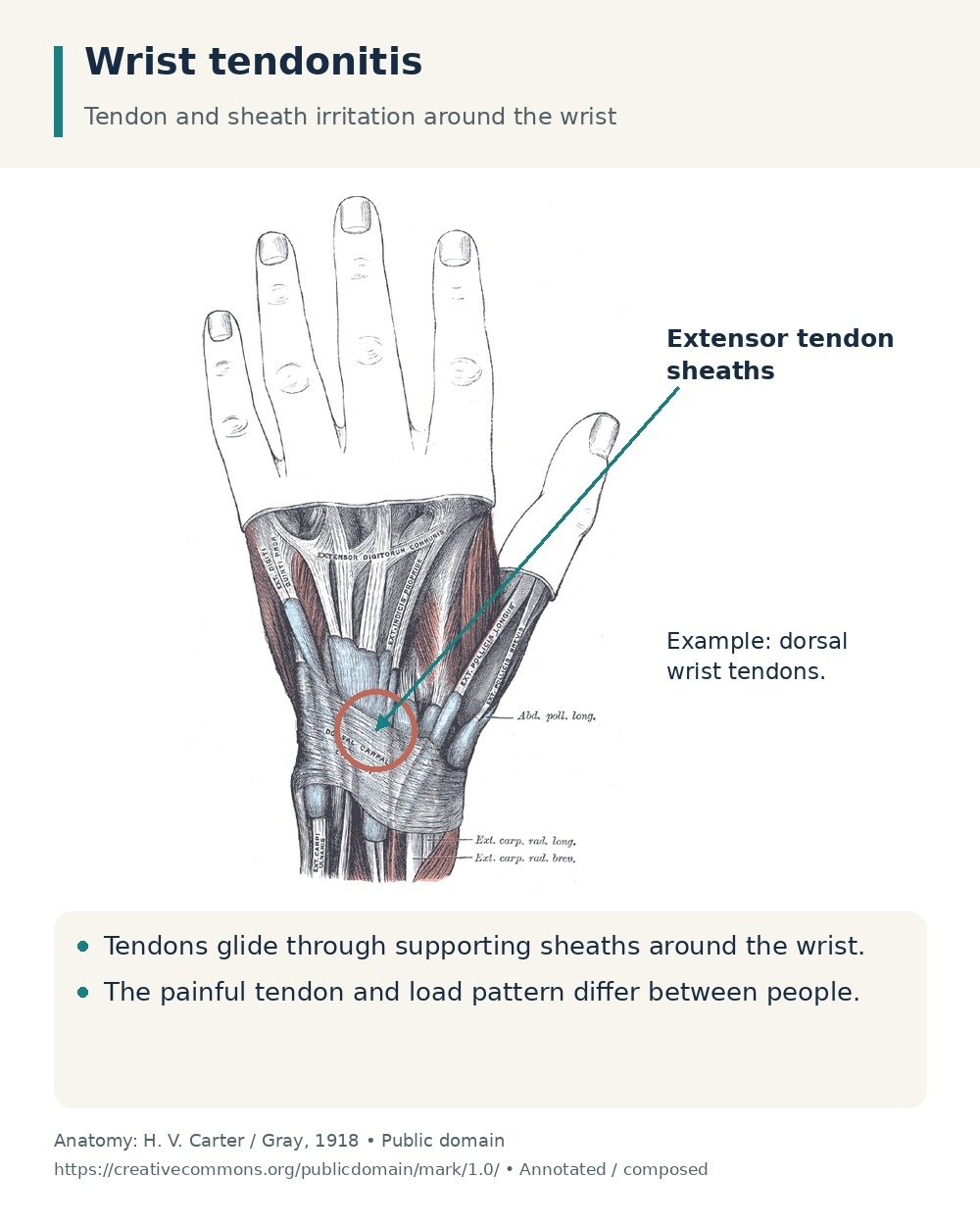
True tenosynovitis — irritation of the synovial sheath surrounding a tendon — is a distinct but related problem, and it does involve an inflammatory and often frictional component. This matters at the wrist, because several classic wrist conditions are sheath problems rather than degeneration within the tendon itself.
Tendons commonly involved at the wrist:
Extensor carpi ulnaris (ECU): the most common source of little-finger-side wrist pain, aggravated by turning your forearm; common in racquet and stick sports.
Flexor carpi radialis (FCR): an under-recognised cause of pain on the palm-thumb side of the wrist, often linked to underlying arthritis at the base of the thumb.
Flexor carpi ulnaris (FCU): degenerative change near the small pisiform bone on the little-finger side, usually from chronic overuse.
Wrist extensors (ECRB and ECRL): the tendons that lift your wrist, which share loading patterns with the tendons involved in tennis elbow.
Intersection syndrome: irritation where the thumb tendons cross over the wrist extensors, producing pain and sometimes a creaking sensation a few centimetres above the wrist on the thumb side of the forearm.
Symptoms generally progress from a reactive, load-sensitive phase that often settles with sensible activity modification, into a longer-standing degenerative phase where progressive strengthening is needed to rebuild the capacity of the tendon.
Do You Experience These Symptoms?
✓ Pain around the wrist tendons that worsens with gripping, lifting or repetitive wrist movement
✓ Tenderness when you press directly over the affected tendon
✓ Swelling or a thickened feeling along the tendon or its sheath
✓ Stiffness, especially first thing in the morning or after a period of rest
✓ A creaking or grating sensation with movement, particularly in intersection syndrome and tenosynovitis
✓ Pain reproduced when you move your wrist against resistance in one specific direction
✓ Reduced grip strength and difficulty with everyday tasks such as opening jars or wringing out a cloth
These symptoms can be treated.
The sooner you begin, the better your chances of a smoother recovery.
What Causes Wrist Tendonitis?
• Repetitive overuse and overload
Sustained or repeated wrist movements — typing, manual work, gaming, racquet sports — accumulate micro-loading on the tendon faster than it can adapt.
Over time this produces the structural change and sensitivity that characterise tendinopathy.
• Sudden increases in activity
A rapid rise in training volume, a new job task, or an unaccustomed DIY project can overwhelm the capacity of a tendon.
This "too much, too soon" pattern is one of the most common triggers of a painful flare-up.
• Sustained or awkward postures
Prolonged wrist positions held under load — such as poor keyboard ergonomics or gripping tools with a bent wrist — increase compression and friction on the tendons.
This is particularly relevant to sheath-based problems such as intersection syndrome.
• Direct strain or injury
A fall, a forceful twist, or a single heavy lift can injure a wrist tendon and tip it into a painful state.
Pre-existing conditions such as inflammatory arthritis or nearby osteoarthritis can also make the tendon more prone to irritation.
How We Treat Wrist Tendonitis at J&J Therapy
Hands-On Manual Therapy
Our physiotherapists use hands-on manual therapy to ease pain and restore movement around your wrist and forearm. Depending on your presentation this may include soft-tissue techniques, graded mobilisation of the wrist and forearm joints, and targeted work on the forearm muscles that load your wrist tendons. Manual therapy settles symptoms and improves your tolerance so that you can progress into the active loading that drives longer-term recovery, and we always pair it with practical activity and ergonomic advice.
Shockwave Therapy*
Swiss Storz Medical MASTERPULS
may be considered as an additional option in selected cases that have not responded to a proper course of manual therapy and exercise. Direct research evidence for shockwave in wrist tendon problems is currently limited, with most supporting evidence coming from related conditions such as De Quervain's tenosynovitis and tennis elbow, where research suggests it may help reduce pain.
Because the wrist contains several superficial nerves, we only consider shockwave after a careful assessment and never as a first-line treatment.
Targeted Exercise Programme
Progressive loading is the best-evidenced approach for tendinopathy and forms the core of your recovery plan. Your programme usually begins with isometric holds to settle pain and build tolerance, then progresses through controlled strengthening — including slow, heavy resistance and eccentric work — to rebuild the capacity of the tendon and the forearm muscles that support your wrist. Research suggests that graded loading rather than complete rest is what restores tendon capacity over time, so we progress your exercises according to how your tendon responds.
When to Seek Urgent Medical Help
While most symptoms are not serious, urgent medical attention is required if you experience any of the following:
Numbness, pins and needles, or weakness in your hand or fingers, which may indicate nerve involvement rather than a tendon problem
A sudden "pop", visible deformity, or inability to move your wrist or a finger, which may suggest a tendon rupture
Spreading redness, heat, significant swelling or fever, which need same-day medical assessment
Severe pain following a significant fall or trauma, to exclude a fracture
FAQs About Wrist Tendonitis
Is wrist tendonitis the same as inflammation?
Not exactly. Although the name implies inflammation, most persistent tendon pain is now understood to be a degenerative change within the tendon (tendinopathy) rather than active inflammation. True tenosynovitis — irritation of the tendon sheath — does occur at the wrist and can involve an inflammatory component, which is one reason we assess your specific presentation carefully.
How long does wrist tendonitis take to recover?
It varies with severity and how long your symptoms have been present. Many people improve over several weeks with a structured physiotherapy plan, though longer-standing degenerative tendons can take a few months to rebuild capacity. Consistent loading and sensible activity modification are the biggest drivers of recovery.
Do I need a scan?
Often not — most wrist tendon problems are diagnosed clinically from your history and examination. We may recommend imaging such as ultrasound or MRI if the diagnosis is unclear, if we need to distinguish your problem from conditions such as carpal tunnel syndrome, or if your symptoms are not responding as expected.
Can shockwave therapy treat wrist tendonitis?
Shockwave is not a first-line treatment for wrist tendonitis. The direct research evidence for the wrist tendons themselves is currently very limited, and most supportive evidence comes from related conditions such as De Quervain's tenosynovitis and tennis elbow, where research suggests it may help reduce pain. In selected cases that have not responded to manual therapy and exercise, we may consider shockwave using our Swiss Storz Medical MASTERPULS system after a careful assessment — and because the wrist contains several superficial nerves, we apply it cautiously and only where it is appropriate.
What can I do at home to help?
Modifying the activities that provoke your pain, improving your workstation ergonomics, and performing the exercises we prescribe are the most useful things you can do. We will guide you on the balance between relative rest and loading, because both complete rest and overloading can slow your recovery.
This page is for general information only and does not replace professional medical advice.
Reviewed by Lavya Arigalayan, MSc, HCPC Registered Physiotherapist.
Last reviewed:
2026년 8월 20일