Quick Summary
A finger or thumb that catches, clicks or locks can make dressing, cooking and gripping difficult. We assess how it affects your hand and discuss activity adjustments, suitable rehabilitation and when a GP or hand specialist should review it.
Understanding Trigger Finger
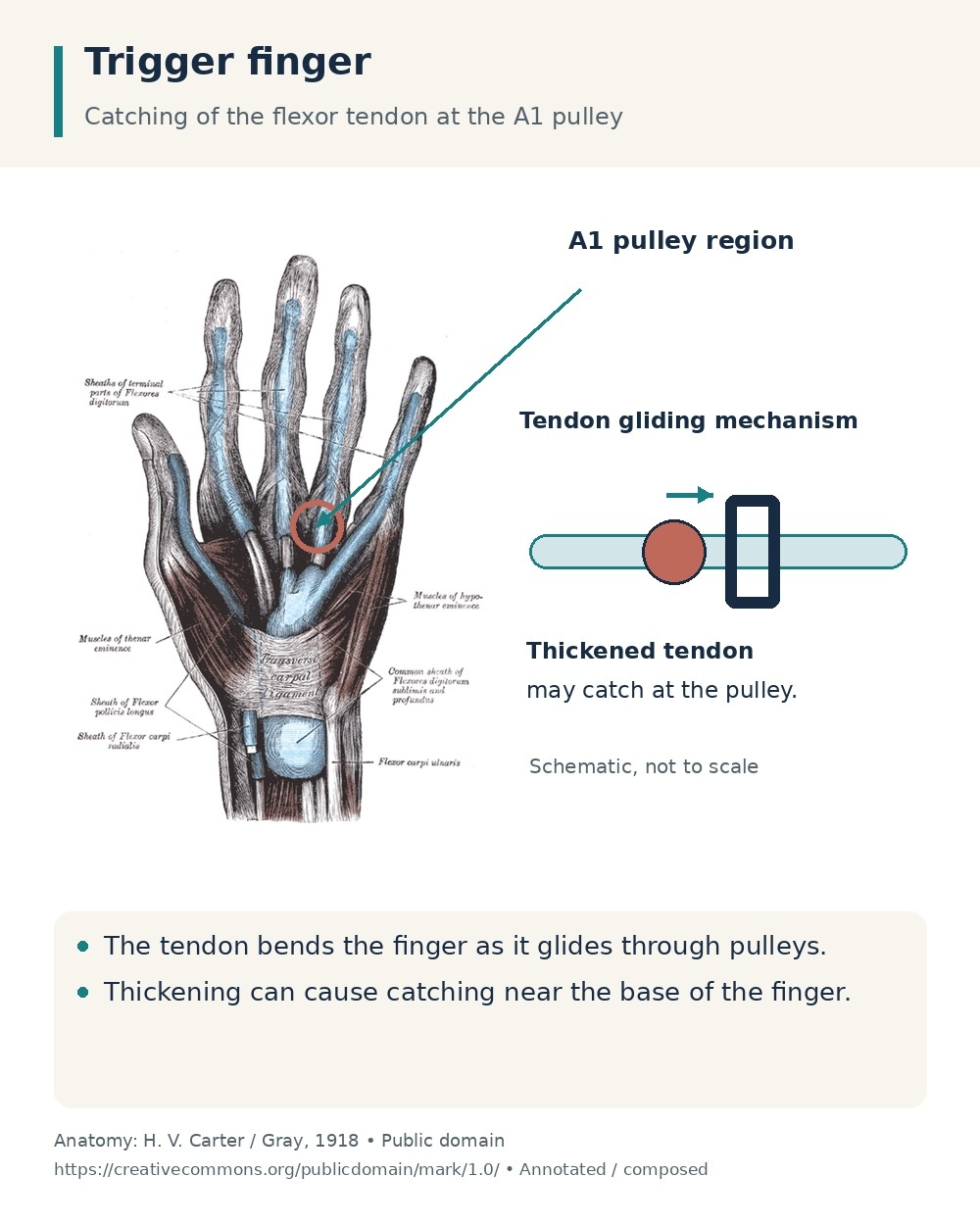
Trigger finger occurs when a flexor tendon does not glide smoothly through its tunnel, commonly near the base of the finger. It can catch as you bend or straighten the digit. This is different from Dupuytren’s contracture, where a palm cord gradually pulls a finger into flexion.
How we assess your symptoms
We check the location of tenderness, movement and locking, and discuss whether splint advice or medical review is appropriate. A persistently locked digit needs prompt assessment; forcing it straight can worsen discomfort.
Image: H. V. Carter / Gray, 1918 · Public domain. Adapted.
Do You Experience These Symptoms?
- Clicking or catching during finger or thumb movement.
- Tenderness at the base of the digit on the palm side.
- Morning stiffness or a digit that becomes stuck bent.
An assessment helps guide your next step, based on your symptoms, health and goals.
A treatment plan built around you
Hands-On Manual Therapy
Gentle treatment may help surrounding discomfort, but deep pressure over a painful tendon tunnel is not necessary. Hands-on treatment is not presented as a reliable way to release persistent locking.
Is Shockwave Suitable?
Shockwave is not routinely recommended for trigger finger. Your assessment will guide appropriate rehabilitation, symptom management and whether medical or specialist review is needed. We will explain why each proposed treatment fits your symptoms before you decide whether to proceed.
Targeted Exercise Programme
Comfortable movement and changes to forceful gripping may be useful. Exercises are selected to avoid repeated painful triggering. If a procedure is recommended, follow-up rehabilitation follows the hand team’s instructions.
When to Seek Urgent Medical Help
While most symptoms are not serious, urgent medical attention is required if you experience any of the following:
- Go to A&E immediately after an injury if a joint is deformed or the hand or finger is cold, pale or blue, or has severe loss of sensation. For other severe swelling or inability to use the arm, seek urgent assessment through NHS 111.
- A hot, red, rapidly swollen joint with fever needs urgent medical assessment. Arrange prompt review for persistent numbness, increasing weakness or loss of dexterity.
Your questions answered
Does every trigger finger need surgery?
No. Depending on severity, options include activity changes, a splint, steroid injection or surgery. Your GP or hand specialist can advise on these choices.
Is this the same as arthritis?
No. Trigger finger is mainly a tendon-gliding problem, although other hand conditions can coexist. An examination helps distinguish locking from joint stiffness or a palm contracture.
Which appointment should I book?
Choose a Physiotherapy Initial Assessment for new, persistent or uncertain symptoms. We will assess what is limiting you, explain the options and agree the next steps. If you already have a diagnosis, bring any relevant scan report or specialist advice.
Visit J&J Therapy on the ground floor of CI Tower, New Malden. Book an assessment or call our reception team on 07935 869938 if you are unsure which service to choose.
Related conditions
Dupuytren’s contracture · Thumb arthritis
Sources and further reading

This page is for general information only and does not replace professional medical advice.
Information updated 15 October 2026. General information to support informed choices; it is not a diagnosis or a personalised treatment plan. Suitability and any need for referral are assessed individually. Seek urgent medical help for the warning signs listed above.