Quick Summary
Lumbar spinal stenosis is a narrowing of the spaces in your lower spine that can compress the nerves, producing leg heaviness, cramping or pain when you walk or stand — symptoms that typically ease when you sit down or lean forwards.
Research consistently shows that supervised physiotherapy is an appropriate first-line treatment, and the natural course is favourable in around a third to a half of mild-to-moderate cases. Our physiotherapists usually recommend a course of roughly 6–12 sessions over 6–12 weeks, combining manual therapy, a flexion-biased exercise programme and walking retraining.
What Is Lumbar Spinal Stenosis?
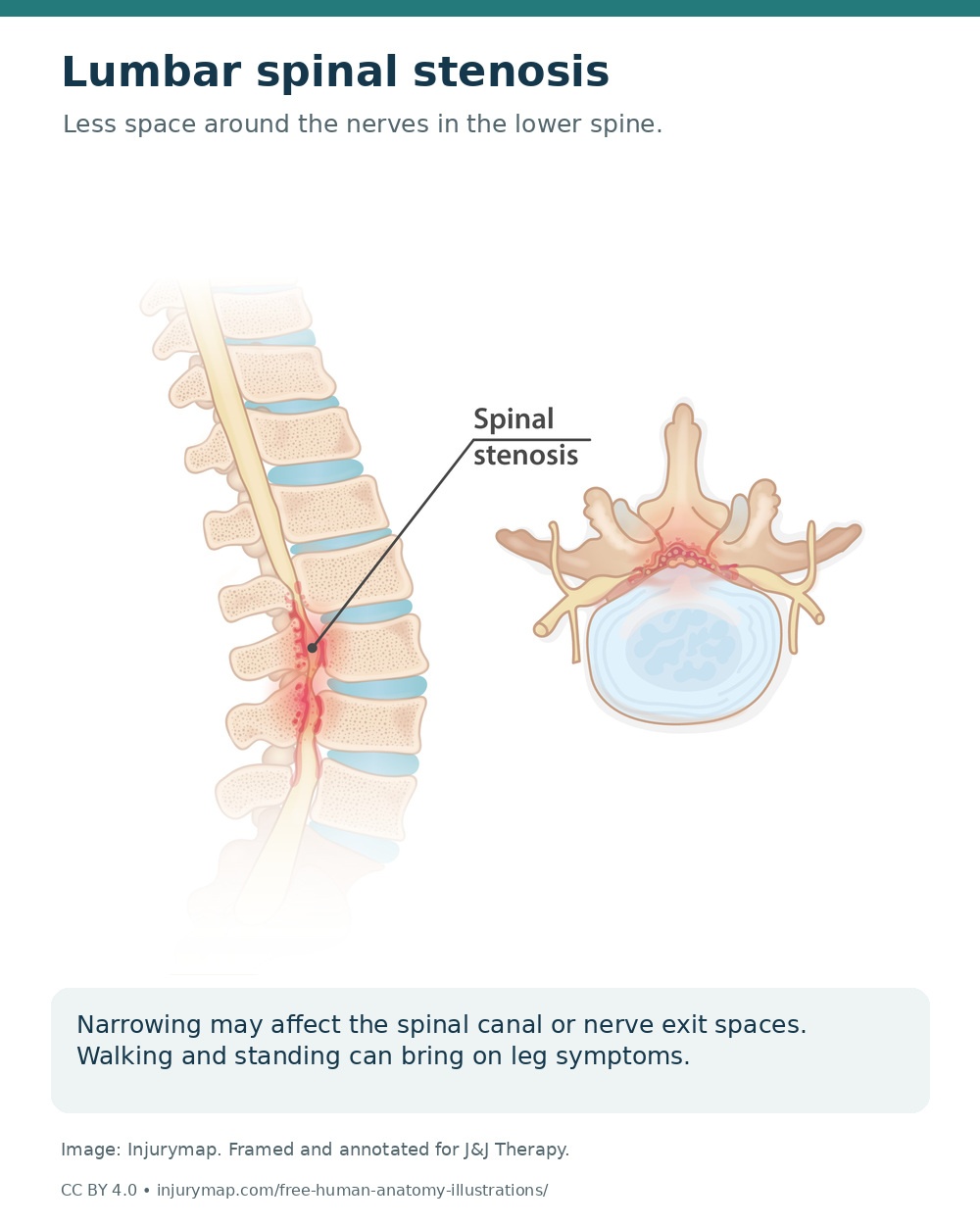
Lumbar spinal stenosis — sometimes shortened to LSS — is a narrowing of the spinal canal, lateral recess or nerve exit channels in your lower back, which reduces the space available for the nerves travelling down to your legs.
It is mainly a condition of later life. Radiological evidence of narrowing is seen in around 20% of people over 60, and lumbar spinal stenosis is the most common reason for spinal surgery in adults over 65.
How the narrowing develops
The process usually begins with disc degeneration and loss of disc height, which places extra load on the small facet joints at the back of the spine. Those joints enlarge and form bony spurs, while the ligamentum flavum — a band at the back of the canal — thickens and buckles inward. Together, a bulging disc at the front, enlarged facet joints at the sides and infolded ligament at the back gradually encroach on the space around the nerves, most commonly at the L4–L5 level (Jensen et al., BMJ, 2021).
Why walking brings on your symptoms
The hallmark symptom — leg pain, heaviness or cramping that comes on with walking or standing and settles when you sit or bend forwards — is called neurogenic claudication. It is not caused by mechanical pressure alone. Narrowing also raises the pressure around the nerve roots, causing venous congestion, reduced blood flow and swelling within the nerve (Kobayashi, Journal of Orthopaedic Research, 2008). Because standing upright narrows the canal and leaning forwards opens it, many people notice they can walk much further leaning on a shopping trolley, or cycle comfortably when walking is difficult.
What to expect over time
Imaging findings correlate only loosely with symptoms — narrowing is common on scans and often causes no trouble at all. The natural course tends to fluctuate rather than steadily worsen: evidence suggests the outlook is stable or improving in roughly a third to a half of mild-to-moderate cases, with around 15% deteriorating. This favourable natural history is a key reason why conservative care is recommended first.
Do You Experience These Symptoms?
✓ Pain, heaviness, cramping or tiredness in one or both legs that comes on when you walk or stand for a while
✓ Symptoms that ease when you sit down, lean forwards or bend over a shopping trolley, and worsen when you stand upright or walk downhill
✓ Being able to walk further when leaning on a trolley, or cycle more comfortably than you can walk
✓ Numbness, tingling or pins and needles in your buttocks, legs or feet
✓ Aching or stiffness in your lower back, which may be milder than your leg symptoms
✓ A feeling that your legs are weak or unsteady, or that you tire quickly on your feet
✓ A walking distance that has gradually reduced over months or years, so you stop and rest more often
These symptoms can be treated.
The sooner you begin, the better your chances of a smoother recovery.
What Causes Lumbar Spinal Stenosis?
• Age-related disc and joint degeneration
The most common cause is the gradual wear of the discs and facet joints that comes with ageing.
As discs lose height and the joints enlarge, the space around the nerves steadily narrows.
• Thickening of the ligamentum flavum
The ligamentum flavum, a band running along the back of the spinal canal, can thicken and buckle inward over time.
It is one of the main structures responsible for reducing canal space in degenerative stenosis.
• Osteoarthritis and bone spurs
Osteoarthritic change in the facet joints leads to bony overgrowth and the formation of osteophytes, or bone spurs.
These project into the canal and nerve exit channels, adding to the compression.
• Degenerative spondylolisthesis
When one vertebra slips slightly forward on the one below, it narrows the canal and adds an element of instability.
This is a common contributor, particularly at the L4–L5 level and more often in women.
• A congenitally narrow canal
Some people are simply born with a smaller-than-average spinal canal.
In these cases, relatively modest age-related change can produce symptoms earlier than it otherwise would.
How We Treat Lumbar Spinal Stenosis at J&J Therapy
Hands-On Manual Therapy
Hands-on lumbar and hip mobilisation, soft-tissue work to the paraspinal and gluteal muscles, and neural mobilisation to improve segmental movement and reduce protective muscle guarding. Evidence shows manual therapy works best combined with exercise, not on its own.
Shockwave Therapy*
Swiss Storz Medical MASTERPULS
may complement your manual therapy and exercise programme when your physiotherapist identifies specific indications during assessment — for example, a secondary component of paraspinal muscle pain. It is not a treatment for the spinal narrowing itself, and the evidence for shockwave in this condition is limited.
Non-invasive, assessment-based.
Targeted Exercise Programme
A tailored, flexion-biased programme — the core of your treatment. Lumbar flexion and core stability work, hip and hamstring flexibility, and graded aerobic conditioning such as cycling or supported walking to rebuild your walking tolerance, progressed as you improve.
When to Seek Urgent Medical Help
While most symptoms are not serious, urgent medical attention is required if you experience any of the following:
Difficulty passing or controlling urine, loss of bowel control, or numbness around your back passage, genitals or inner thighs — go to A&E immediately
New or rapidly worsening weakness in both legs, or difficulty lifting your feet
Numbness, weakness or altered sensation that is steadily spreading rather than staying stable
New severe back or leg pain with fever, unexplained weight loss, or a history of cancer
FAQs About Lumbar Spinal Stenosis
Will I need surgery for lumbar spinal stenosis?
Usually not. Most people with mild-to-moderate stenosis stay stable or improve with conservative care, and physiotherapy is recommended as a first-line treatment. Surgery is generally considered only when symptoms are severe or persistent despite a fair trial of non-surgical care. Research comparing the two shows surgery can give greater early relief for well-selected patients, but the difference tends to narrow over the longer term (Weinstein et al., Spine, 2010; Zaina et al., Cochrane Database of Systematic Reviews, 2016).
Why do my legs feel better when I sit or lean on a trolley?
Because bending forwards opens up the narrowed spaces in your spine and takes pressure off the nerves, while standing and walking upright narrows them again. This is why many people find they can walk further leaning on a shopping trolley, or cycle comfortably when walking is hard — and it is exactly why we build flexion-biased positions into your exercise programme.
Can physiotherapy really help, or does it just manage the pain?
Evidence shows that structured physiotherapy — manual therapy combined with individualised, flexion-biased exercise and walking retraining — may meaningfully improve pain, walking distance and function (Schneider et al., JAMA Network Open, 2019). It will not reverse the underlying narrowing, but it can help you stay active, walk further and reduce how much your symptoms limit your daily life.
How many sessions will I need?
This varies with your symptoms and your goals, but many people follow a course of roughly 6–12 sessions over 6–12 weeks, with a home exercise programme alongside. Your physiotherapist will review your progress regularly, adjust the plan, and discuss onward referral if your symptoms do not respond as expected.
Do you use shockwave therapy for spinal stenosis?
Not as a treatment for the stenosis itself. There is no good-quality evidence that shockwave helps the narrowing or the nerve compression causing your leg symptoms, so it is never our first-line approach for this condition. Occasionally, if your assessment shows a separate component of paraspinal muscle pain, your physiotherapist may suggest the Swiss Storz Medical MASTERPULS alongside your manual therapy and exercise. We will always be clear that its role here is limited and secondary.
This page is for general information only and does not replace professional medical advice.
Reviewed by Lavya Arigalayan, MSc, HCPC Registered Physiotherapist.
Last reviewed:
2026년 8월 20일