top of page
Physiotherapist assessing a patient's knee for a suspected ligament sprain at J&J Therapy in New Malden

Knee Ligament Sprain

300+ Reviews 5.0

Open 7 Days

10+ Years' Experience

HCPC Physio On Team

Insurance Accepted

85% Return Rate

PHYSIOTHERAPY & THERAPEUTIC MASSAGE IN NEW MALDEN

Quick Summary

A knee ligament sprain is an overstretch or partial tear of one of the ligaments that stabilise your knee — most often the medial collateral ligament (MCL) on the inner side — causing pain, swelling and a sense that the knee may give way. Our physiotherapists confirm which ligament is involved and how severe the injury is, then guide you through a staged recovery of movement, strength and stability. Most mild to moderate sprains respond well to physiotherapy over several weeks, with the number of sessions tailored to your grade, goals and progress.

What Is a Knee Ligament Sprain?

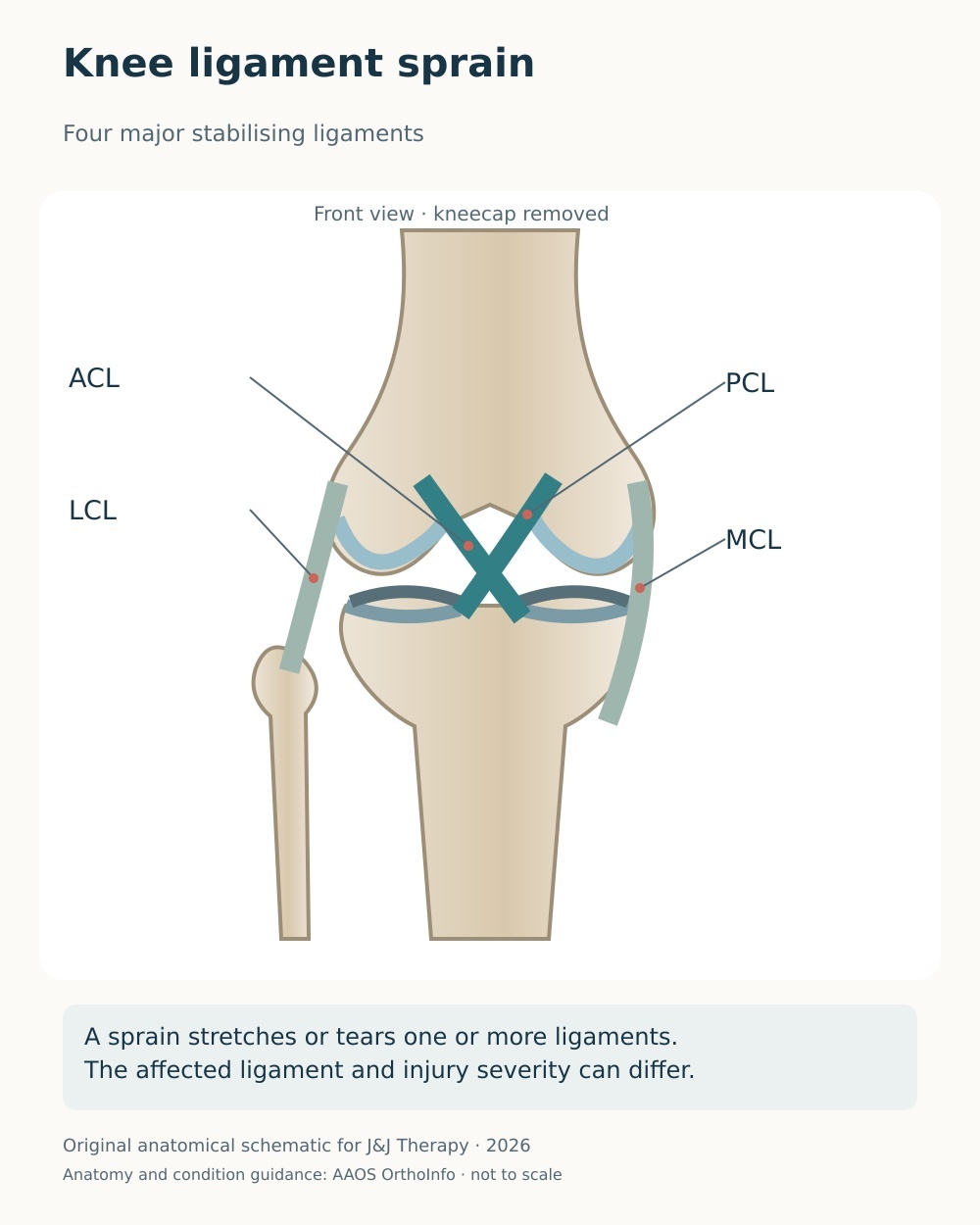
Anatomical diagram of the knee showing the MCL, LCL, ACL and PCL ligaments

A sprain is an injury in which a ligament — a tough band of connective tissue joining bone to bone — is overstretched or torn. Your knee is stabilised by four main ligaments: the medial collateral ligament (MCL) on the inner side and the lateral collateral ligament (LCL) on the outer side, which limit side-to-side movement, and the anterior and posterior cruciate ligaments (ACL and PCL), which cross inside the joint and control forward, backward and rotational movement.

The MCL is the most commonly injured knee ligament, involved in approximately 40% of all knee injuries.


How sprains are graded

Grade I (mild): the ligament fibres are overstretched with only microscopic tearing. There is local tenderness and minimal swelling, but no instability.

Grade II (moderate): a partial tear, with more pain, swelling and bruising and mild looseness on testing.

Grade III (severe): a complete rupture with clear instability, often alongside other injuries such as an ACL or meniscal tear. This grade usually warrants specialist review.


How ligaments heal

Healing passes through three overlapping phases: inflammation in roughly the first week, when bleeding and swelling occur; proliferation over weeks two to six, as repair tissue is laid down; and remodelling over the following months, as collagen matures and regains strength.

Because the MCL sits outside the joint and has a good blood supply, it has a strong capacity to heal without surgery. Typical non-operative timelines are around one to three weeks for Grade I, four to six weeks for Grade II, and eight to twelve weeks or longer for Grade III.


A 2024 systematic review of non-operative management of MCL injuries (Svantesson, Piussi et al., BMJ Open Sport & Exercise Medicine, 2024) included 26 reports and 1,912 patients, and found that immediate weight bearing and walking were tolerated in both Grade I and Grade II injuries.

Do You Experience These Symptoms?

✓  Pain and tenderness over the injured ligament — the inner knee for an MCL sprain, the outer knee for an LCL sprain

✓  Swelling that often develops within hours of the injury

✓  A "pop" or tearing sensation felt or heard at the moment of injury

✓  A feeling of instability, as though your knee may buckle or give way

✓  Bruising around the joint in the days after the injury

✓  Difficulty fully bending or straightening your knee

✓  Pain or reduced confidence when weight bearing, pivoting or changing direction

These symptoms can be treated.
The sooner you begin, the better your chances of a smoother recovery.

What Causes a Knee Ligament Sprain?

•  A direct blow to the knee

A force to the outer knee that pushes the joint inwards commonly sprains the MCL, while a blow to the inner knee can injure the LCL.

These contact mechanisms are typical in football, rugby and hockey.


•  Twisting or pivoting on a planted foot

A sudden change of direction with your foot fixed to the ground can overstretch the collateral or cruciate ligaments.

This non-contact mechanism is common in sports involving cutting and rapid deceleration.


•  An awkward landing or hyperextension

Landing poorly from a jump, or forcing the knee beyond full straightening, can strain the ligaments — particularly the ACL.

Reduced neuromuscular control and fatigue both increase this risk.


•  Falls and everyday missteps

A fall onto a bent knee or a misstep on uneven ground can generate enough force to sprain a ligament.

Weak surrounding muscles, poor balance and inadequate conditioning raise your susceptibility.

Not sure which condition applies to you?

How We Treat Knee Ligament Sprain at J&J Therapy

Hands-On Manual Therapy

A thorough assessment — history, mechanism of injury, palpation and specific ligament stress tests such as the valgus stress test at 30 degrees of flexion — to identify the injured ligament, grade the sprain and screen for anything needing onward referral. Early care prioritises protection and settling of pain and swelling, followed by soft-tissue work, graded joint mobilisation to restore movement, and taping or bracing to protect the healing ligament while allowing controlled motion.

Shockwave Therapy*

Swiss Storz Medical MASTERPULS radial shockwave therapy is not used for a fresh knee ligament sprain, and it is never our first-line treatment. During the acute stage, when the knee is swollen or bruised, hands-on therapy and graded exercise take priority and are supported by the strongest evidence. In a small number of longer-standing cases — where pain persists and healing appears to have stalled beyond about twelve weeks — the MASTERPULS may complement your manual therapy and exercise programme if your physiotherapist identifies specific indications during assessment. We will be open with you that the direct evidence for shockwave in ligament sprains is currently limited.

Targeted Exercise Programme

A staged, criteria-based programme: protection and pain control with early pain-free movement and isometric activation; restoration of full range of movement; progressive strengthening of the quadriceps, hamstrings, hip and calf from double-leg to single-leg loading; proprioception and balance work to rebuild joint control; and a graded return to running, agility and sport-specific tasks. You progress when your knee meets the goals of each phase, not by the calendar alone.

When to Seek Urgent Medical Help

While most symptoms are not serious, urgent medical attention is required if you experience any of the following:

  • Inability to bear weight — you cannot take four steps on the injured leg, or you are aged 55 or over with knee tenderness after a fall (an X-ray may be needed to exclude a fracture)

  • Gross instability, or a knee that repeatedly gives way, suggesting a possible complete ligament rupture

  • A locked knee that cannot be fully straightened or bent, or an obvious deformity

  • Numbness, pins and needles, or a cold, pale lower leg, or a hot swollen knee with fever — seek emergency care

FAQs About Knee Ligament Sprain

  • How long will my knee ligament sprain take to heal?

It depends on which ligament is injured and how severe the sprain is. Grade I sprains often settle within one to three weeks, Grade II within about four to six weeks, and more severe injuries can take three months or longer. Your physiotherapist will give you a realistic timeline based on your assessment.


  • Do I need a scan or an X-ray?

Usually not. Most ligament sprains are diagnosed from your history and a clinical examination. We use validated criteria to decide whether an X-ray is needed to rule out a fracture, and an MRI is generally reserved for suspected complete tears or injuries involving more than one ligament.


  • Should I rest completely or keep moving?

Early relative rest and protection help settle pain and swelling, but prolonged immobilisation is unhelpful. Evidence shows that gentle, early, pain-free movement and progressive loading support better recovery for most mild to moderate sprains, which is why we start guided exercise as soon as it is safe.


  • Will I need surgery?

Most isolated MCL sprains, and many other ligament sprains, recover well without surgery. An operation is generally considered only for complete ruptures, combined ligament injuries, or when instability persists despite good rehabilitation. We will refer you for a specialist opinion if this applies to you.


  • Can shockwave therapy help a knee ligament sprain?

Not in the early stages, and it is never our first-line treatment. Shockwave is not used while the knee is acutely swollen or bruised, and the direct evidence for shockwave in ligament sprains is currently limited to laboratory studies and isolated case reports. In a small number of longer-standing cases, where pain persists and healing appears to have stalled, our physiotherapists may consider the Swiss Storz Medical MASTERPULS as one part of a wider programme — but only if a thorough assessment identifies specific indications.

Not sure this condition matches your symtoms?
Find your condition and explore related pain areas.

Logo_Navy.png

Ready to start your recovery?
Book your Initial Assessment today.

This page is for general information only and does not replace professional medical advice.

Reviewed by Lavya Arigalayan, MSc, HCPC Registered Physiotherapist.

Last reviewed

2026년 8월 20일

bottom of page