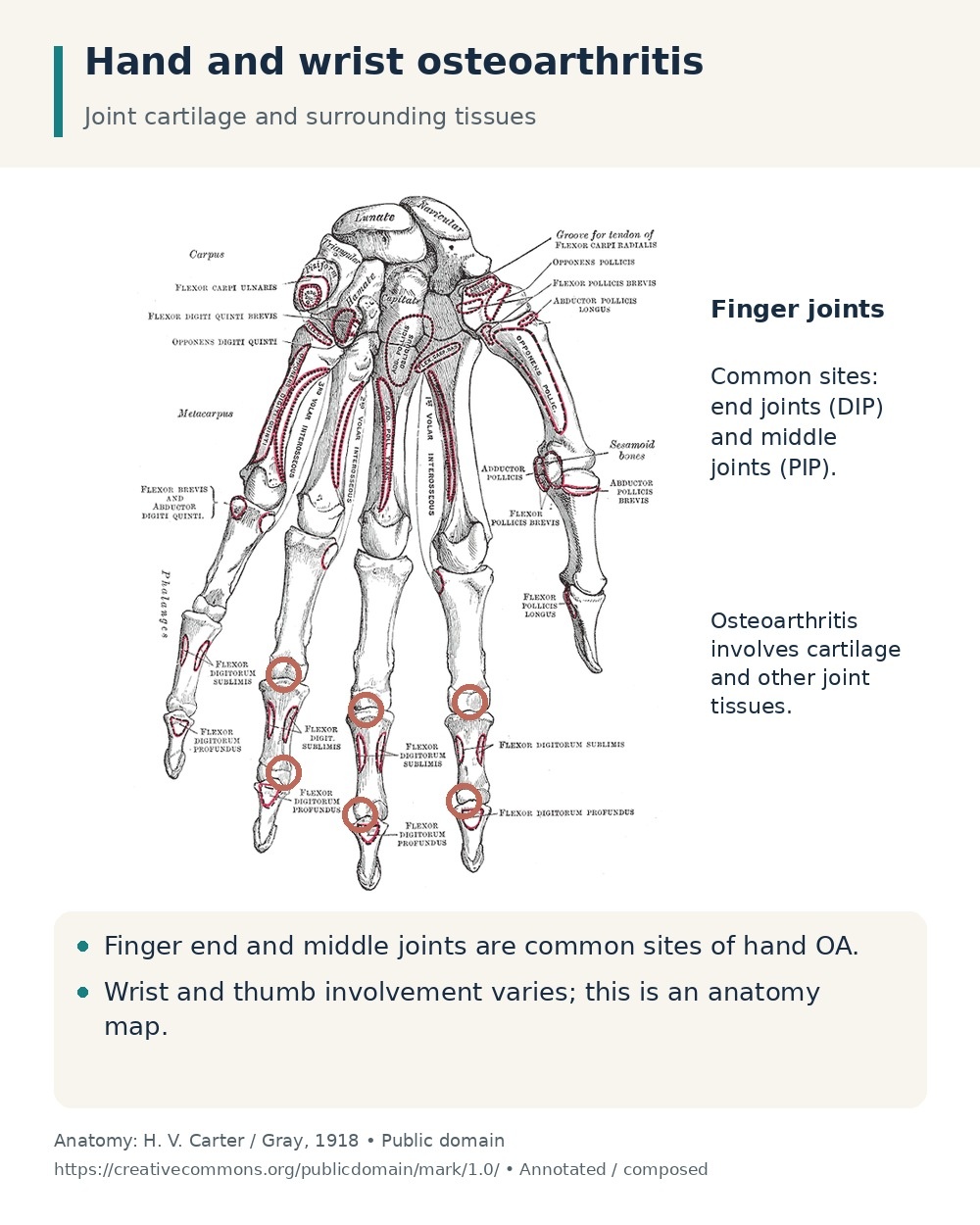
Quick Summary
Hand and wrist osteoarthritis is a common degenerative joint condition that causes stiff, achy and sometimes swollen joints — most often at the base of the thumb and the finger joints — which typically feel worst first thing in the morning.
Our HCPC-registered physiotherapists in New Malden provide an evidence-based programme of manual therapy and targeted exercise to reduce pain, maintain movement and protect your grip and pinch strength, guided by NICE, EULAR and ACR recommendations.
Most patients are seen over a course of approximately 6 to 8 sessions across 8 to 12 weeks, with a strong emphasis on a home exercise and joint-protection routine you can sustain long term.
What Is Hand and Wrist Osteoarthritis?
Osteoarthritis is the most common form of arthritis in the UK, and the hand is among the most frequently affected sites. It is a whole-joint condition involving gradual loss of articular cartilage, changes in the underlying bone, the formation of bony spurs (osteophytes) and episodes of joint inflammation — rather than simple wear and tear. Symptoms fluctuate and flare, and evidence shows they do not inevitably worsen over time (NICE, NG226, 2022).
Hand and wrist osteoarthritis covers several distinct patterns:
• Thumb base osteoarthritis — the first carpometacarpal joint is the most commonly affected single joint in the hand. In a UK community study of adults aged 50 and over, symptomatic hand osteoarthritis was more common than knee or foot osteoarthritis, with the thumb base the most frequent site (Peat et al., Musculoskeletal Care, 2020).
• Finger joint osteoarthritis — bony swellings at the fingertip joints (Heberden's nodes) and at the middle finger joints (Bouchard's nodes).
• Wrist osteoarthritis — affecting the radiocarpal and scaphotrapeziotrapezoid joints. Primary wrist osteoarthritis is comparatively uncommon.
• Post-traumatic wrist osteoarthritis — most often following a scapholunate ligament injury or a scaphoid fracture that has not united, leading to progressive degenerative change in a predictable pattern.
NICE advises that osteoarthritis is a clinical diagnosis in people aged 45 and over with activity-related joint pain and either no morning stiffness or stiffness lasting no longer than 30 minutes, and that X-rays are not routinely needed unless atypical features suggest another diagnosis. Importantly, how a joint looks on an X-ray often does not match how your hand actually feels.
A smaller number of people have erosive hand osteoarthritis, a more inflammatory subset affecting roughly one in ten of those with symptomatic hand osteoarthritis, which carries a higher symptom burden and may warrant rheumatology assessment (Kwok et al., Annals of the Rheumatic Diseases, 2011).
Do You Experience These Symptoms?
✓ Stiff, achy joints in your fingers, thumb base or wrist — often worse first thing in the morning but usually easing within about 30 minutes
✓ Pain when gripping or pinching, such as opening jars, turning keys or using a tin opener
✓ Swelling, tenderness or a warm feeling around an affected joint during a flare
✓ Bony swellings at the finger joints — Heberden's nodes at the fingertips and Bouchard's nodes at the middle joints
✓ Reduced grip and pinch strength, with difficulty fastening buttons, writing or carrying shopping
✓ A grating or creaking sensation (crepitus) and, over time, a squared-off appearance at the base of the thumb
✓ Symptoms that fluctuate, with good days, bad days and intermittent flares
These symptoms can be treated.
The sooner you begin, the better your chances of a smoother recovery.
What Causes Hand and Wrist Osteoarthritis?
• Age and female sex
The likelihood of hand osteoarthritis rises steeply with age and it is considerably more common in women, particularly around and after the menopause. A meta-analysis found that radiographic thumb base osteoarthritis increased from around 7 per cent in women aged 50 to almost 40 per cent by age 80 (van der Oest et al., Osteoarthritis and Cartilage, 2021).
• Genetics and family history
Hand osteoarthritis is strongly heritable, and a large twin study estimated a substantial genetic contribution, highest at the thumb base (Magnusson et al., Osteoarthritis and Cartilage, 2022). A family history of Heberden's nodes markedly increases your likelihood of developing similar changes.
• Occupational and repetitive hand use
Work and hobbies involving many years of repetitive or heavy gripping — manual trades, sewing, hairdressing or prolonged tool use — are associated with a higher risk of thumb base and finger osteoarthritis. The pattern of loading over decades appears to matter more than any single activity.
• Previous injury and joint instability
Earlier fractures, dislocations or ligament injuries can trigger post-traumatic osteoarthritis, and in the wrist an untreated scapholunate ligament rupture or scaphoid nonunion leads to progressive degenerative collapse. Generalised joint hypermobility and ligament laxity at the thumb base encourage subluxation and abnormal loading.
• Metabolic and systemic factors
A higher body mass index and related metabolic factors are associated with hand osteoarthritis, even though the hands are not weight-bearing joints. This suggests that systemic influences contribute alongside purely mechanical ones.
How We Treat Hand and Wrist Osteoarthritis at J&J Therapy
Hands-On Manual Therapy
Our physiotherapists use hands-on techniques including graded joint mobilisation, thumb carpometacarpal mobilisation with movement, soft-tissue work to the thenar muscles and neurodynamic assessment where a nerve component is suspected. A randomised controlled trial found that combining joint mobilisation, neural mobilisation and exercise produced greater pain relief than a sham intervention in thumb base osteoarthritis (Villafane et al., JOSPT, 2013), and a systematic review reported moderate-quality evidence that manual therapy, particularly alongside exercise, may improve pain at short and intermediate follow-up (Bertozzi et al., Disability and Rehabilitation, 2015). We are honest that these gains are typically modest and work best as part of an active programme rather than passive treatment alone.
Shockwave Therapy*
Swiss Storz Medical MASTERPULS may complement your manual therapy and exercise programme when your physiotherapist identifies specific indications during assessment. Non-invasive, evidence-based. It is not applied to the arthritic joints themselves and is never a first-line therapy for osteoarthritis — the evidence in hand and wrist osteoarthritis is limited, and national guidelines do not recommend it for this condition.
Targeted Exercise Programme
Targeted exercise is the cornerstone of care and is strongly recommended for all osteoarthritis sites (NICE, NG226, 2022; ACR, 2020). We prescribe an individualised programme of hand and thumb strengthening — including the thenar muscles and the first dorsal interosseous, a key thumb-base stabiliser — alongside grip and pinch training, range-of-movement work and joint-protection education. A Cochrane review found evidence that exercise may produce small to moderate benefits for hand pain, function and finger stiffness (Osteras et al., Cochrane Database, 2017). Where a thumb orthosis is indicated, we will advise on the most suitable option and arrange or refer for provision alongside your exercise programme. We set realistic expectations: effect sizes are modest, and sustained adherence to your home routine is what drives results.
When to Seek Urgent Medical Help
While most symptoms are not serious, urgent medical attention is required if you experience any of the following:
Morning stiffness lasting well over an hour, several symmetrical joints affected, or systemic symptoms such as fatigue, malaise or unexplained weight loss — this may indicate inflammatory arthritis and needs prompt GP or rheumatology assessment
A hot, red, acutely and severely swollen joint, particularly with a fever or feeling generally unwell — this may indicate a joint infection and requires same-day medical assessment
Rapidly progressive deformity or a sudden loss of your ability to use your hand
New numbness, pins and needles or weakness in your hand, which may suggest nerve involvement rather than osteoarthritis alone
FAQs About Hand and Wrist Osteoarthritis
Is hand osteoarthritis the same as rheumatoid arthritis?
No. Osteoarthritis is a degenerative joint condition, whereas rheumatoid and psoriatic arthritis are inflammatory autoimmune diseases. Osteoarthritis stiffness is usually brief, under about 30 minutes, and related to activity, while inflammatory arthritis typically causes prolonged morning stiffness, symmetrical joint swelling and systemic symptoms. We screen for these differences and will refer you to your GP if we suspect inflammatory arthritis. Conditions such as De Quervain's tenosynovitis, carpal tunnel syndrome and trigger finger can also mimic hand osteoarthritis, and we assess for these too.
Will my hand osteoarthritis keep getting worse?
Not necessarily. NICE emphasises that osteoarthritis does not inevitably progress. Symptoms fluctuate, with flares and better spells, and many people maintain good function for years with exercise, joint protection and self-management. How a joint looks on an X-ray often does not reflect how your hand feels day to day.
Can physiotherapy really help, or do I just have to live with it?
Research suggests physiotherapy can help. Evidence shows that exercise and manual therapy may reduce pain and support hand function, although the effects are generally modest and work best as a sustained, active programme rather than a quick fix. We focus on protecting your grip and pinch strength and keeping you able to do the activities that matter to you. Osteoarthritis cannot be reversed, and we will never suggest otherwise.
Should I wear a thumb splint?
Possibly. For thumb base osteoarthritis, EULAR recommends considering an orthosis for symptom relief, and a rigid thumb splint may ease pain during aggravating tasks. However, a large UK randomised trial found that adding a splint to supported self-management gave no additional short-term benefit (Adams et al., Rheumatology, 2021), so it is not essential for everyone. We will advise whether a splint suits your particular pattern of symptoms.
Do you use shockwave therapy for hand and wrist osteoarthritis?
Not routinely. Shockwave therapy using our Swiss Storz Medical MASTERPULS is not a first-line treatment for hand or wrist osteoarthritis, and we do not apply it to the arthritic joints themselves. The available research in hand osteoarthritis is limited and comes from small studies using a different, focused form of shockwave, and international guidelines do not recommend it for this condition. It may occasionally be considered only if your assessment identifies a specific soft-tissue problem that could benefit, applied safely away from the superficial nerves and bony swellings of the hand. Your manual therapy and exercise programme remain the core of your care.
This page is for general information only and does not replace professional medical advice.
Reviewed by Lavya Arigalayan, MSc, HCPC Registered Physiotherapist.
Last reviewed:
2026년 8월 20일