
Quick Summary
Inner elbow pain with gripping, carrying or twisting can be golfer’s elbow even if you never play golf. Our assessment looks at tendon loading and other possible causes, then builds a practical plan for work, exercise and everyday use.
Understanding Golfer’s Elbow
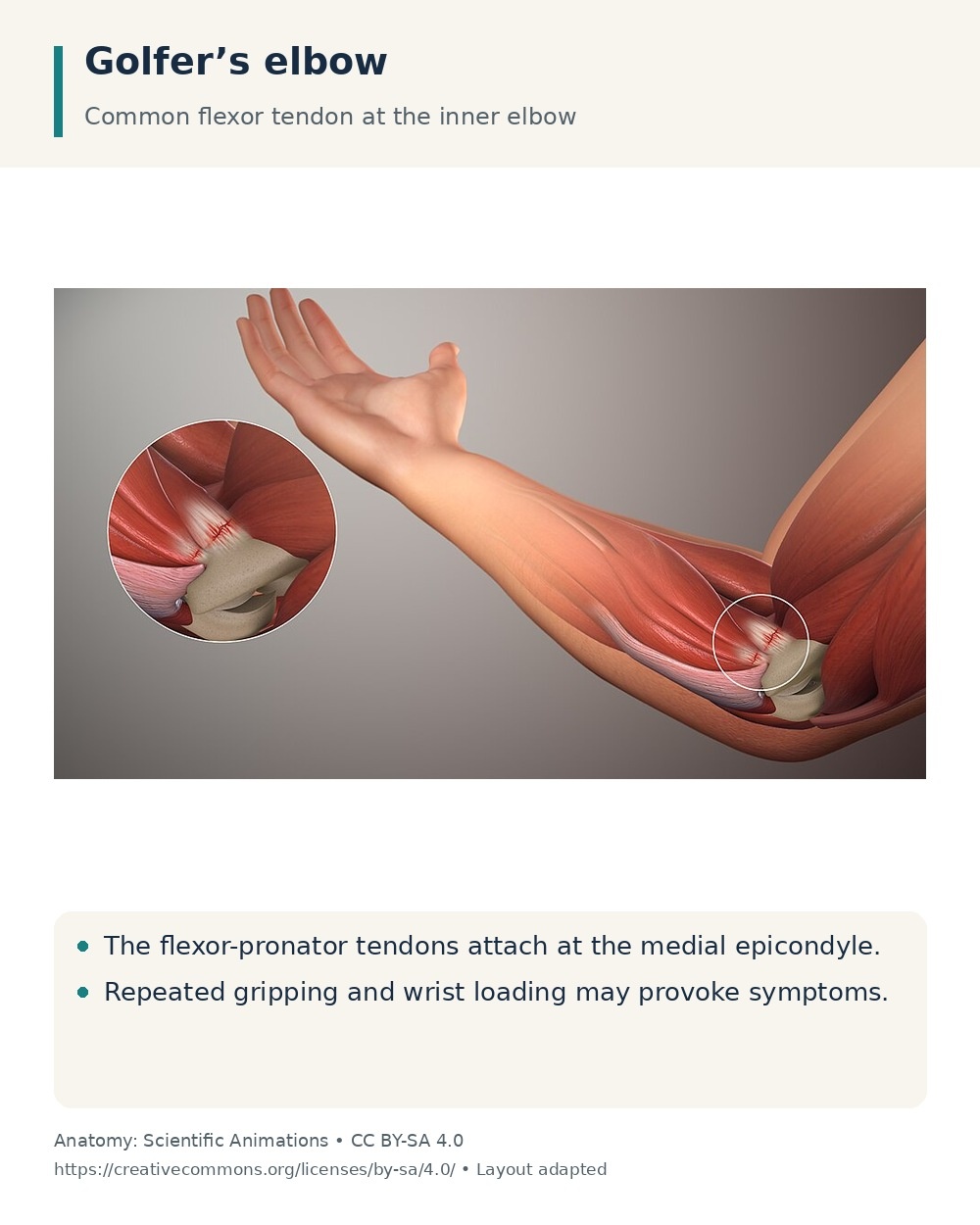
Golfer’s elbow, or medial elbow tendinopathy, affects the tendon attachment of muscles that bend the wrist and rotate the forearm. It differs from tennis elbow, which causes pain on the outside. Tingling in the ring or little finger may indicate an associated ulnar nerve problem.
How we assess your symptoms
We assess resisted wrist and forearm movements, grip, elbow motion and relevant sport or work tasks. Where symptoms suggest it, we examine the ulnar nerve and consider neck-related pain before recommending treatment.
Image: Scientific Animations · Source · CC BY-SA 4.0. Adapted; this image is also licensed CC BY-SA 4.0.
Do You Experience These Symptoms?
- Pain or tenderness around the inner elbow.
- Discomfort with gripping, wrist bending or forearm rotation.
- Reduced tolerance for lifting, throwing or tool use.
An assessment helps guide your next step, based on your symptoms, health and goals.
What may contribute?
A change in training, repeated gripping or unfamiliar manual work may trigger symptoms. The tendon’s capacity and opportunity for recovery matter as well as the activity itself. A sudden injury or persistent nerve symptoms require a different assessment.
A treatment plan built around you
Hands-On Manual Therapy
Manual therapy can be used for symptom relief alongside progressive rehabilitation. Soft tissue work is adapted to avoid irritating the ulnar nerve near the inside of the elbow.
Is Shockwave Suitable?
Shockwave is not routinely recommended for golfer’s elbow. Your assessment will guide appropriate rehabilitation, symptom management and whether medical or specialist review is needed. We will explain why each proposed treatment fits your symptoms before you decide whether to proceed.
Targeted Exercise Programme
Loading exercises for wrist flexion, forearm rotation and grip progress towards your usual activities. We can review throwing, lifting or tool-handling demands and change the programme if pain repeatedly flares.
When to Seek Urgent Medical Help
While most symptoms are not serious, urgent medical attention is required if you experience any of the following:
- Go to A&E immediately after an injury if a joint is deformed or the hand or finger is cold, pale or blue, or has severe loss of sensation. For other severe swelling or inability to use the arm, seek urgent assessment through NHS 111.
- A hot, red, rapidly swollen joint with fever needs urgent medical assessment. Arrange prompt review for persistent numbness, increasing weakness or loss of dexterity.
Your questions answered
Must I give up golf or the gym?
Often you can modify the load, frequency or technique rather than stopping everything. Return to heavier activity depends on your response, strength and confidence.
Is shockwave proven to cure golfer’s elbow?
No. Evidence from other tendon conditions cannot be assumed to apply. Start with assessment, load management and rehabilitation; any additional treatment should have a clear reason and review plan.
Which appointment should I book?
Choose a Physiotherapy Initial Assessment for new, persistent or uncertain symptoms. We will assess what is limiting you, explain the options and agree the next steps. If you already have a diagnosis, bring any relevant scan report or specialist advice. For assessed muscle tension, Soft Tissue Therapy with Brigitte may complement your exercise plan. New weakness or nerve symptoms should be assessed before massage.
Visit J&J Therapy on the ground floor of CI Tower, New Malden. Book an assessment or call our reception team on 07935 869938 if you are unsure which service to choose.
Related conditions
Tennis elbow · Cubital tunnel syndrome
Sources and further reading

This page is for general information only and does not replace professional medical advice.
Information updated 15 October 2026. General information to support informed choices; it is not a diagnosis or a personalised treatment plan. Suitability and any need for referral are assessed individually. Seek urgent medical help for the warning signs listed above.