
Quick Summary
A smooth lump around the wrist or hand may be a ganglion cyst, but a new lump should be checked before treatment. Once the diagnosis is clear, we can help with movement or activity limitations and explain when medical review is appropriate.
Understanding Ganglion Cyst
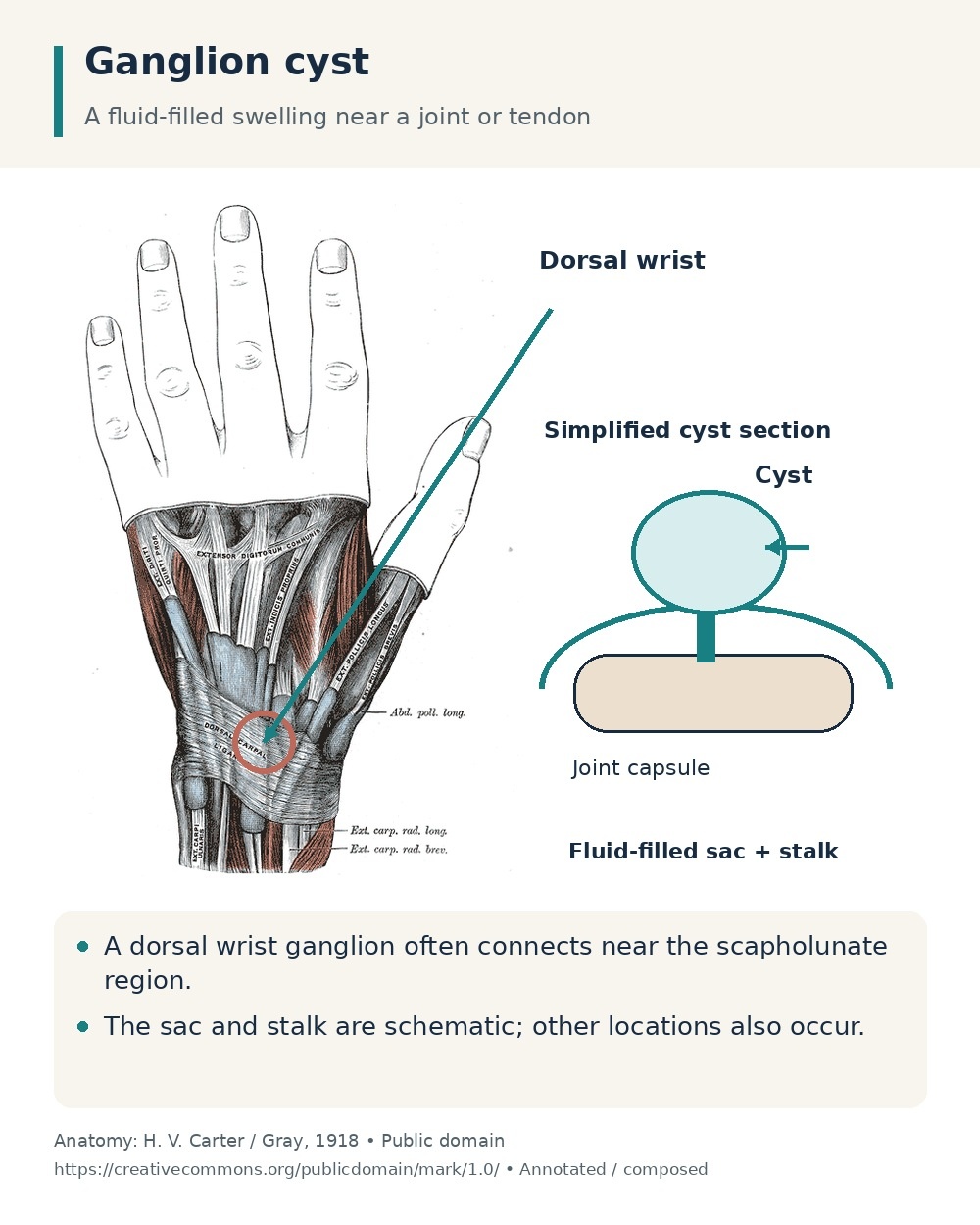
A ganglion is a fluid-filled swelling connected to a joint or tendon sheath. It may change size and can be painless. Confirmed ganglia are benign, but appearance alone cannot identify every lump. Physiotherapy does not remove or drain the cyst.
How we assess your symptoms
We ask whether the lump has changed, examine movement and discuss its effect on daily tasks. Uncertain, hard, fixed or enlarging lumps need medical assessment. A doctor may arrange imaging if the diagnosis is unclear.
Image: H. V. Carter / Gray, 1918 · Public domain. Adapted.
Do You Experience These Symptoms?
- A rounded lump near the wrist, hand or finger joint.
- Aching with leaning on the hand or some wrist positions.
- Occasional restriction or pressure symptoms; some cysts cause none.
An assessment helps guide your next step, based on your symptoms, health and goals.
A treatment plan built around you
Hands-On Manual Therapy
We do not try to burst, crush or massage away a ganglion. If surrounding muscles are uncomfortable, treatment may be considered away from the lump after the diagnosis is established.
Is Shockwave Suitable?
Shockwave is not an established treatment to remove a ganglion. The priority is confirming the diagnosis and discussing observation or medical treatment when appropriate.
Targeted Exercise Programme
Comfortable wrist movement and gradual loading can maintain function. Temporary modification of weight-bearing tasks may help. After surgery, rehabilitation must follow the surgeon’s wound and movement advice.
When to Seek Urgent Medical Help
While most symptoms are not serious, urgent medical attention is required if you experience any of the following:
- Go to A&E immediately after an injury if a joint is deformed or the hand or finger is cold, pale or blue, or has severe loss of sensation. For other severe swelling or inability to use the arm, seek urgent assessment through NHS 111.
- A hot, red, rapidly swollen joint with fever needs urgent medical assessment. Arrange prompt review for persistent numbness, increasing weakness or loss of dexterity.
Your questions answered
Can a ganglion go away on its own?
Some do. A confirmed ganglion that causes little trouble may simply be observed. A doctor can discuss aspiration or surgery when symptoms justify it; recurrence is possible.
Should I hit or pop it?
No. This can injure skin, tendons, nerves or blood vessels and may cause infection. A change in the lump should lead to review rather than self-treatment.
Which appointment should I book?
Have a new or changing lump or contracture checked by your GP. Physiotherapy can help assess movement and discuss suitable support, or rehabilitation after a procedure when recommended. Treatment at our clinic does not replace a hand specialist’s assessment.
Visit J&J Therapy on the ground floor of CI Tower, New Malden. Book an assessment or call our reception team on 07935 869938 if you are unsure which service to choose.
Related conditions
Wrist sprain · Hand and wrist osteoarthritis
Sources and further reading

This page is for general information only and does not replace professional medical advice.
Information updated 15 October 2026. General information to support informed choices; it is not a diagnosis or a personalised treatment plan. Suitability and any need for referral are assessed individually. Seek urgent medical help for the warning signs listed above.