top of page
Physiotherapist assessing a patient with an elbow hyperextension injury at J&J Therapy clinic in New Malden

Elbow Hyperextension Injury

300+ Reviews 5.0

Open 7 Days

10+ Years' Experience

HCPC Physio On Team

Insurance Accepted

85% Return Rate

PHYSIOTHERAPY & THERAPEUTIC MASSAGE IN NEW MALDEN

Quick Summary

An elbow hyperextension injury happens when your elbow is forced backwards beyond its normal straight position, overstretching the soft tissues at the front of the joint and compressing the structures at the back. Most cases are sprains of the joint capsule or ligaments that respond well to physiotherapy, although some involve an associated fracture or joint instability that must be excluded first.


At J&J Therapy, our HCPC-registered physiotherapists assess the severity of your injury, screen for signs that need imaging, and then guide you through protected early movement rather than prolonged rest. Milder injuries often settle within three to six weeks, while more significant sprains typically need eight to twelve weeks of structured rehabilitation.

What Is an Elbow Hyperextension Injury?

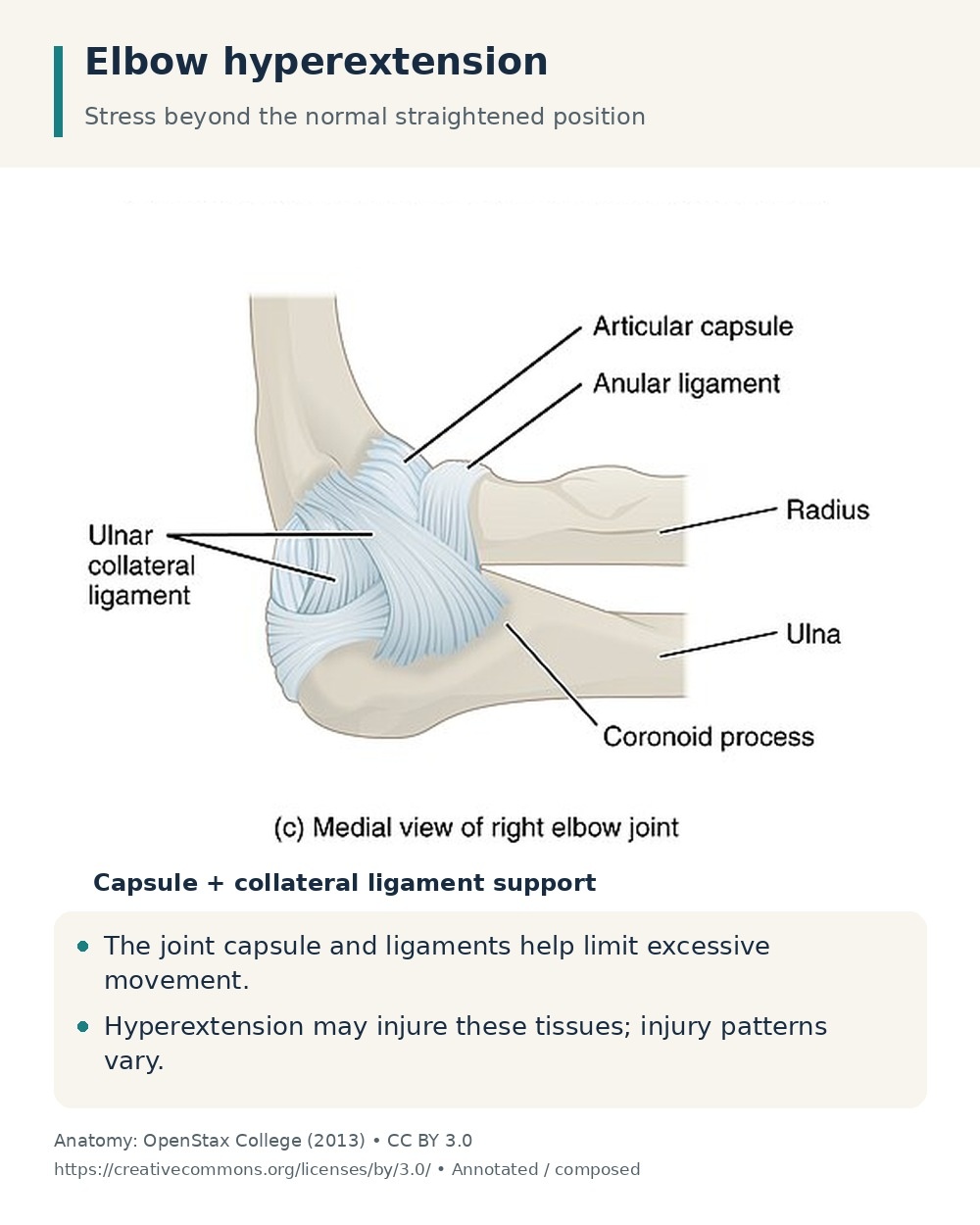
Anatomical diagram of the elbow showing the anterior capsule and collateral ligaments stressed during hyperextension

Your elbow is a hinge joint formed by the humerus, ulna and radius, held together by a combination of bony shape and soft-tissue restraints. The anterior joint capsule, the anterior band of the medial (ulnar) collateral ligament, the lateral collateral ligament complex and the muscles crossing the joint — the biceps and the deeper brachialis — all work to resist excessive straightening, while the olecranon seats into the olecranon fossa at the back.


When the joint is forced past its normal end point, the structures at the front are overstretched and those at the back are compressed together. Cadaveric research has shown a predictable sequence of failure under pure hyperextension loading: the anterior capsule gives way first, followed by stretching or partial tearing of the anterior part of the medial collateral ligament, and occasionally incomplete tearing of the lateral collateral ligament (Tyrdal & Olsen, Journal of Shoulder and Elbow Surgery, 1998). When the forearm is also twisted outwards during the injury, the lateral ligament complex becomes particularly vulnerable.


The injury therefore covers a wide spectrum. It may involve a sprain or tear of the anterior capsule, a strain of the brachialis, impaction of the olecranon at the back of the joint, sprains of the collateral ligaments, or — at the more severe end — a fracture of the coronoid or radial head, or a posterior elbow dislocation. Ligament sprains are usually graded as Grade I (stretched, with the ligament intact), Grade II (partially torn, with some laxity) or Grade III (completely torn, with instability).


Research suggests that people with generalised joint hypermobility, one marker of which is elbow extension beyond ten degrees, may reach damaging end-range positions more easily and can be more prone to hyperextension events and a persistent feeling of instability (Malek et al., Rheumatology International, 2021).

Do You Experience These Symptoms?

✓  Pain at the front of your elbow, worse when you straighten the arm fully or when the joint is pushed backwards

✓  Swelling and sometimes bruising around the joint, most often at the front of the elbow crease

✓  Difficulty or reluctance straightening the elbow completely, because of pain and stiffness

✓  Tenderness to touch at the front of the joint, and sometimes at the back where the bones press together

✓  A sense that the elbow feels weak, unstable or as though it might give way when you push or lean on it

✓  Pain with gripping, lifting, pushing up from a chair, or during throwing and racquet actions

✓  In more significant injuries, a feeling that the joint briefly slipped out of place, which needs urgent assessment

These symptoms can be treated.
The sooner you begin, the better your chances of a smoother recovery.

What Causes an Elbow Hyperextension Injury?

•  Fall on an outstretched hand

Landing on a straightened arm drives the elbow backwards beyond its normal range and is the most common single-event cause.

The force travels through the anterior capsule and collateral ligaments and, in higher-energy falls, on into the bone.


•  Contact and collision sports

Rugby, football, martial arts and wrestling frequently load the elbow into extension during tackles, holds and falls.

Goalkeeping and handball are strongly associated, as blocking a shot can force the elbow sharply backwards.


•  Gymnastics and weight-bearing lockout loading

Gymnastics, cheerleading and bodyweight training repeatedly load a straightened, weight-bearing elbow.

Heavy bench-press or overhead lockout work can also push the joint into its very end range under load.


•  Throwing and overhead sports

Baseball, cricket, javelin and racquet sports generate high sideways and straightening forces during the follow-through phase.

Over time this may produce repeated impaction at the back of the joint alongside strain at the front.


•  Generalised joint hypermobility

If your elbows naturally straighten well beyond neutral, there is less passive ligament protection at end range.

This means damaging positions are reached more easily, and hyperextension injuries may recur more readily.


Not sure which condition applies to you?

How We Treat Elbow Hyperextension Injury at J&J Therapy

Hands-On Manual Therapy

A thorough assessment first grades your injury and screens for the signs that need imaging or onward referral. Once serious injury has been excluded, we use graded joint mobilisation, soft tissue work to the brachialis and biceps, and mobilisation with movement to restore comfortable range — avoiding forced stretching, which can aggravate the healing tissues.

Shockwave Therapy*

Swiss Storz Medical MASTERPULS is not used during the acute stage of an elbow hyperextension injury, where protected movement and healing take priority. Where discomfort becomes long-standing after the injury has fully settled, it may complement your manual therapy and exercise programme when your physiotherapist identifies specific indications during assessment. Evidence in this particular setting is limited, so it is only ever used alongside your rehabilitation and never as a stand-alone treatment.

Targeted Exercise Programme

A staged programme restores pain-free movement first, often using gravity-assisted positions that keep the joint stable, before progressing to isometric and eccentric strengthening of the elbow, forearm and grip. Proprioception and joint-control retraining are central — particularly if you are naturally hypermobile — alongside taping or bracing and a graded return to your sport or occupation.

When to Seek Urgent Medical Help

While most symptoms are not serious, urgent medical attention is required if you experience any of the following:

  • Obvious deformity, or a sense that your elbow slipped out of place — this needs emergency assessment

  • Numbness, pins and needles, weakness, or a cold, pale or bluish hand, or rapidly worsening severe pain

  • Inability to fully straighten your elbow after the injury, as research shows this carries a substantially higher chance of fracture and warrants an X-ray

  • Severe swelling with marked instability, or an inability to use the arm at all

FAQs About Elbow Hyperextension Injury

  • How long will an elbow hyperextension injury take to recover?

It depends on severity. Milder Grade I sprains often settle within three to six weeks, while Grade II and Grade III injuries may need eight to twelve weeks of structured rehabilitation, and the most severe injuries longer.

Starting appropriate physiotherapy early, rather than resting for weeks, generally leads to faster and more complete recovery.


  • Should I rest my elbow completely or keep it moving?

For most sprains, gentle protected movement is better than complete immobilisation. The elbow is very prone to stiffness, and evidence shows early mobilisation reduces stiffness and disability without increasing complications (Iordens et al., British Journal of Sports Medicine, 2017).

Your physiotherapist will guide you on exactly which movements are safe at each stage of healing.


  • Do I need an X-ray or a scan?

Not always. Research on the elbow extension test found that being able to fully straighten the elbow makes a fracture much less likely, while an inability to do so warrants referral for radiography (Appelboam et al., BMJ, 2008).

Deformity, significant bony tenderness or any numbness or circulation changes also require imaging. Our physiotherapists screen for these signs and refer you on where appropriate.


  • Will my elbow become unstable or hyperextend again?

Most people regain full, stable function with rehabilitation. If you are naturally hypermobile, or you have had a more significant ligament injury, the risk of recurrence is higher.

For this reason we place particular emphasis on strengthening and joint-control training, and sometimes bracing, to protect the joint as you return to activity.


  • Can shockwave therapy treat my elbow hyperextension injury?

Shockwave therapy is not used for a fresh elbow hyperextension injury. It is not supported in acute ligament or capsular injury, and the early stage is best managed with protected movement, manual therapy and exercise.

Occasionally, if discomfort becomes long-standing once the injury has fully settled, our physiotherapists may assess whether radial shockwave therapy using the Swiss Storz Medical MASTERPULS could support your rehabilitation as a second-line option — always after a full assessment and always alongside your exercise programme.


Not sure this condition matches your symtoms?
Find your condition and explore related pain areas.

Logo_Navy.png

Ready to start your recovery?
Book your Initial Assessment today.

This page is for general information only and does not replace professional medical advice.

Reviewed by Lavya Arigalayan, MSc, HCPC Registered Physiotherapist.

Last reviewed

2026년 8월 20일

bottom of page