top of page
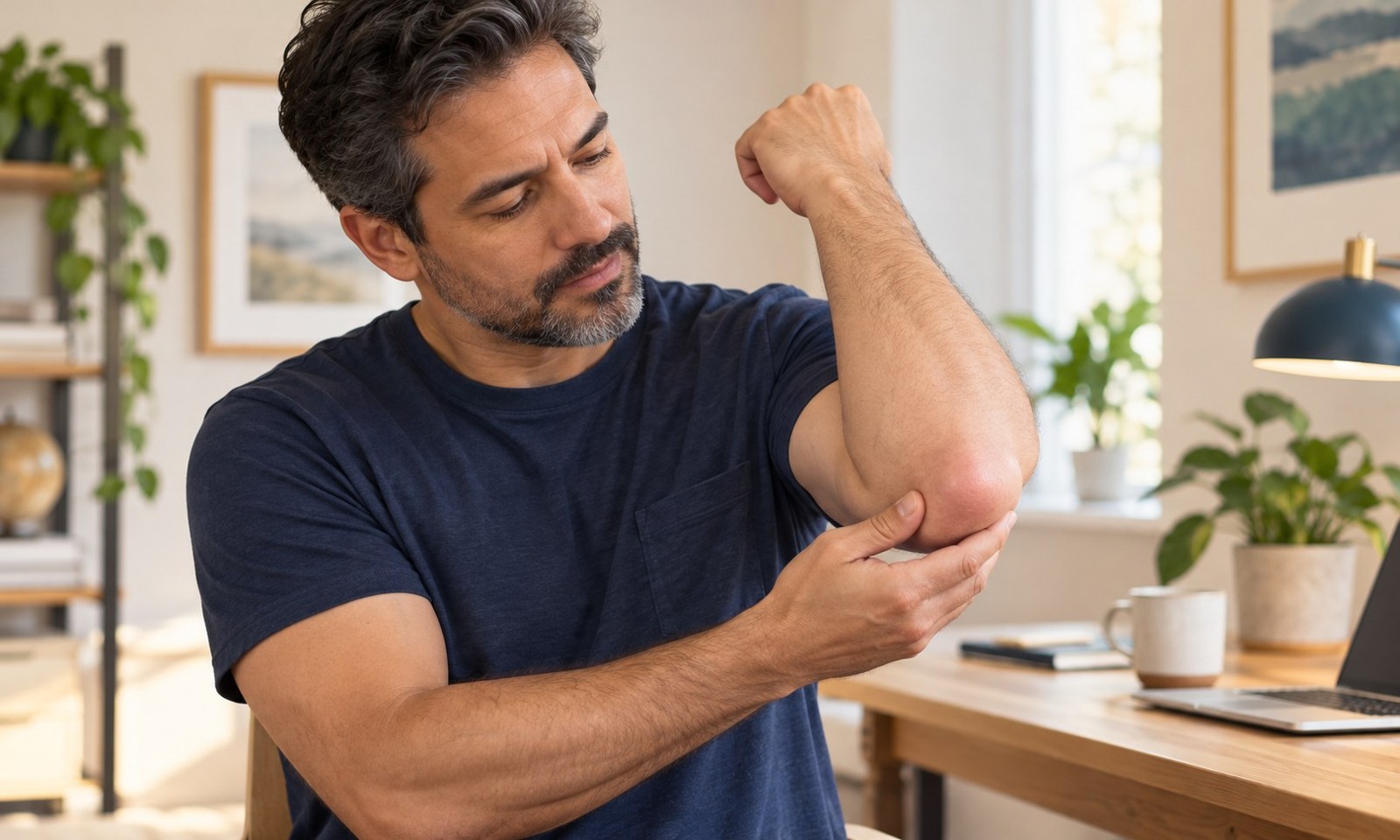
Physiotherapist examining the swollen bony tip of a patient’s elbow in a New Malden clinic

Elbow Bursitis (Olecranon)

300+ Reviews 5.0

Open 7 Days

10+ Years' Experience

HCPC Physio On Team

Insurance Accepted

85% Return Rate

PHYSIOTHERAPY & THERAPEUTIC MASSAGE IN NEW MALDEN

Quick Summary

Elbow bursitis (olecranon bursitis) is inflammation of the small fluid-filled sac over the bony point of your elbow, producing a visible swelling that is often tender to lean on. Most non-infected cases settle well with conservative care — research suggests that compression, activity modification and simple pain relief resolve the majority within a few weeks. Our physiotherapists combine hands-on manual therapy with targeted exercises specifically suited to protecting and offloading your elbow, typically over 3–6 sessions.

What Is Elbow Bursitis?

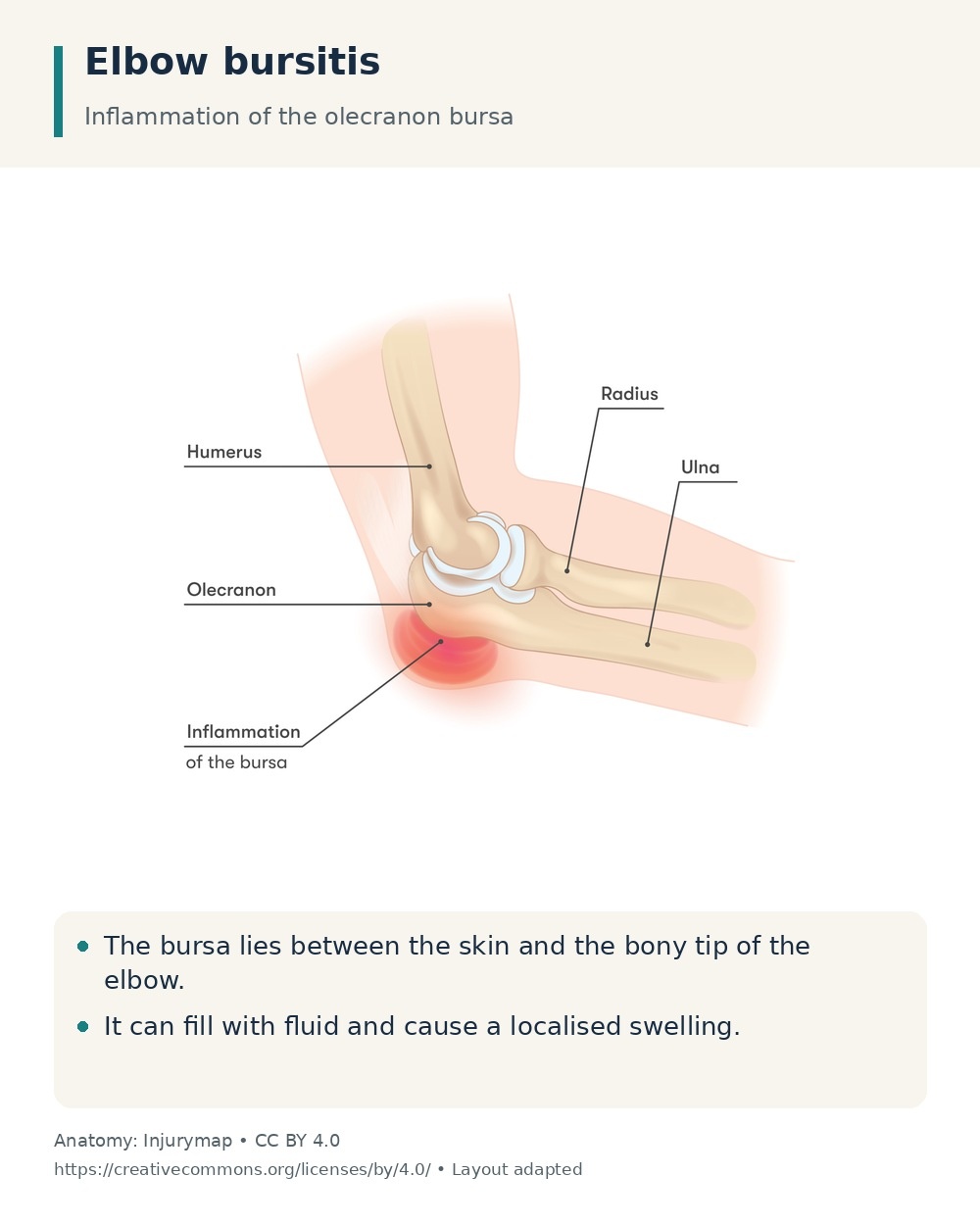
Anatomical illustration of the olecranon bursa between the skin and the bony tip of the elbow

The olecranon bursa is a thin, fluid-filled sac that sits between your skin and the olecranon — the bony tip of your elbow. Its job is to reduce friction as the skin glides over the bone when you bend and straighten your arm. When the bursa becomes irritated or inflamed, fluid builds up inside it and creates the characteristic swelling at the back of the elbow, often described as a soft goose-egg.


Elbow bursitis is relatively common, with a reported minimum annual incidence of up to 10 per 100,000 (Kim et al., Clinical Orthopaedics and Related Research, 2016). It occurs more often in men, and several health conditions raise the risk, including rheumatoid arthritis, gout and other crystal arthropathies, diabetes, and chronic kidney disease (Nchinda and Wolf, Journal of Hand Surgery, 2021).


The main types

Acute bursitis often follows a single knock or fall onto the elbow. Chronic bursitis develops gradually from repeated pressure or leaning — the reason it has long been nicknamed student’s elbow or miner’s elbow — and can leave the bursa thickened and lumpy. Haemorrhagic bursitis involves bleeding into the sac after an injury.


Why infection must be ruled out first

Septic bursitis means the sac itself has become infected, most often with Staphylococcus aureus. This matters because it is common — evidence shows roughly one in five cases overall are septic, rising to as many as half of those presenting to emergency departments (Beyde et al., Academic Emergency Medicine, 2022) — and because it needs medical treatment rather than hands-on therapy. Our physiotherapists therefore assess carefully for signs of infection before any local treatment begins, and will direct you promptly to your GP or urgent care if there is any doubt.


For non-infected elbow bursitis the outlook is generally good. In a randomised trial, compression with a short course of anti-inflammatory medication resolved most cases in around 3.2 weeks, comparable to aspiration at 3.1 weeks, and with fewer complications than invasive options (Kim et al., 2016; Sayegh and Strauch, Archives of Orthopaedic and Trauma Surgery, 2014). Recurrence is common if the elbow continues to be knocked or leaned on, which is why offloading and technique advice form a central part of our care.

Do You Experience These Symptoms?

✓  Visible swelling over the point of your elbow — often a soft, squashy lump that protrudes noticeably

✓  Tenderness when you lean on the back of your elbow or press on the swelling

✓  Swelling that appears over a few hours to a few days, sometimes after a knock or fall

✓  Discomfort at the end of fully bending your elbow, as the swollen bursa is squeezed

✓  A firm, thickened or lumpy feel to the area in longstanding cases, which may be painless

✓  Warmth and redness over the swelling — a possible sign of infection that needs prompt medical review

✓  Catching or knocking the elbow more often, because the swelling sticks out further than usual

These symptoms can be treated.
The sooner you begin, the better your chances of a smoother recovery.

What Causes Elbow Bursitis?

•  Direct trauma or a single blow

A hard knock or a fall onto the tip of the elbow can damage small blood vessels within the bursa, triggering bleeding and inflammation.

This is one of the most common reasons for sudden, obvious swelling appearing within hours of an injury.


•  Repeated pressure and leaning

Prolonged or repetitive leaning on the elbow irritates the bursa over time, which is why the condition is so common in students, office workers, gardeners, mechanics and plumbers.

This chronic pattern tends to produce a thickened bursa that flares up repeatedly unless the pressure is reduced.


•  Infection entering through the skin

Because the bursa lies just beneath the surface, bacteria can enter through a cut, graze, insect bite or puncture over the elbow and infect the sac.

Even a minor break in the skin can be enough, which is why any redness, warmth or fever alongside the swelling needs same-day medical assessment.


•  Inflammatory and systemic conditions

Rheumatoid arthritis, gout and other crystal arthropathies can inflame the bursa directly, sometimes producing recurrent episodes without any injury.

Diabetes and chronic kidney disease also raise the risk, both by promoting inflammation and by affecting how well the body handles infection.


•  Occupational and sporting pressure

Sports involving falls onto the elbow or repeated ground contact, such as football, wrestling and martial arts, place the bursa under repeated stress.

Work that involves kneeling and propping on hard surfaces has a similar effect, particularly without protective padding.

Not sure which condition applies to you?

How We Treat Elbow Bursitis at J&J Therapy

Hands-On Manual Therapy

Gentle hands-on techniques around the elbow to settle discomfort and maintain movement, once infection has been excluded.
Combined with practical advice on offloading, protective padding and activity modification from your first session.

Shockwave Therapy*

For conditions involving a superficial fluid-filled bursa where infection must first be excluded, our care emphasises specialised manual therapy and targeted exercises — the most appropriate approach for your specific needs.

Targeted Exercise Programme

A graded programme starting with pain-free elbow and wrist range-of-motion work, progressing to forearm, triceps and shoulder strengthening.
Includes practical guidance on protecting the elbow to reduce the chance of recurrence.

When to Seek Urgent Medical Help

While most symptoms are not serious, urgent medical attention is required if you experience any of the following:

  • Spreading redness, warmth, fever or feeling generally unwell — possible signs of an infected bursa needing same-day assessment

  • Any cut, graze, bite or break in the skin over the swelling

  • Rapidly increasing pain or swelling, or fluid or pus draining from the elbow

  • Severe pain, inability to move the elbow, or fever with chills and fatigue

FAQs About Elbow Bursitis

  • Will elbow bursitis get better on its own?

Most non-infected cases settle with simple measures. In a randomised trial, compression with a short course of anti-inflammatory medication resolved most cases in around 3.2 weeks — comparable to draining the fluid, and with fewer complications. Recurrence is common if the elbow continues to be knocked or leaned on, so protecting the area matters just as much as settling the current episode.


  • How do I know if my elbow bursitis is infected?

Infected bursitis tends to bring spreading redness, warmth, marked tenderness and sometimes fever, and there is often a break in the skin nearby. Because evidence shows roughly one in five cases are infected — and the difference is not always obvious from the outside — we assess carefully at your first appointment and will refer you to your GP or urgent care if there is any doubt.


  • What does treatment at J&J Therapy involve?

After a thorough assessment to rule out infection, our physiotherapists combine gentle manual therapy with practical advice on offloading the elbow and a graded exercise programme to restore movement and strength. Most people need only a short course of around 3–6 sessions over four to six weeks, and we liaise with your GP if drainage or an injection is being considered.


  • Should I have the fluid drained or have an injection?

Draining the fluid can relieve a tense, uncomfortable swelling, and a corticosteroid injection may speed things up, but both carry risks. A systematic review found that around one in nine patients who received a steroid injection developed thinning of the skin and underlying tissue, with more complications overall (Sayegh and Strauch, 2014). These procedures are usually reserved for persistent cases and decided with your GP.


  • Do you use shockwave therapy for elbow bursitis?

No — and we think it is worth explaining why. Elbow bursitis involves a superficial, fluid-filled sac lying directly over the bony tip of the elbow, and a significant proportion of cases are caused by infection, so shockwave is not a clinically appropriate option here. There is also no published research supporting its use for this particular condition. Our care instead emphasises careful assessment, specialised manual therapy and targeted exercises, with prompt medical referral when infection needs excluding.

Not sure this condition matches your symtoms?
Find your condition and explore related pain areas.

Logo_Navy.png

Ready to start your recovery?
Book your Initial Assessment today.

This page is for general information only and does not replace professional medical advice.

Reviewed by Lavya Arigalayan, MSc, HCPC Registered Physiotherapist.

Last reviewed

2026년 8월 20일

bottom of page