Quick Summary
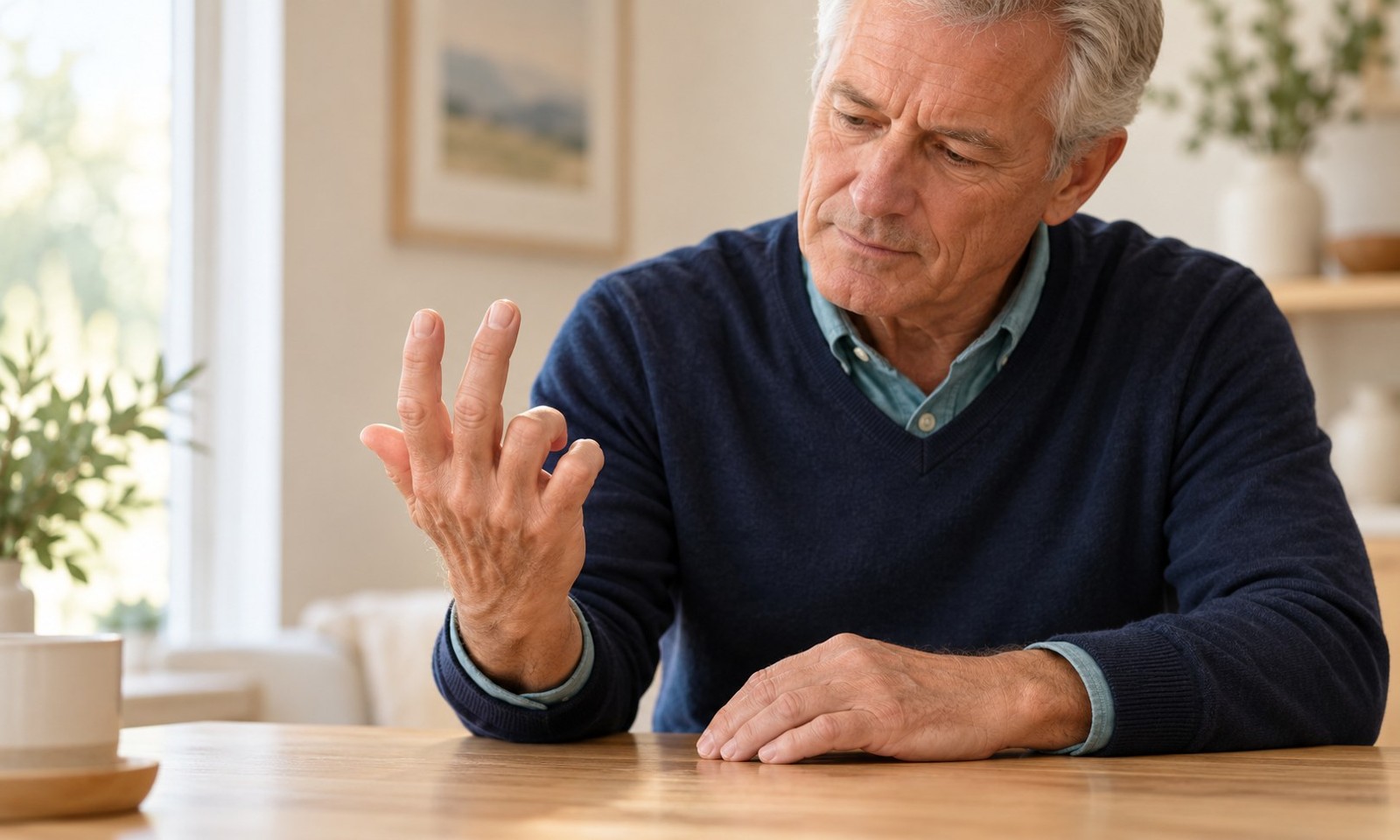
A firm palm nodule or a finger gradually bending towards the palm may be Dupuytren’s disease. Assessment helps distinguish it from other hand problems and identify when a hand specialist should advise on treatment.
Understanding Dupuytren’s Contracture
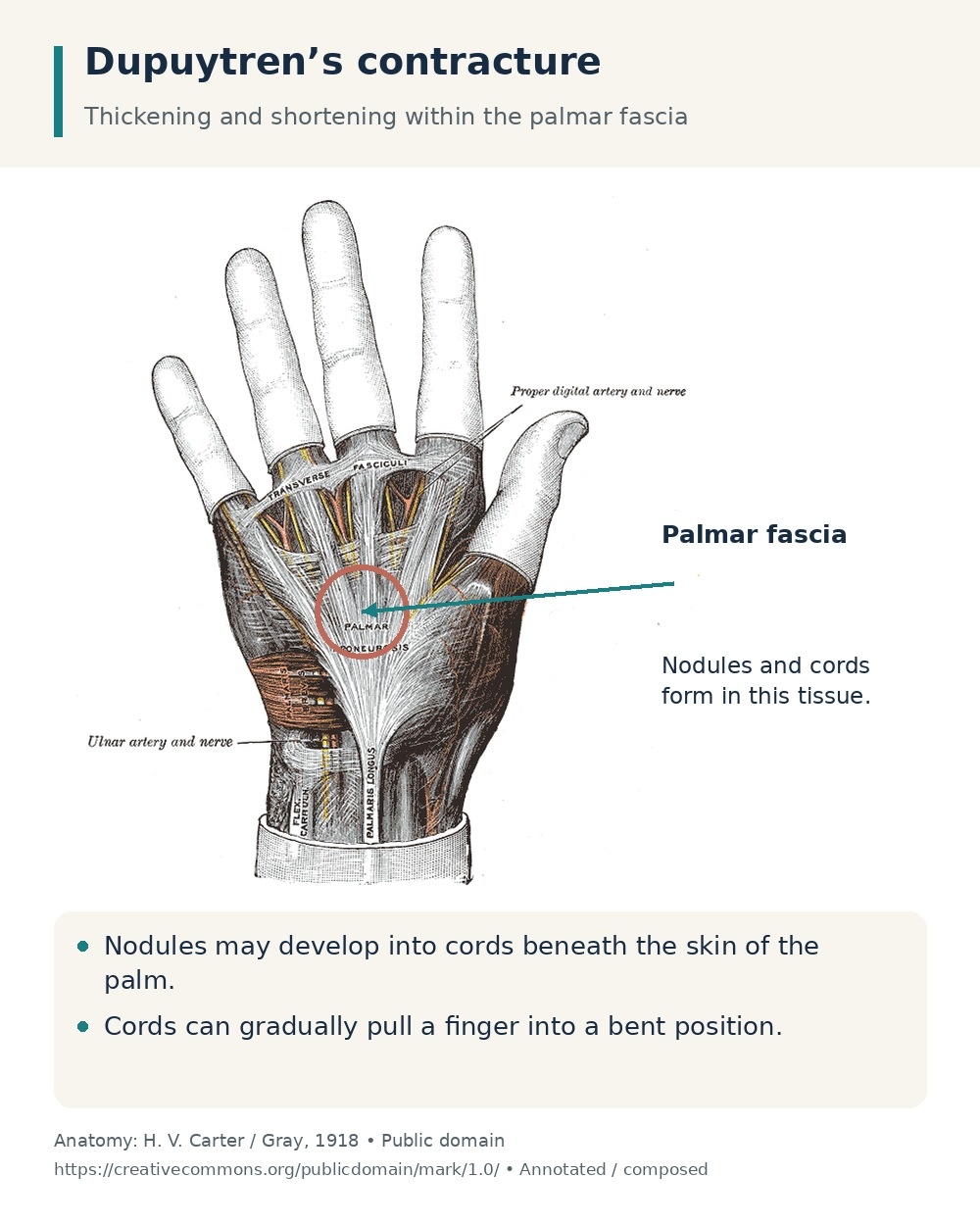
Dupuytren’s affects the tissue beneath the skin of the palm. Nodules may develop into cords that limit finger straightening, often involving the ring or little finger. It is not simply a tight muscle or tendon that can be stretched or massaged back to normal.
How we assess your symptoms
We discuss changes in hand use and assess the degree of movement restriction. If you cannot place the palm and fingers flat, or the bend is progressing, a GP or hand specialist can discuss whether a procedure is appropriate.
Image: H. V. Carter / Gray, 1918 · Public domain. Adapted.
Do You Experience These Symptoms?
- Firm nodules, skin dimpling or cords in the palm.
- Gradual loss of finger extension.
- Difficulty putting the hand flat, wearing gloves or reaching into a pocket.
An assessment helps guide your next step, based on your symptoms, health and goals.
What may contribute?
The cause is not fully understood and it often runs in families. Progression varies considerably. Some nodules remain stable, while others develop a contracture over time; forceful stretching has not been established as a way to prevent this.
A treatment plan built around you
Hands-On Manual Therapy
Massage is not a proven way to dissolve Dupuytren’s cords or reverse a fixed contracture. After a procedure, scar and swelling management may be appropriate only within the hand team’s rehabilitation instructions.
Is Shockwave Suitable?
Shockwave is not offered here as a proven way to remove Dupuytren’s cords or correct contracture. Appropriate medical review is more useful than promising a non-surgical cure.
Targeted Exercise Programme
We can support comfortable hand use and prescribed rehabilitation after treatment. Any splinting or exercise programme is matched to the procedure and specialist advice rather than forcing a contracted finger straight.
When to Seek Urgent Medical Help
While most symptoms are not serious, urgent medical attention is required if you experience any of the following:
- Go to A&E immediately after an injury if a joint is deformed or the hand or finger is cold, pale or blue, or has severe loss of sensation. For other severe swelling or inability to use the arm, seek urgent assessment through NHS 111.
- A hot, red, rapidly swollen joint with fever needs urgent medical assessment. Arrange prompt review for persistent numbness, increasing weakness or loss of dexterity.
Your questions answered
Does a small nodule need treatment immediately?
Not always. Monitoring may be appropriate when function is unaffected. A new lump still needs diagnosis, and increasing loss of extension should be reviewed.
Can treatment stop it returning?
No treatment guarantees that. A specialist can explain options for a troublesome contracture, expected benefits and recurrence risk. Rehabilitation supports recovery but does not remove the underlying tendency.
Which appointment should I book?
Have a new or changing lump or contracture checked by your GP. Physiotherapy can help assess movement and discuss suitable support, or rehabilitation after a procedure when recommended. Treatment at our clinic does not replace a hand specialist’s assessment.
Visit J&J Therapy on the ground floor of CI Tower, New Malden. Book an assessment or call our reception team on 07935 869938 if you are unsure which service to choose.
Related conditions
Trigger finger · Hand osteoarthritis
Sources and further reading

This page is for general information only and does not replace professional medical advice.
Information updated 15 October 2026. General information to support informed choices; it is not a diagnosis or a personalised treatment plan. Suitability and any need for referral are assessed individually. Seek urgent medical help for the warning signs listed above.