top of page
Physiotherapist at J&J Therapy in New Malden assessing a patient's lower back during a chronic low back pain consultation

Chronic Low Back Pain

300+ Reviews 5.0

Open 7 Days

10+ Years' Experience

HCPC Physio On Team

Insurance Accepted

85% Return Rate

PHYSIOTHERAPY & THERAPEUTIC MASSAGE IN NEW MALDEN

Quick Summary

Chronic low back pain is pain that persists for 12 weeks or more, and it can affect your sleep, your mood and your ability to get on with daily life.


At J&J Therapy in New Malden, our HCPC-registered physiotherapists combine hands-on manual therapy with a tailored, progressive exercise programme — the approach most strongly supported by current UK guidance.


Most people benefit from a planned course of treatment over several weeks rather than a single visit, with your programme reviewed and progressed as you improve.

What Is Chronic Low Back Pain?

Diagram of the lower spine and lumbar muscles illustrating common sources of chronic low back pain

Low back pain is pain and discomfort felt below the rib margin and above the buttock creases, with or without leg pain. It is described as chronic, or persistent, when it has lasted 12 weeks (three months) or longer.


For most people it is not possible to identify one specific tissue as the source. Around 90–95% of cases are classified as non-specific low back pain, roughly 5–10% involve a nerve-root (radicular) syndrome, and specific spinal pathology accounts for under 1% of presentations in primary care (Hartvigsen et al., Lancet, 2018). Non-specific does not mean nothing is wrong — your pain is real, but it cannot be pinned to a single structure.


Why pain persists

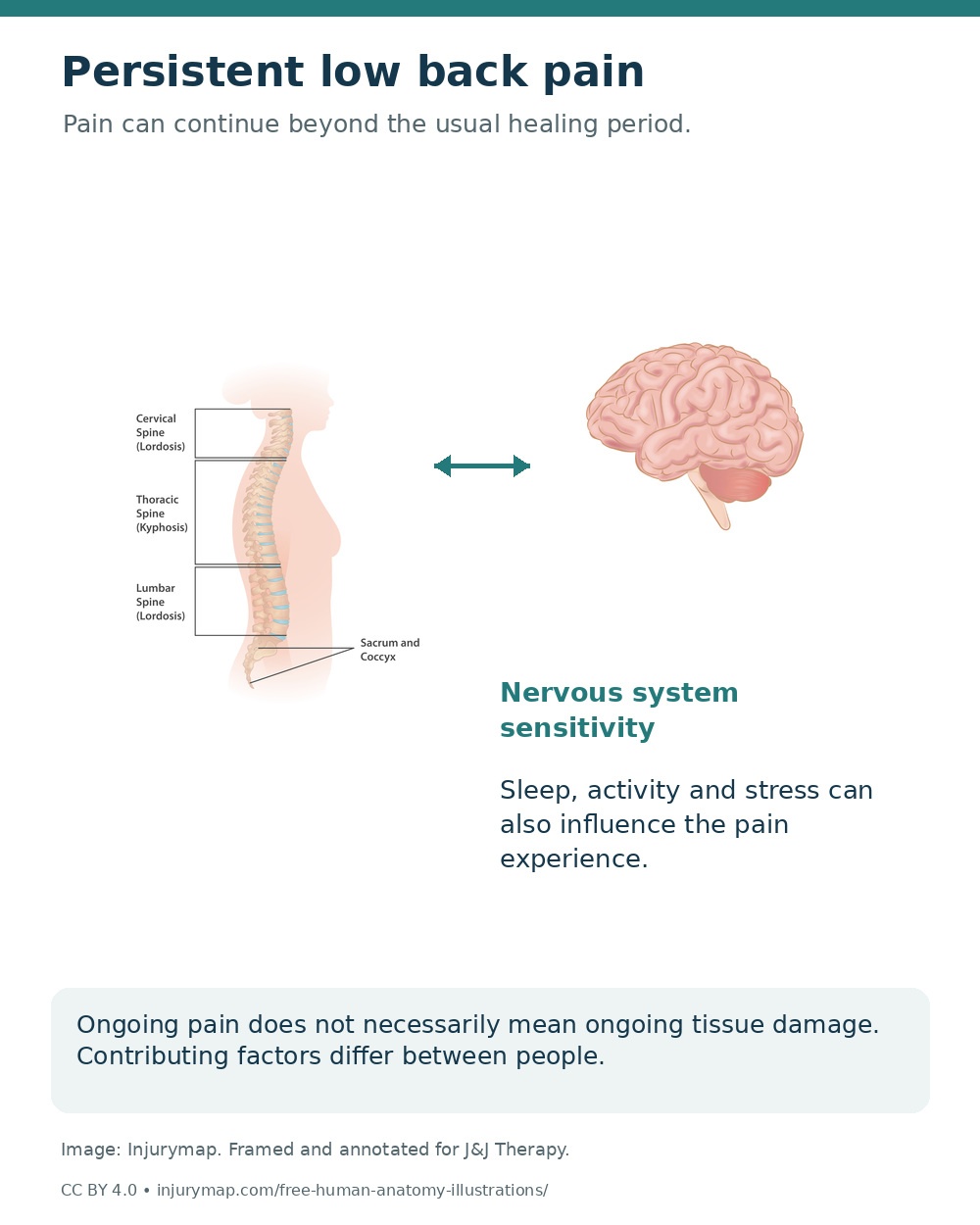
Persistent back pain is best understood through a biopsychosocial model. Physical factors such as muscles, joints and movement patterns interact with sleep quality, stress, mood and worry about movement, as well as with work and activity demands (Hartvigsen et al., Lancet, 2018). Over time the nervous system can also become more sensitive and amplify pain signals, which helps explain why symptoms may continue after the original tissue irritation has settled.


What scans do and do not tell you

Findings on imaging often do not match how much pain someone has. A large systematic review found disc degeneration in 37% of pain-free 20-year-olds, rising to 96% of pain-free 80-year-olds, with disc bulges rising from 30% to 84% across the same age range (Brinjikji et al., AJNR, 2015). These changes are a normal part of ageing for many people, and finding them on a scan does not mean your back is damaged or fragile. This is why current UK guidance advises against routine imaging for non-specific low back pain (NICE NG59, 2016, updated 2020).


What to expect

Serious causes are rare, but persistent and recurrent symptoms are common and can fluctuate from week to week. The encouraging message from the evidence is that staying active, rebuilding confidence in movement and addressing sleep and stress can meaningfully reduce how much pain interferes with your life. Recent high-quality trial evidence shows that individualised, biopsychosocially informed physiotherapy produces large improvements in activity limitation that are sustained at 12 months (Kent et al., Lancet, 2023).

Do You Experience These Symptoms?

✓  Pain in your lower back that has lasted 12 weeks or more, with an intensity that rises and falls over time

✓  Stiffness and reduced movement, often worse first thing in the morning or after sitting still

✓  Aching, burning or occasionally sharp pain that may spread into your buttock or the back of your thigh

✓  Symptoms that flare with certain activities, prolonged postures, or during periods of stress or poor sleep

✓  Disturbed sleep, tiredness or low mood linked to living with ongoing pain

✓  A sense that your back feels vulnerable, leading you to avoid certain movements or activities

✓  Difficulty with everyday tasks such as bending, lifting, dressing or sitting for long periods

These symptoms can be treated.
The sooner you begin, the better your chances of a smoother recovery.

What Causes Chronic Low Back Pain?

•  Non-specific mechanical low back pain

In most cases no single tissue can be identified as the source, and symptoms relate to how the muscles, joints and discs of your lower back are loading and moving.

This is by far the most common pattern and, reassuringly, it is not a sign of serious disease.


•  Age-related and disc-related changes

Changes such as disc degeneration and disc bulging become more common with age and are frequently found in people with no pain at all (Brinjikji et al., AJNR, 2015).

They may contribute to symptoms in some people, but on their own they do not reliably explain pain and are not a cause for alarm.


•  Myofascial and muscular dysfunction

Overload, weakness or sustained tension in the muscles that support your spine — particularly the quadratus lumborum and the lumbar paraspinals — can generate persistent pain and tender trigger points.

This myofascial component is often overlooked, yet it is one of the patterns that responds well to targeted hands-on treatment and progressive loading.


•  Lifestyle and psychosocial factors

Low physical activity, sedentary or heavy work, poor sleep, stress, low mood and worry about movement are all associated with back pain becoming persistent.

Addressing these factors is a core part of effective, evidence-based care rather than an optional extra.


•  Specific spinal pathology (uncommon)

In a small minority of cases back pain is caused by a specific condition such as a fracture, infection, inflammatory disease or nerve compression.

In one primary care study of 1,172 patients, fewer than 1% had serious underlying pathology (Henschke et al., Arthritis & Rheumatism, 2009) — but our physiotherapists always screen for these features at your first appointment.

Not sure which condition applies to you?

How We Treat Chronic Low Back Pain at J&J Therapy

Hands-On Manual Therapy

Hands-on spinal mobilisation and soft tissue techniques to reduce pain, ease stiffness and restore your confidence to move. Research suggests spinal manual therapy offers short-term pain relief comparable to other recommended treatments, with a small improvement in function (Rubinstein et al., BMJ, 2019). In line with NICE guidance, we use manual therapy alongside your exercise programme rather than on its own.

Shockwave Therapy*

Swiss Storz Medical MASTERPULS
may be considered when your assessment identifies a myofascial component, such as tension or trigger points in the muscles alongside your spine. It is applied only to the paraspinal soft tissue, never over the spine itself.
Evidence for back pain is limited and it is never used as a first-line or stand-alone treatment — your physiotherapist will advise whether it is suitable for you.

Targeted Exercise Programme

A progressive, individualised exercise programme is the cornerstone of evidence-based care for persistent back pain, and the best results usually build over 8–12 weeks rather than a few sessions (Foster et al., Lancet, 2018). We rebuild your strength, mobility and confidence to move, taking a psychologically informed approach where worry, low mood or poor sleep are contributing to your symptoms.

When to Seek Urgent Medical Help

While most symptoms are not serious, urgent medical attention is required if you experience any of the following:

  • Difficulty passing or controlling urine, loss of bowel control, or numbness around your back passage, genitals or inner thighs

  • New weakness, heaviness or loss of sensation in one or both legs

  • Unexplained weight loss, fever or chills, a history of cancer, or constant pain that is markedly worse at night and unrelieved by rest

  • Back pain following a significant fall or accident, or in anyone with osteoporosis or long-term steroid use

FAQs About Chronic Low Back Pain

  • My back pain has lasted for months — does that mean something is seriously wrong, and do I need a scan?

In most cases, no. Persistent low back pain is very common and only rarely caused by serious disease. Current UK guidance advises against routine scans for non-specific low back pain, because changes such as disc bulges are found in large numbers of people who have no pain at all and the findings can be misleading (Brinjikji et al., AJNR, 2015; NICE NG59). Our physiotherapists carry out a thorough assessment, screen for warning signs, and will refer you on if a scan or specialist opinion is genuinely needed.


  • How long will it take to feel better, and how many sessions will I need?

Persistent pain usually responds to a planned course of treatment over several weeks rather than a single session, and the benefits of exercise typically build over 8–12 weeks (Foster et al., Lancet, 2018). Everyone is different, so after your initial assessment we will give you a realistic estimate and review your progress as we go.


  • Should I rest, or keep active?

Keeping gently active is one of the most helpful things you can do. Prolonged bed rest tends to make persistent back pain worse, whereas staying active, pacing your activities and gradually building up supports recovery — a core message of both NHS advice and NICE guidance. Our team will help you find the right starting level and progress safely.


  • Can shockwave therapy help my chronic low back pain?

Sometimes, but only in specific circumstances. Shockwave is not a first-line or stand-alone treatment for back pain, and the evidence base is limited and of modest quality. Where your assessment identifies a myofascial component — tension or trigger points in the muscles alongside your spine — research suggests shockwave combined with exercise may help reduce pain and improve function (Walewicz et al., Clinical Interventions in Aging, 2019). It is applied only to the paraspinal muscles, never over the spine itself, and it is not suitable for everyone. Your physiotherapist will advise whether it is appropriate for you.


  • Do I need a GP referral, and can I use my private insurance?

You do not need a GP referral to see us — you can book directly. We welcome both self-paying patients and those using private medical insurance, and we accept Bupa and AXA. If you would prefer to be seen in Korean, please let us know when you book.

Not sure this condition matches your symtoms?
Find your condition and explore related pain areas.

Logo_Navy.png

Ready to start your recovery?
Book your Initial Assessment today.

This page is for general information only and does not replace professional medical advice.

Reviewed by Lavya Arigalayan, MSc, HCPC Registered Physiotherapist.

Last reviewed

2026년 8월 20일

bottom of page