top of page
Physiotherapist assessing the acromioclavicular joint at the top of a patient’s shoulder at J&J Therapy in New Malden

AC Joint Osteoarthritis

300+ Reviews 5.0

Open 7 Days

10+ Years' Experience

HCPC Physio On Team

Insurance Accepted

85% Return Rate

PHYSIOTHERAPY & THERAPEUTIC MASSAGE IN NEW MALDEN

Quick Summary

Acromioclavicular (AC) joint osteoarthritis is wear of the small joint at the very top of your shoulder, where your collarbone meets your shoulder blade. It causes pain that is typically pinpointed with one finger and is worse when you reach across your body or overhead. Our HCPC-registered physiotherapists combine hands-on manual therapy with a targeted exercise programme to reduce your pain and restore comfortable movement — most patients benefit from a course of around 6–12 sessions.

What Is AC Joint Osteoarthritis?

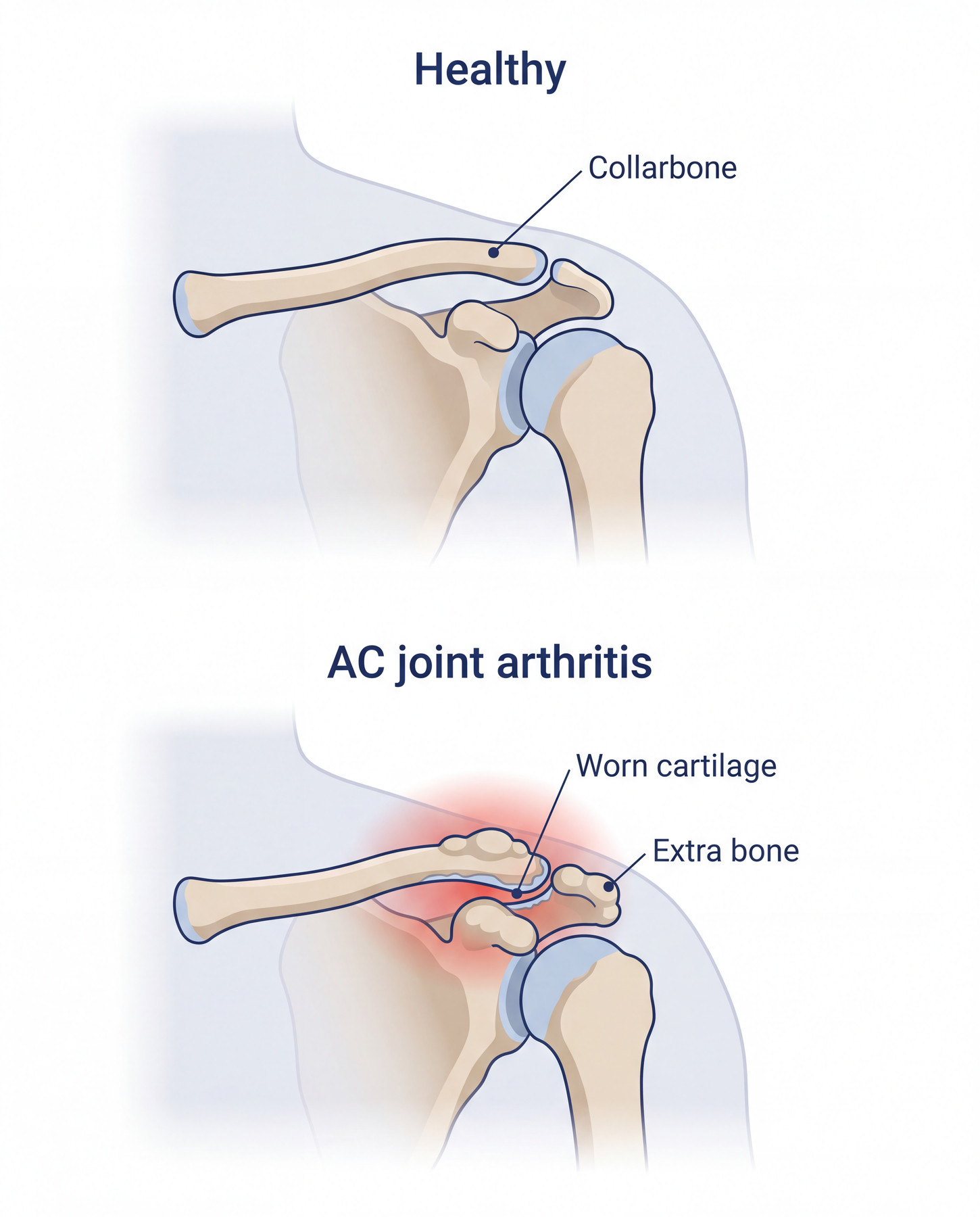
Illustration of the acromioclavicular joint where the collarbone meets the shoulder blade, showing joint wear

The acromioclavicular joint — usually shortened to the AC joint — is a small synovial joint that connects the outer end of your collarbone (clavicle) to the acromion, a bony projection of your shoulder blade. Inside it sits a fibrocartilaginous disc that cushions the joint, playing a role similar to the meniscus in your knee.


Because it is a small joint transmitting large loads across a very small contact area, the AC joint is prone to early wear. Research suggests the cushioning disc can begin to break down from the second decade of life, often without causing any symptoms until many years later (Mall et al., American Journal of Sports Medicine, 2013).


Importantly, degenerative changes on imaging are extremely common and increase with age, which is why scans alone cannot diagnose this condition. A systematic review found AC joint degenerative changes in around 48% of cadaver and skeletal specimens and 70% of MRI scans of shoulders that were causing no symptoms at all (Rossano et al., Journal of Orthopaedics, 2022). This is why we diagnose symptomatic AC joint osteoarthritis clinically — through your history and a careful examination — rather than from an X-ray or MRI report alone.


As a source of shoulder pain, AC joint problems account for approximately 13–24% of patients presenting with shoulder pain, with isolated symptomatic AC joint osteoarthritis estimated at around 7% (Farrell et al., Shoulder & Elbow, 2019). It is recognised as one of the most common shoulder conditions in adults over 40, after rotator cuff problems.


Radiographic severity is often described in grades — progressing from mild narrowing of the joint space, through the formation of bony spurs (osteophytes), to markedly abnormal joints in advanced disease. Symptoms do not track neatly with these grades, and many people with significant imaging changes have no pain whatsoever.


Evidence shows that therapeutic exercise — including local muscle strengthening and general fitness work — is a core first-line treatment for all people with osteoarthritis, tailored to the individual (NICE NG226, 2022).

Do You Experience These Symptoms?

✓  Localised pain at the very top and outer edge of your shoulder — often the kind you can point to with one finger

✓  Pain that worsens when you reach your arm across your body, such as putting on a seatbelt or washing the opposite shoulder

✓  Discomfort with overhead activities and lifting, including reaching into high cupboards

✓  Tenderness directly over the joint, sometimes with a visible or palpable bony bump at the top of your shoulder

✓  Night pain, particularly when lying on the affected side

✓  Clicking, grinding or a grating sensation as you move your shoulder

✓  Occasional referred ache into the upper trapezius, the base of your neck or the front of your shoulder

These symptoms can be treated.
The sooner you begin, the better your chances of a smoother recovery.

What Causes AC Joint Osteoarthritis?

•  Age-related degeneration

The cushioning disc and cartilage within the AC joint wear down gradually under cumulative load over decades.

This is the most common cause, and explains why AC joint osteoarthritis becomes increasingly prevalent in middle-aged and older adults.


•  Previous AC joint injury or separation

A past shoulder separation (an AC joint sprain) or a fall directly onto the point of your shoulder alters how the joint loads and moves.

This can lead to post-traumatic osteoarthritis developing considerably earlier than age-related wear alone would produce.


•  Repetitive overhead loading

Occupations and sports involving repeated overhead reaching, carrying or lifting place high, repetitive forces through this small joint.

Over time this may accelerate degeneration of the fibrocartilaginous disc and the joint surfaces.


•  Heavy weight training

Heavy pressing exercises — particularly bench press, dips and overhead press — transmit substantial forces across the AC joint.

Sustained high-load training is a well-recognised contributor and is also linked to distal clavicle osteolysis, a related overuse condition sometimes called weightlifter’s shoulder.


•  Manual and overhead occupations

Painting, plastering, scaffolding, warehouse work and similar roles combine sustained overhead positions with load.

The repeated compression across the joint through the working day may contribute to symptom onset and flare-ups.

Not sure which condition applies to you?

How We Treat AC Joint Osteoarthritis at J&J Therapy

Hands-On Manual Therapy

Targeted mobilisation of the AC joint and surrounding shoulder girdle, with soft-tissue techniques for the trapezius and periscapular muscles — plus assessment of your neck and thoracic spine, which often contribute to symptoms at the top of the shoulder.

Shockwave Therapy*

Swiss Storz Medical MASTERPULS
may complement your manual therapy and exercise programme when your physiotherapist identifies specific indications during assessment.
Non-invasive, evidence-based.

Targeted Exercise Programme

A progressive programme focusing on scapular control, rotator cuff and periscapular strengthening, alongside practical load modification — such as adjusting your grip width, range or exercise selection — so you can stay active while offloading the joint.

When to Seek Urgent Medical Help

While most symptoms are not serious, urgent medical attention is required if you experience any of the following:

  • A hot, red, swollen shoulder with fever or feeling generally unwell (possible infection)

  • An unexplained lump or mass around the shoulder, or new shoulder pain with a history of cancer

  • Significant trauma with visible deformity, sudden loss of shoulder function or marked weakness

  • Constant night pain alongside unexplained weight loss or night sweats

FAQs About AC Joint Osteoarthritis

  • How is AC joint osteoarthritis diagnosed?

Diagnosis is primarily clinical. Our physiotherapists localise tenderness directly over the AC joint and use provocation tests such as the cross-body (scarf) adduction test and O’Brien’s active compression test, interpreted together rather than in isolation. Because degenerative changes appear on scans of many people with no symptoms, imaging is read alongside your examination — research shows individual AC joint tests have limited accuracy on their own, so the combined clinical picture is most reliable (Cadogan et al., BMC Musculoskeletal Disorders, 2013).


  • Will I need an injection or surgery?

Most people improve with conservative care. If your pain persists, a corticosteroid injection into the joint can provide short-term relief and may also help confirm the diagnosis. Surgery — distal clavicle excision, known as the Mumford procedure — is generally reserved for cases that have not responded to several months of conservative management, typically a trial of around 4–6 months (Farrell et al., Shoulder & Elbow, 2019). We will discuss onward referral with you if that becomes appropriate.


  • How long will it take to feel better?

Timelines vary with severity and how heavily you load the shoulder. Many patients notice meaningful improvement over a course of care spanning several weeks, with continued gains as strength builds across the following months. Consistency with your exercise programme is the single most important factor, and we review your progress at every stage.


  • Can shockwave therapy help my AC joint arthritis?

Possibly, as an adjunct — but it is not a first-line treatment for this condition. There is currently no direct high-quality evidence for shockwave therapy in AC joint osteoarthritis specifically; the stronger evidence base relates to adjacent shoulder conditions such as rotator cuff calcific tendinopathy. If your assessment indicates it may help, we may include it alongside your manual therapy and exercise programme — and we will always be clear with you about what the evidence does and does not show.


  • Can I keep training or working with AC joint osteoarthritis?

Usually yes, with modification. Rather than stopping activity altogether, we help you adjust how you load the joint — changing your grip, reducing depth or range, or swapping specific exercises — so you can stay active while your symptoms settle. Complete rest is rarely necessary or helpful.

Not sure this condition matches your symtoms?
Find your condition and explore related pain areas.

Logo_Navy.png

Ready to start your recovery?
Book your Initial Assessment today.

This page is for general information only and does not replace professional medical advice.

Reviewed by Lavya Arigalayan, MSc, HCPC Registered Physiotherapist.

Last reviewed

2026년 8월 20일

bottom of page