Quick Summary
An acromioclavicular (AC) joint injury — often called a shoulder separation — is a sprain of the joint and ligaments at the top of your shoulder, typically caused by a fall or direct blow. The great majority are low-grade injuries, and research suggests most recover well without surgery.
Our physiotherapists focus on hands-on manual therapy and a progressive, individualised exercise programme to settle your pain, restore movement and rebuild strength around the shoulder blade and shoulder.
What Is an AC Joint Injury?
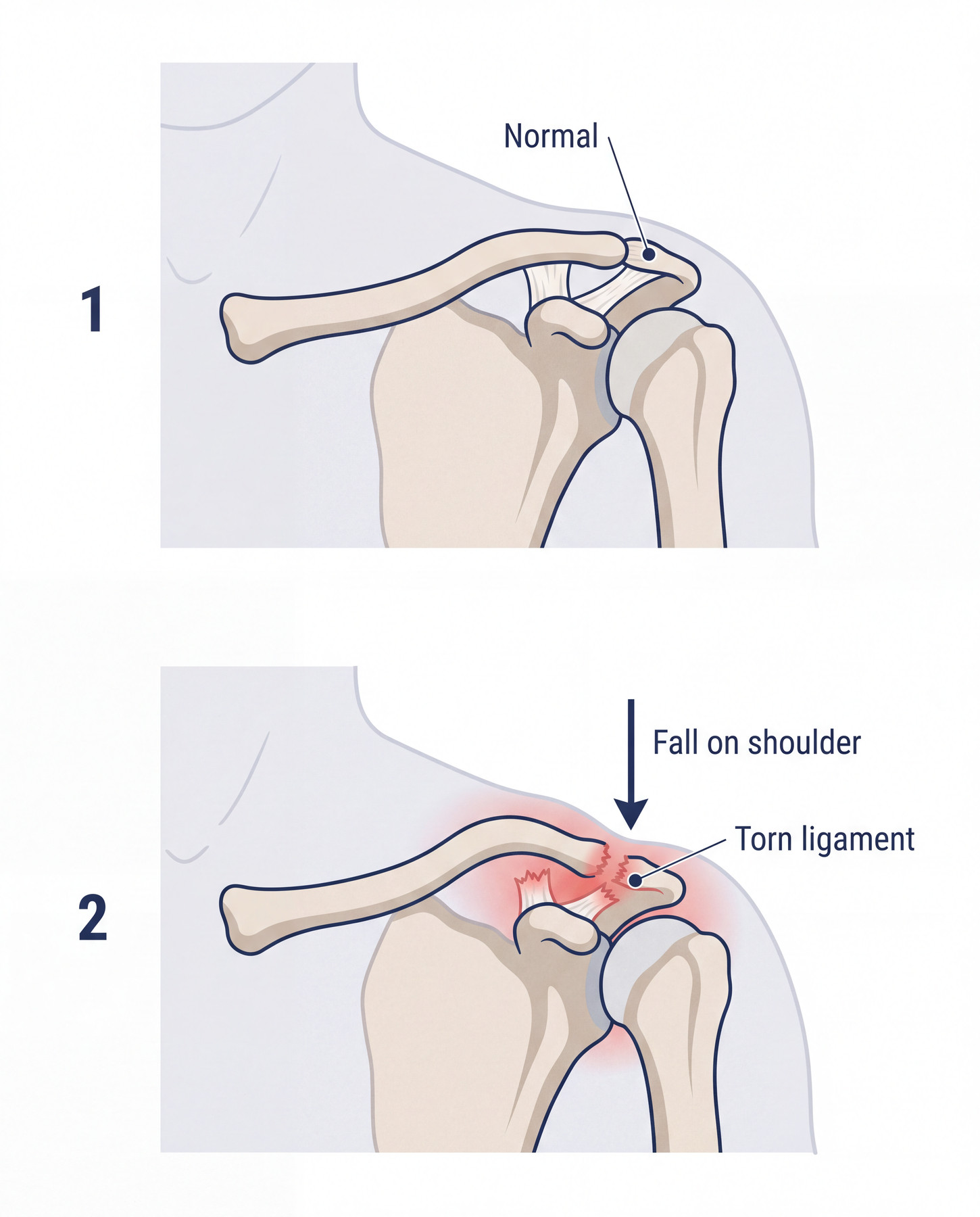
The AC joint is a small joint at the very top of your shoulder, where the outer end of your collarbone (clavicle) meets a bony projection of your shoulder blade called the acromion. It is held together by two ligament systems: the acromioclavicular ligaments, which wrap around the joint itself, and the coracoclavicular ligaments, which anchor the collarbone down to the shoulder blade and stop it riding upward.
An AC joint injury happens when a fall or blow stretches or tears these ligaments. Injuries are graded using the Rockwood classification: grade I is a sprain of the joint ligaments only, grade II involves a tear of the joint ligaments with the deeper ligaments strained, and grade III means both ligament systems are torn, producing the visible “step” or bump at the end of the collarbone. Grades IV–VI are rarer, higher-energy injuries. Physiotherapy is most relevant to grades I–III, and low-grade injuries make up the large majority — around 89% in one study of young athletes (Pallis et al., American Journal of Sports Medicine, 2012).
Interestingly, research shows the X-ray grade does not always match how much pain you feel (Granville-Chapman et al., Shoulder & Elbow, 2018) — which is why our physiotherapists assess your movement, strength and function, not just the scan.
Do You Experience These Symptoms?
✓ Pain at the top of the shoulder, directly over the AC joint, often after a fall or knock
✓ A visible bump or “step” at the end of the collarbone
✓ Tenderness when the joint is pressed, for example by a bag strap
✓ Pain when reaching your arm across your body
✓ Swelling or bruising around the top of the shoulder
✓ Pain when lifting the arm overhead or lying on the affected side
✓ A feeling of weakness or wanting to guard and support the arm
These symptoms can be treated.
The sooner you begin, the better your chances of a smoother recovery.
What Causes an AC Joint Injury?
• Falling directly onto the shoulder
The most common cause is a direct fall or blow onto the point of the shoulder with the arm by your side. This drives the shoulder blade downward while the collarbone stays put, straining or tearing the ligaments.
• Falling onto an outstretched hand
An indirect injury can occur when you fall onto an outstretched hand or elbow, pushing the arm bone up into the acromion. This tends to produce lower-grade injuries affecting mainly the joint ligaments.
• Contact and collision sports
Rugby, football, hockey and martial arts carry a high risk because of tackles and collisions. Research suggests AC joint injuries account for a large share of shoulder injuries in athletes, particularly young men.
• Cycling, skiing and snowboarding
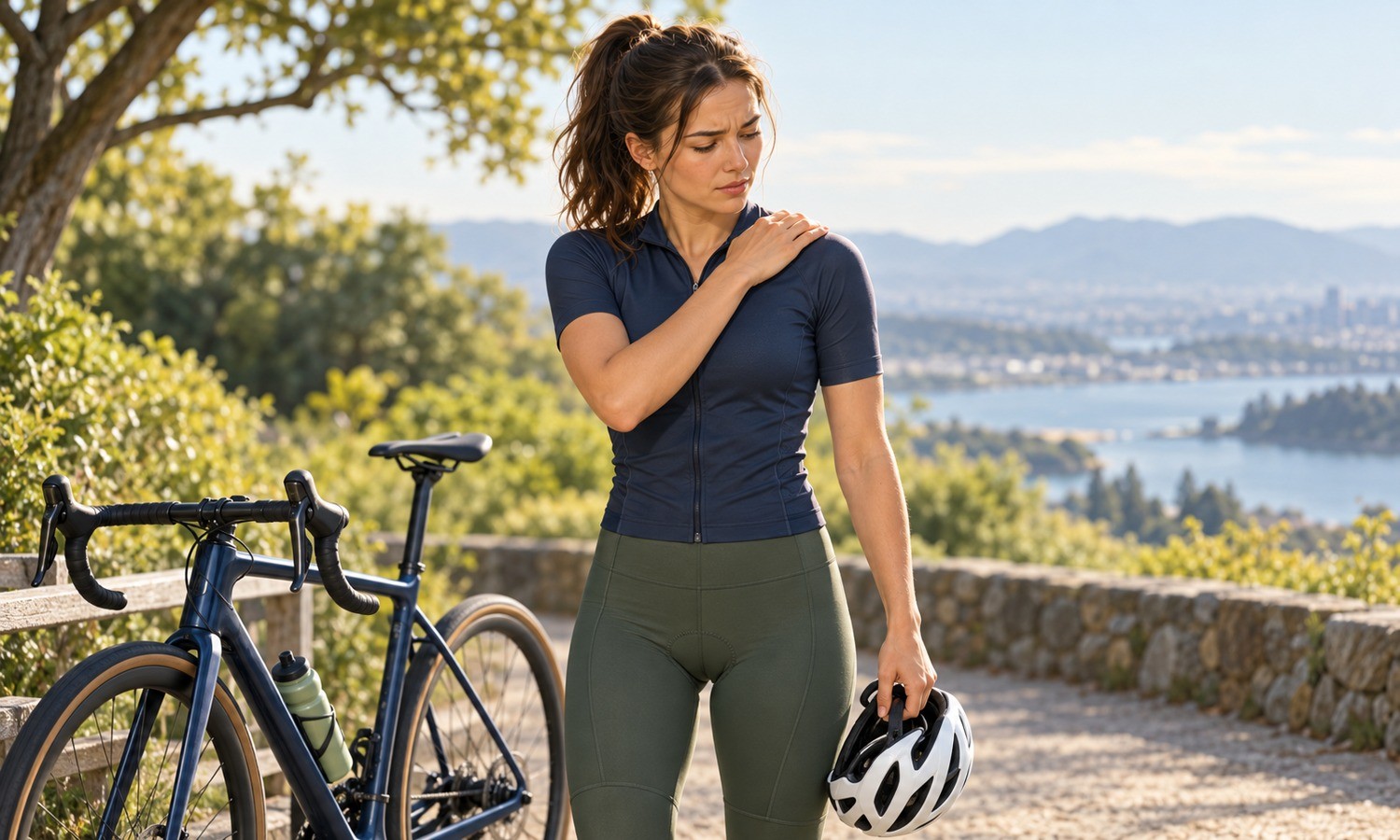
High-speed sports where a crash sends you over the handlebars or onto your shoulder are common causes. Cycling accidents are one of the leading non-contact mechanisms seen in clinic.
• Road traffic and other high-energy trauma
Less commonly, higher-grade injuries follow high-energy impacts such as road traffic accidents. These injuries are more likely to need specialist orthopaedic review before rehabilitation.
How We Treat AC Joint Injuries at J&J Therapy
Hands-On Manual Therapy
Our HCPC-registered physiotherapists begin with a thorough assessment to confirm the diagnosis, estimate the likely grade and rule out red flags. Where appropriate, hands-on manual therapy may be used to help settle pain and restore comfortable movement — including gentle joint mobilisations of the shoulder complex and soft-tissue techniques for the surrounding muscles. We use manual therapy as one part of a broader, exercise-led programme to help you move more freely and progress your rehabilitation.
Shockwave Therapy*
Swiss Storz Medical MASTERPULS may complement your manual therapy and exercise programme when your physiotherapist identifies specific indications during assessment. Non-invasive, evidence-based.
Targeted Exercise Programme
A progressive, individualised exercise programme is the cornerstone of recovery from an AC joint injury. After a short period of relative rest, we guide you through staged rehabilitation: gentle range-of-motion and early shoulder-blade activation, then rotator cuff and scapular strengthening, and finally progressive loading with sport- or work-specific control. Return to sport is guided by your restored strength, movement and confidence rather than time alone.
When to Seek Urgent Medical Help
While most symptoms are not serious, urgent medical attention is required if you experience any of the following:
A large, obvious deformity or severe pain with inability to move the arm — this may indicate a higher-grade injury needing specialist orthopaedic assessment
Skin over the collarbone that looks stretched, tented or pale — this can signal an unstable injury threatening the skin
Numbness, pins and needles, coldness or a pale or dusky arm or hand — possible nerve or blood vessel involvement requires immediate medical attention
Severe tenderness or a grinding sensation over the collarbone after a high-energy injury — an X-ray may be needed to exclude a fracture
FAQs About AC Joint Injuries
How long does an AC joint injury take to recover?
Recovery depends on the grade. Research suggests low-grade injuries often settle over roughly two to six weeks, while grade III injuries can take longer — sometimes up to around twelve weeks. Most people managed without surgery regain functional movement by around six weeks. Your own timeline depends on your injury, your goals and how your rehabilitation progresses.
Will I need surgery?
Usually not. Evidence shows grades I and II — and most grade III injuries — do well with conservative physiotherapy. A Cochrane review found surgery does not appear to be superior to conservative management for AC joint dislocation, with most complications occurring in the surgical group (Tamaoki et al., Cochrane, 2019). Surgery is generally reserved for rarer higher-grade injuries or cases that do not respond to rehabilitation.
Will the bump on my shoulder go away?
For higher-grade injuries the bump may remain to some degree even after full recovery, because the ligaments have healed in a slightly altered position. This is usually a cosmetic change — the joint typically still functions well and the bump does not necessarily cause ongoing pain or limit activity.
Can I return to sport, and when?
Most people return to sport. Return is guided by regaining pain-free movement, strength and control rather than by time alone. Low-grade injuries may allow a graded return within a couple of weeks, while grade III injuries are more variable. We use progressive, criteria-based rehabilitation to help you return as safely and confidently as possible.
Could shockwave therapy help my AC joint injury?
Shockwave therapy is not a first-line treatment for an AC joint injury, and the evidence for shockwave in this specific condition is limited. If your physiotherapist identifies specific indications during your assessment — for example a co-existing tendon problem — our Swiss Storz Medical MASTERPULS shockwave may complement your manual therapy and exercise programme. Any recommendation would be made only after a careful assessment.
This page is for general information only and does not replace professional medical advice.
Reviewed by Lavya Arigalayan, MSc, HCPC Registered Physiotherapist.
Last reviewed:
2026년 8월 20일