Quick Summary
Thoracic outlet syndrome (TOS) causes numbness, tingling, pain or weakness in the arm and hand when the nerves or blood vessels passing between your neck and shoulder become compressed. Around 95% of cases are nerve-related, and evidence shows that specialised physiotherapy — hands-on manual therapy and targeted exercises specifically suited to opening the thoracic outlet — is the recommended first-line treatment. Many people notice meaningful improvement within 4–6 weeks of starting rehabilitation.
What Is Thoracic Outlet Syndrome?
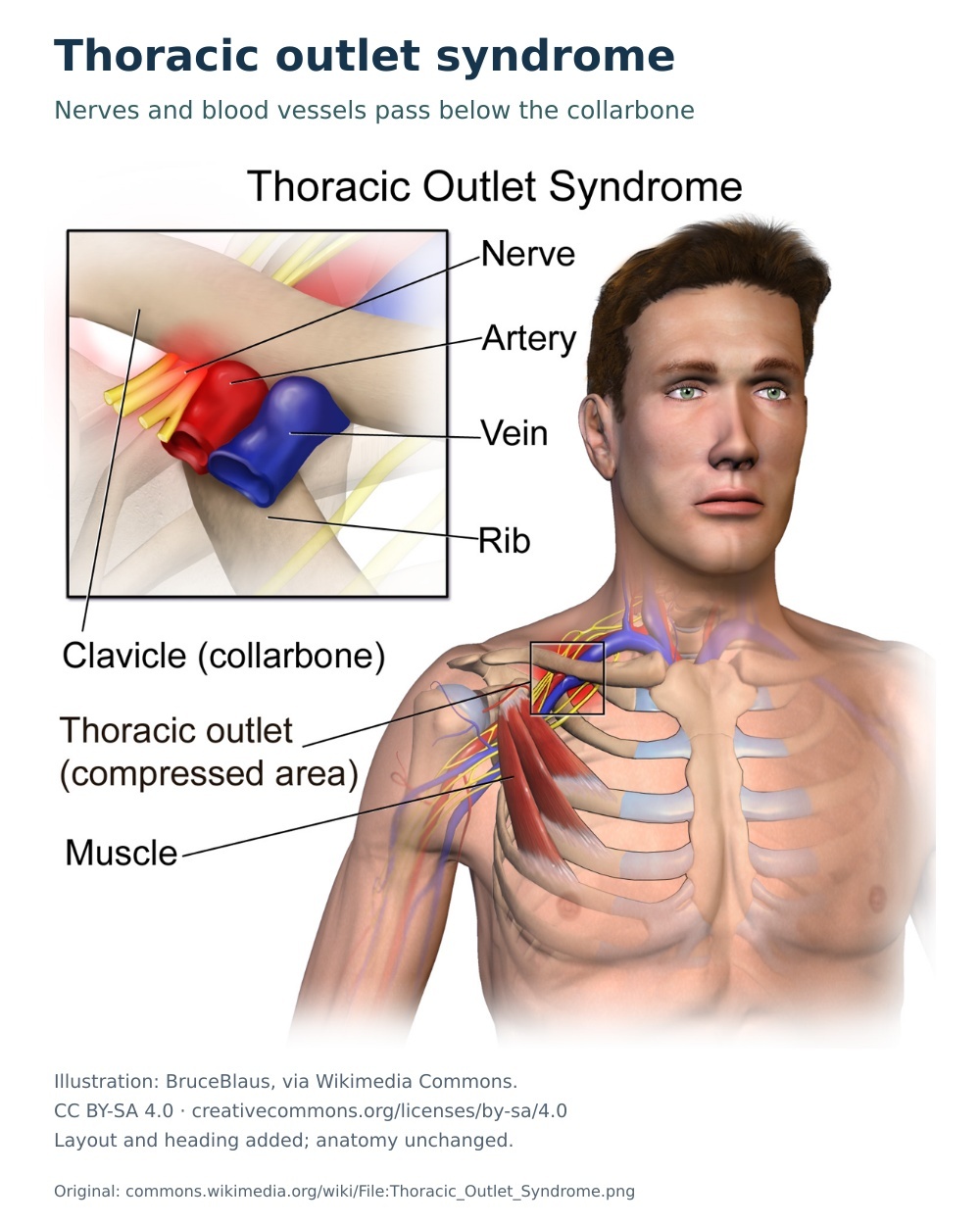
Thoracic outlet syndrome is an umbrella term for a group of disorders caused by compression of the nerves and blood vessels — the brachial plexus, subclavian artery and subclavian vein — as they travel from your lower neck towards your armpit.
Compression can occur at one or more of three narrow spaces:
The interscalene triangle — between the scalene muscles at the side of your neck and the first rib. This is the most common site of nerve compression.
The costoclavicular space — between your collarbone and first rib, where the nerves, artery and vein can all be squeezed.
The pectoralis minor space — beneath the chest muscle at the front of your shoulder, where muscle tightness can irritate the nerves.
There are three types of TOS. Neurogenic TOS (around 95% of cases) involves compression of the brachial plexus, causing pain, pins and needles, numbness and weakness. Venous TOS (3–5%) involves compression of the subclavian vein and can lead to a blood clot. Arterial TOS (around 1%) is the rarest and most serious form, usually linked to an extra rib in the neck (a cervical rib).
TOS most often affects working-age adults and is more common in women. Research suggests its impact on daily life can be considerable, which is why early, specialised assessment and treatment matter (O'Sullivan et al., Hand Therapy, 2026).
Do You Experience These Symptoms?
✓ Numbness or tingling in the arm, hand or fingers — often the little and ring fingers
✓ Aching pain in the neck, shoulder, arm or hand, often worse with overhead activity
✓ Weakness, clumsiness or a heavy, tired feeling in the arm
✓ Symptoms that worsen when your arm is raised or that disturb your sleep at night
✓ In long-standing cases, wasting of the muscles at the base of the thumb
✓ Sudden arm swelling, heaviness and bluish discolouration (possible vein involvement)
✓ A cold, pale hand with a weak pulse or cramping pain on exertion (possible artery involvement)
These symptoms can be treated.
The sooner you begin, the better your chances of a smoother recovery.
What Causes Thoracic Outlet Syndrome?
• Posture and muscle imbalance
Forward-head posture and rounded shoulders bring the collarbone closer to the first rib and tighten the scalene and pectoralis minor muscles, narrowing the thoracic outlet. This is one of the most common — and most treatable — contributors, especially in desk-based workers.
• Repetitive overhead activity
Repeatedly reaching, lifting or working with your arms above shoulder height increases pressure within the thoracic outlet. Swimmers, throwers, musicians and manual trades are particularly at risk of developing symptoms over time.
• Trauma and whiplash
Neck injuries such as whiplash, collarbone fractures or shoulder-girdle injuries can cause scarring and muscle spasm that narrow the outlet. A combination of injury and an underlying anatomical predisposition is a frequent trigger.
• Anatomical anomalies
Some people are born with an extra rib arising from the lowest neck vertebra (a cervical rib) or a tight fibrous band that reduces the available space. Only a minority of people with a cervical rib develop symptoms, but it is a recognised cause of both nerve and artery compression.
• Muscle enlargement in athletes
In sports involving heavy upper-body training, enlargement of the scalene, subclavius or pectoralis minor muscles can reduce the space within the outlet. This particularly affects overhead athletes such as swimmers and weightlifters.
How We Treat Thoracic Outlet Syndrome at J&J Therapy
Hands-On Manual Therapy
Our HCPC-registered physiotherapists use hands-on techniques aimed at gently decompressing the thoracic outlet: soft-tissue release of the scalene and pectoralis minor muscles, first rib mobilisation, thoracic spine and shoulder-blade mobilisation, and graded nerve gliding techniques for the brachial plexus. Research suggests these approaches may help reduce symptoms, and we apply them carefully and progressively, avoiding positions that provoke your symptoms.
Shockwave Therapy*
For conditions involving direct nerve compression such as thoracic outlet syndrome, our care emphasises specialised manual therapy and targeted exercises — the most appropriate and safest approach for your specific needs. Shockwave therapy is not suitable here, as it should not be applied over the major nerves and blood vessels of the neck and shoulder.
Targeted Exercise Programme
Your tailored programme typically includes postural retraining, strengthening of the muscles that support and reposition your shoulder blade, stretches for the scalene and pectoralis minor muscles, gentle nerve gliding, diaphragmatic breathing to reduce over-reliance on the neck muscles, and practical advice on workstation set-up, load management and sleeping position. Evidence shows a structured exercise programme is central to first-line care for nerve-related TOS.
When to Seek Urgent Medical Help
While most symptoms are not serious, urgent medical attention is required if you experience any of the following:
Sudden swelling, heaviness and bluish discolouration of the arm — this may indicate a blood clot in the subclavian vein and needs urgent assessment (ask for an urgent GP appointment or call NHS 111)
A cold, pale arm or hand with a weak or absent pulse, or cramping pain when using the arm — possible reduced blood supply
Rapidly progressive weakness or visible wasting of the hand muscles — significant nerve involvement needing prompt review
Sudden breathlessness, sharp chest pain that is worse on breathing in, or coughing up blood — call 999, as a clot may have travelled to the lungs
FAQs About Thoracic Outlet Syndrome
How long does thoracic outlet syndrome take to recover with physiotherapy?
Many people notice early improvement within about 4–6 weeks of starting rehabilitation, but a full course of conservative treatment usually runs over several months. Progress is not always linear, and staying consistent with your programme gives the best chance of a good outcome.
Will I need surgery?
Most people with nerve-related TOS are managed without surgery. Surgery is generally reserved for cases involving the blood vessels, or for nerve-related cases that do not improve after an adequate trial of specialised physiotherapy. We can advise whether an onward referral is appropriate for you.
How is TOS different from carpal tunnel syndrome or a trapped nerve in the neck?
All three can cause arm tingling and numbness, so careful assessment matters. Carpal tunnel syndrome affects the median nerve at the wrist (usually the thumb, index and middle fingers); a trapped nerve in the neck follows a specific nerve-root pattern; TOS arises higher up, between the neck and shoulder, and often affects the inner forearm and the little and ring fingers, with symptoms provoked by overhead positions. Sometimes these conditions coexist, which is why a thorough examination is important.
Do you use shockwave therapy for TOS?
No. Shockwave therapy is not suitable for thoracic outlet syndrome because it should not be applied over the major nerves and blood vessels of the neck and shoulder. For this condition our care focuses on specialised manual therapy and a targeted exercise programme, which are the appropriate first-line approach.
Will it go away on its own, and what can I do at home?
TOS driven by posture and muscle tightness often responds well to activity and ergonomic changes alongside physiotherapy. Helpful steps include improving your workstation set-up, taking regular movement breaks, avoiding prolonged overhead arm positions, not carrying heavy bags on the affected shoulder, and adjusting your sleeping position. We will give you a tailored home exercise plan to support your recovery.
This page is for general information only and does not replace professional medical advice.
Reviewed by Lavya Arigalayan, MSc, HCPC Registered Physiotherapist.
Last reviewed:
2026년 8월 20일