top of page
Physiotherapist assessing a patient upper back and thoracic spine at a New Malden clinic

T4 Syndrome

300+ Reviews 5.0

Open 7 Days

10+ Years' Experience

HCPC Physio On Team

Insurance Accepted

85% Return Rate

PHYSIOTHERAPY & THERAPEUTIC MASSAGE IN NEW MALDEN

Quick Summary

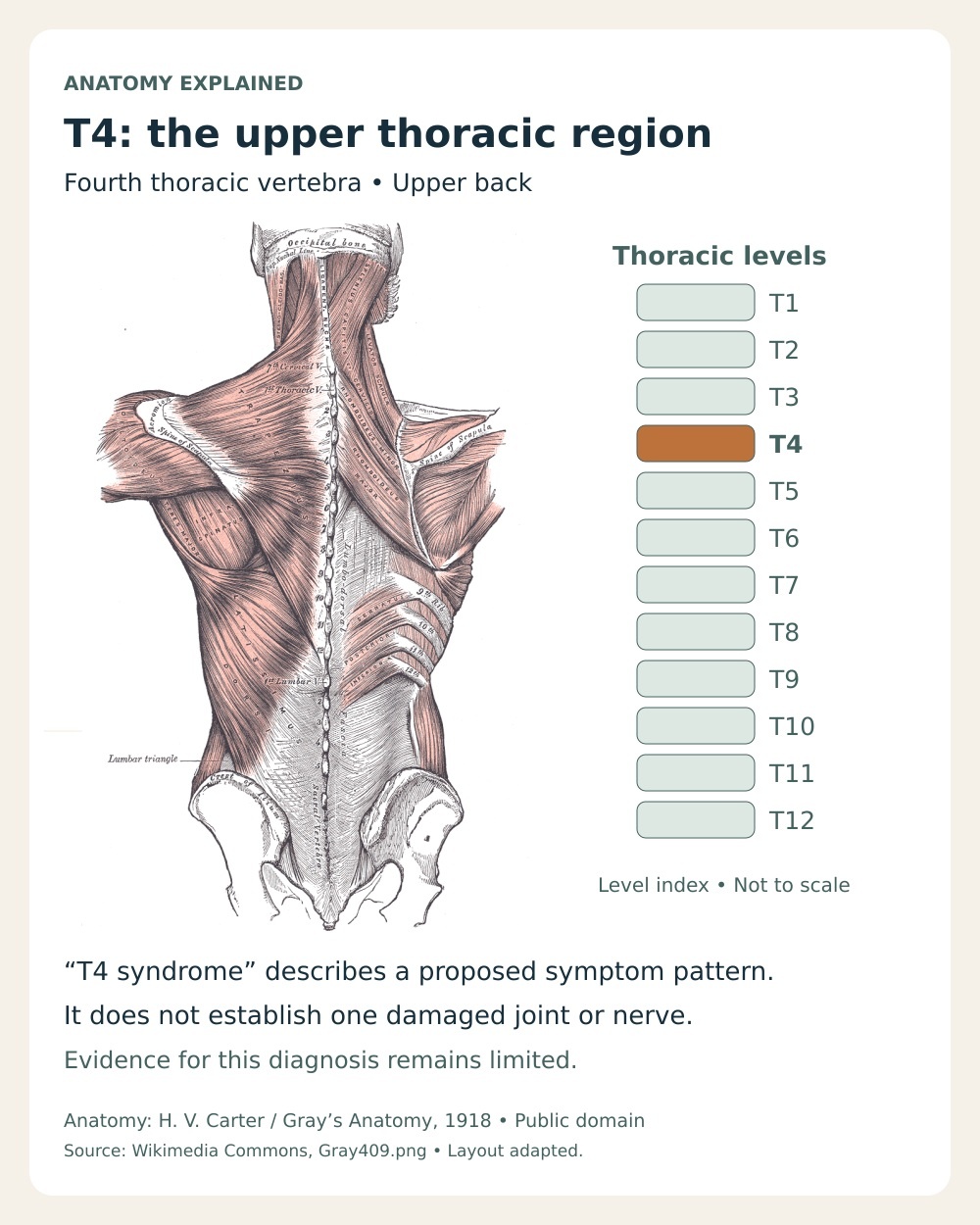
T4 syndrome — also called upper thoracic syndrome — describes vague, glove-like numbness or tingling in one or both hands, usually alongside stiffness and aching between your shoulder blades, thought to arise from dysfunction of the upper thoracic spine. It is a diagnosis of exclusion: we first rule out other causes such as carpal tunnel syndrome, cervical radiculopathy and thoracic outlet syndrome. Research on this condition is limited, but evidence and clinical experience suggest most people respond well to hands-on therapy combined with targeted exercise, typically over a course of 4–8 sessions with an early progress review.

What Is T4 Syndrome?

Diagram of the upper thoracic spine and sympathetic nerve chain illustrating the proposed T4 syndrome mechanism

T4 syndrome was first described in 1986 by Maitland and by McGuckin, who used the term for a cluster of upper limb, upper back and head symptoms attributed to dysfunction of the upper thoracic spine. The name can mislead: although the fourth thoracic vertebra is the level most often cited, the pattern is not confined to it, which is why Evans proposed the broader term upper thoracic syndrome (Evans, Physiotherapy, 1997).


The leading proposed mechanism involves the sympathetic nervous system. Stiffness of the upper thoracic intervertebral, facet and costovertebral joints may irritate the sympathetic chain, whose ganglia sit immediately in front of the costovertebral joints. Because sympathetic supply to the head and neck arises from roughly T1–T4, and to the upper limb from roughly T2–T5, this could offer a pathway for symptoms to be referred into the hands, arm and head — which would explain why the numbness is typically diffuse and does not follow a single nerve root.


Some experimental support exists. A randomised, placebo-controlled trial in 36 healthy volunteers found that a grade III posteroanterior rotatory mobilisation applied at T4 produced a measurably greater change in hand skin conductance than a validated placebo, suggesting thoracic mobilisation can influence sympathetic activity in the hands (Jowsey and Perry, Manual Therapy, 2010). A meta-analysis of 11 studies similarly found that cervical or thoracic manual therapy produces a sympathetic excitatory response, though with only small-to-moderate effect sizes (Chu et al., Journal of Manual and Manipulative Therapy, 2014).


We think it is important to be straightforward about how limited this evidence is. A scoping review found only eight peer-reviewed articles meeting inclusion criteria — one mechanistic trial in healthy volunteers, two case series, and expert opinion or case reports — rated the overall quality as low, and concluded that no definitive conclusions can yet be drawn (Karas and Pannone, Journal of Manipulative and Physiological Therapeutics, 2017). There are no validated diagnostic criteria and no confirmatory test, and NHS guidance notes that the literature rests on case reports. Our view is that T4 syndrome is best treated as a clinically useful pattern rather than a proven disease — a working label reached only after other causes have been carefully excluded, and one we keep under review as your treatment progresses.

Do You Experience These Symptoms?

✓  Vague numbness, tingling or pins and needles in your hands, often described as glove-like and frequently affecting both hands

✓  Stiffness and aching in your upper back, particularly between your shoulder blades

✓  Diffuse pain in your arm or forearm that does not follow the path of a single nerve

✓  A sense that your hands feel puffy, swollen, heavy or clumsy, sometimes with reduced grip strength

✓  Headache, and sometimes neck or chest-wall discomfort

✓  Altered temperature sensation or coldness in your hands

✓  Symptoms that are worse at night or first thing in the morning, and are often linked to sustained postures such as desk work

These symptoms can be treated.
The sooner you begin, the better your chances of a smoother recovery.

What Causes T4 Syndrome?

•  Thoracic joint dysfunction

Stiffness or restricted movement in the upper thoracic intervertebral, facet and costovertebral joints is the most frequently proposed driver of this condition.

This may mechanically irritate the sympathetic chain that runs immediately alongside these joints, producing referred symptoms in your hands and arms.


•  Sustained or poor posture

Prolonged sitting, desk and screen work, slouching and a forward-head posture are the precipitants patients report most often.

Persistent or repetitive loading is thought to overwork the upper thoracic tissues and may reduce blood flow around the sympathetic plexus.


•  Non-traumatic onset in predisposed individuals

Case-level reports suggest T4 syndrome is seen more often in women than men, typically between the ages of 30 and 50, and usually with no injury to explain it.

This pattern comes only from case reports and has never been confirmed in a population study, so we treat it as a loose guide rather than a rule.


•  Acute trauma or a change in activity

Some cases follow a specific injury, while others begin after a change in routine such as a new job, hobby or training load.

Age-related change around the costovertebral joints has also been proposed as a contributing factor in older patients.


Not sure which condition applies to you?

How We Treat T4 Syndrome at J&J Therapy

Hands-On Manual Therapy

Thoracic spine mobilisation and, where appropriate and consented, manipulation, combined with rib and costovertebral mobilisation and soft-tissue work to the paraspinal, rhomboid and pectoral muscles — always preceded by a thorough assessment to exclude other causes of your symptoms.

Shockwave Therapy*

Swiss Storz Medical MASTERPULS
may complement your manual therapy and exercise programme when your physiotherapist identifies specific indications during assessment, such as associated myofascial trigger points in the surrounding muscles.
It is not a first-line treatment for T4 syndrome and the evidence in this specific condition is limited, so we use it only when your assessment indicates it may help. Non-invasive, evidence-based.

Targeted Exercise Programme

A tailored programme of thoracic mobility and extension work, scapular and postural retraining, progressive strengthening and — where indicated — neural mobility exercises, supported by practical workstation and ergonomic advice so you can maintain your progress at home.

When to Seek Urgent Medical Help

While most symptoms are not serious, urgent medical attention is required if you experience any of the following:

  • Chest pain or tightness, breathlessness, pain spreading to your jaw or left arm, sweating or feeling generally unwell — call 999

  • Unexplained weight loss, fever or night sweats, a history of cancer, or severe unremitting night pain

  • Worsening weakness, numbness spreading into your legs, unsteadiness when walking, or any change in bladder or bowel control

  • Significant trauma, or a minor injury if you have osteoporosis or take long-term steroids

FAQs About T4 Syndrome

  • Is T4 syndrome a real diagnosis?

It is a recognised clinical pattern rather than a firmly proven disease. The evidence base is limited to case reports, small case series and one mechanistic trial in healthy volunteers, and there are no validated diagnostic criteria (Karas and Pannone, 2017). We use it as a working label only after excluding other causes, and we keep the diagnosis under review as your treatment progresses.


  • Why do I feel it in my hands when the problem is in my back?

The leading theory is that dysfunction of the upper thoracic joints irritates the nearby sympathetic nerve chain, which has connections to the arm and hand. This is why the numbness is typically vague, glove-like and does not follow a single nerve — and it is also why we carefully rule out other conditions first.


  • How is it different from carpal tunnel syndrome or a trapped nerve in my neck?

Each has its own pattern. Carpal tunnel syndrome usually affects the thumb-side fingers and is often worse at night; cervical radiculopathy generally follows a one-sided nerve path and is provoked by neck movement; thoracic outlet symptoms are often brought on by raising your arms. Our assessment is designed to tell these apart before any treatment begins.


  • How many sessions will I need?

This varies. Many people improve within a handful of sessions of manual therapy and exercise, while more stubborn cases take several weeks to a few months. We typically review your progress within about three sessions and would expect a course in the region of 4–8 sessions for most people — if you are not improving as expected, we refer on rather than simply continue.


  • Can shockwave therapy treat T4 syndrome?

Shockwave is not a first-line treatment for T4 syndrome, and the evidence for shockwave in this specific condition is limited. We would only consider the Swiss Storz Medical MASTERPULS when your assessment indicates it may help an associated soft-tissue problem, such as myofascial trigger points in the surrounding muscles — and always alongside manual therapy and exercise rather than instead of them.


  • What can I do myself?

Keeping your upper back moving, breaking up long periods of sitting, and improving your workstation set-up all tend to help. Your physiotherapist will give you a tailored thoracic mobility and posture programme to continue at home between sessions.

Not sure this condition matches your symtoms?
Find your condition and explore related pain areas.

Logo_Navy.png

Ready to start your recovery?
Book your Initial Assessment today.

This page is for general information only and does not replace professional medical advice.

Reviewed by Lavya Arigalayan, MSc, HCPC Registered Physiotherapist.

Last reviewed

2026년 8월 20일

bottom of page