Quick Summary
Recovery after shoulder surgery is a gradual, staged process, and structured physiotherapy is central to a good outcome. Depending on the operation, you can expect several weeks in a sling followed by progressive stages of movement and strengthening, with most people needing four to six months to regain confident function and up to a year for full recovery after larger repairs.
Our physiotherapists work within your surgeon’s protocol to protect the healing repair while helping you rebuild movement, strength and daily function at the right pace.
What Is Post-Surgery Shoulder Rehab?
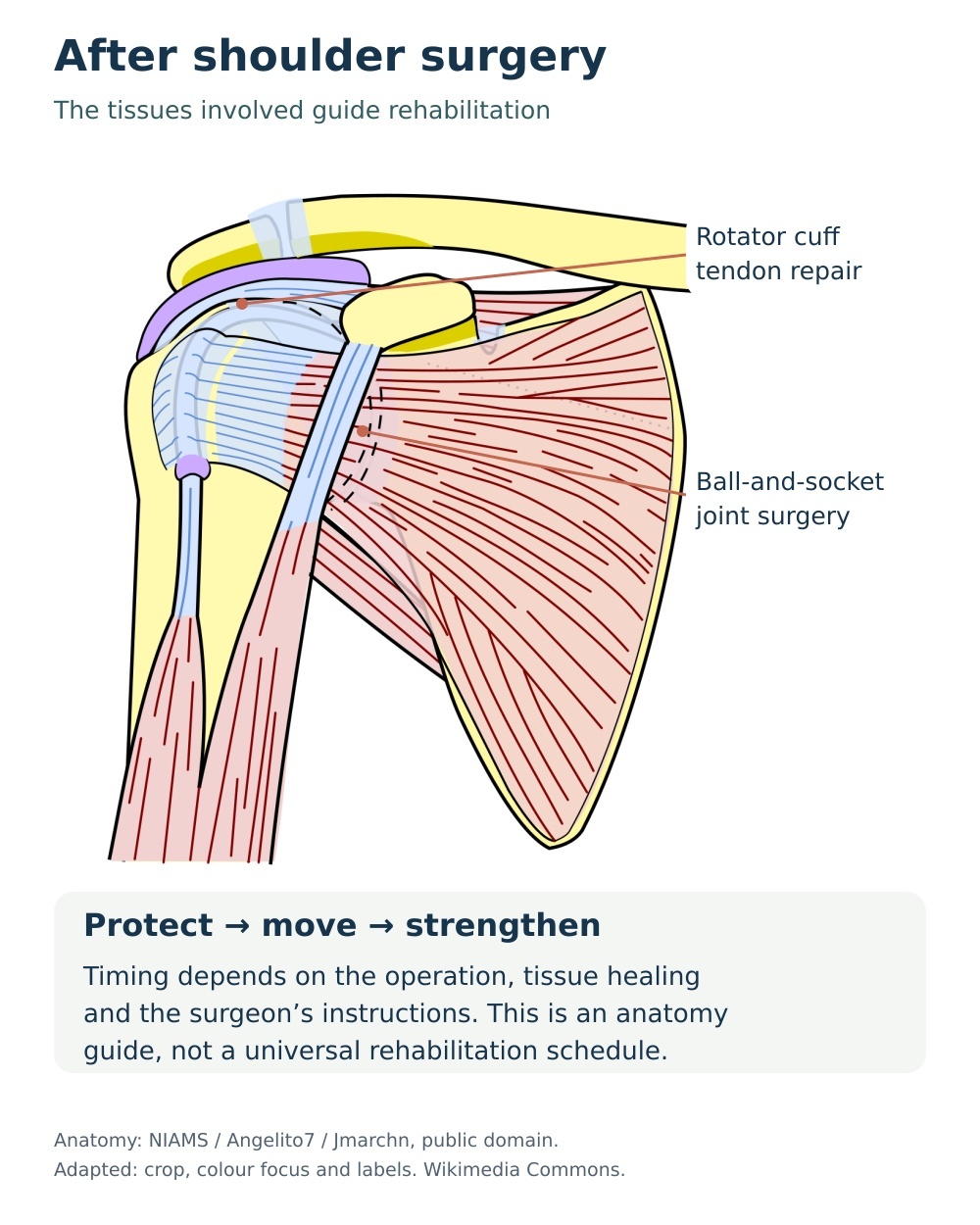
Post-surgery shoulder rehabilitation is a structured, phased programme of physiotherapy that helps restore movement, strength and function after an operation on the shoulder, while protecting the surgical repair as it heals. It applies to a range of common procedures, including rotator cuff repair, total and reverse shoulder replacement, labral repair, shoulder stabilisation surgery, subacromial decompression and AC joint surgery. Each of these operations has different tissue-healing constraints, so your rehabilitation is tailored accordingly.
Rehabilitation matters because surgical success depends heavily on what happens afterwards. Most published protocols follow four broad phases: a protection phase with the arm supported in a sling; passive and assisted range of movement; active range of movement; and progressive strengthening leading to a return to work, hobbies or sport. Consensus guidance from shoulder specialists describes a staged, milestone-based framework, with protected movement introduced in the early weeks, active movement restored from around six weeks, and progressive strengthening typically beginning around week twelve (Thigpen et al., Journal of Shoulder and Elbow Surgery, 2016).
The evidence on timing is reassuring. A systematic review of 20 randomised trials involving over 1,800 patients found that carefully introduced early movement after rotator cuff repair led to faster recovery of range of movement, with no increase in the risk of the repair failing (Mazuquin et al., PLOS ONE, 2021). Research also suggests that well-taught, well-supported exercise programmes — whether supervised in clinic or completed at home with professional guidance — are the key driver of recovery, with programmes usually progressing over a minimum of twelve weeks (Powell et al., JSES International, 2021). Because every operation and every shoulder is different, we coordinate closely with your surgeon and progress your programme based on healing milestones rather than fixed dates alone.
Do You Experience These Symptoms?
✓ Stiffness and marked loss of movement, especially reaching overhead or behind your back
✓ Weakness in the arm and difficulty lifting or carrying, even light objects
✓ Pain with movement or at the end of your range, particularly in the early weeks
✓ Disturbed sleep and difficulty lying on the operated side
✓ Fear or apprehension about moving the shoulder, which can slow recovery
✓ Difficulty with everyday tasks such as dressing, washing and reaching into cupboards
✓ Reduced confidence returning to work, driving, hobbies or sport
These symptoms can be treated.
The sooner you begin, the better your chances of a smoother recovery.
Why Is Rehabilitation Needed After Shoulder Surgery?
• Surgical trauma and tissue healing
Surgery deliberately repairs or reconstructs tissue, and that tissue needs protected time to heal before it can bear load.
Rehabilitation provides the graded stimulus that helps healing tissue remodel and regain load tolerance without overloading the repair too soon.
• Immobilisation-related stiffness and muscle wasting
Necessary time in a sling protects the repair but causes the joint capsule to tighten and the muscles to weaken.
Structured rehabilitation is designed to reverse this stiffness and rebuild muscle at a pace the healing tissue can tolerate.
• Pain inhibition and altered movement patterns
Post-surgical pain switches off the muscles around the shoulder blade and rotator cuff, disrupting normal coordinated movement.
Rehabilitation restores muscle timing, shoulder blade control and confident, efficient movement patterns.
• Scar tissue formation
As tissues heal, scar tissue and adhesions can form and restrict the natural glide of the joint and surrounding layers.
Graded mobilisation and scar management help maintain and restore mobility during the healing window.
• Deconditioning and fear of movement
After weeks of guarding the arm, the whole limb becomes deconditioned and many people develop an understandable fear of moving it.
Research links fear of movement to poorer outcomes after shoulder surgery, so graded, confidence-building exercise is a core part of your recovery.
How We Support Your Recovery at J&J Therapy
Hands-On Manual Therapy
Our physiotherapists use gentle, graded joint mobilisation and soft tissue techniques strictly within your surgeon’s precautions, helping restore movement without stressing the repair. As healing progresses we add hands-on mobilisation for stiffness, scar management to keep tissues supple, and soft tissue work for the neck and shoulder blade region. Evidence suggests mobilisation-based physiotherapy may improve function in patients with stiffness after rotator cuff repair, and we coordinate closely with your surgeon’s protocol throughout.
Shockwave Therapy*
Swiss Storz Medical MASTERPULS may complement your manual therapy and exercise programme when your physiotherapist identifies specific indications during assessment. Non-invasive, evidence-based.
Targeted Exercise Programme
Exercise is the core of post-surgical shoulder recovery. We build a phased, progressive programme individualised to your operation and stage of healing — from protected range-of-movement work, through active movement, to targeted rotator cuff and shoulder blade strengthening and functional or sport-specific loading. Programmes typically progress over a minimum of twelve weeks, using healing milestones rather than fixed dates, and we rebuild your confidence alongside your strength.
When to Seek Urgent Medical Help
While most symptoms are not serious, urgent medical attention is required if you experience any of the following:
Signs of wound infection — fever, spreading redness or warmth, swelling, or discharge from the incision
Sudden severe pain or a sudden loss of movement, which may suggest a problem with the repair and needs prompt surgical review
Calf pain, tenderness or swelling in the leg, or breathlessness or chest pain — possible signs of a blood clot needing emergency care
Persistent numbness, pins and needles, or a cold or discoloured hand, which should be assessed promptly
FAQs About Post-Surgery Shoulder Rehab
How long does recovery take after shoulder surgery?
It depends on the operation. Many people need around four to six months to regain confident, functional use of the shoulder, and full recovery after larger repairs — such as a sizeable rotator cuff tear or a shoulder replacement — can take up to a year. Your surgeon and physiotherapist will guide your timeline, and improvements come gradually rather than all at once.
When can I stop wearing my sling?
Sling times vary by procedure and tissue quality — commonly around four to six weeks after rotator cuff repair and roughly six weeks after reverse shoulder replacement. The sling protects your repair, so remove it only for washing, dressing and your prescribed exercises until your surgeon or physiotherapist advises otherwise.
When can I drive or return to work?
Most people should not drive until they are out of the sling and can steer and perform an emergency stop safely — often around six to eight weeks, but be guided by your team and check with your insurer. Light or desk-based work may resume within a couple of weeks, while heavy or overhead work is often avoided for three to six months.
Will physiotherapy be painful?
Some discomfort is normal, especially when restoring movement, but rehabilitation should not involve sharp or severe pain. We progress your programme within comfortable limits and your surgical precautions, and adjust the pace to your response. Managing pain well helps you move and sleep better, which supports recovery.
Can shockwave therapy help after shoulder surgery?
Shockwave therapy is not a first-line treatment after shoulder surgery, and it is never applied over a healing surgical site. It is only ever considered later in your recovery, and only when your physiotherapist identifies a specific indication during assessment — for example, an associated calcific tendinopathy limiting your progress. For most patients, recovery is driven by protected movement, manual therapy and progressive exercise.
This page is for general information only and does not replace professional medical advice.
Reviewed by Lavya Arigalayan, MSc, HCPC Registered Physiotherapist.
Last reviewed:
2026년 8월 20일