top of page
Physiotherapist assessing the range of movement of a patient elbow during a consultation at J&J Therapy in New Malden

Elbow Osteoarthritis

300+ Reviews 5.0

Open 7 Days

10+ Years' Experience

HCPC Physio On Team

Insurance Accepted

85% Return Rate

PHYSIOTHERAPY & THERAPEUTIC MASSAGE IN NEW MALDEN

Quick Summary

Elbow osteoarthritis is a degenerative condition in which the cartilage and underlying bone of your elbow joint gradually change, causing stiffness, a slow loss of movement, and pain that is classically felt at the very ends of straightening and bending rather than in the middle of the range. Bony spurs and loose fragments inside the joint can also cause catching or locking, and difficulty fully straightening the elbow is often the first sign. Our physiotherapists in New Malden combine hands-on manual therapy with a targeted, progressive exercise programme to help you ease pain, protect your range of movement, and stay active — with your plan reassessed and progressed as you improve.

What Is Elbow Osteoarthritis?

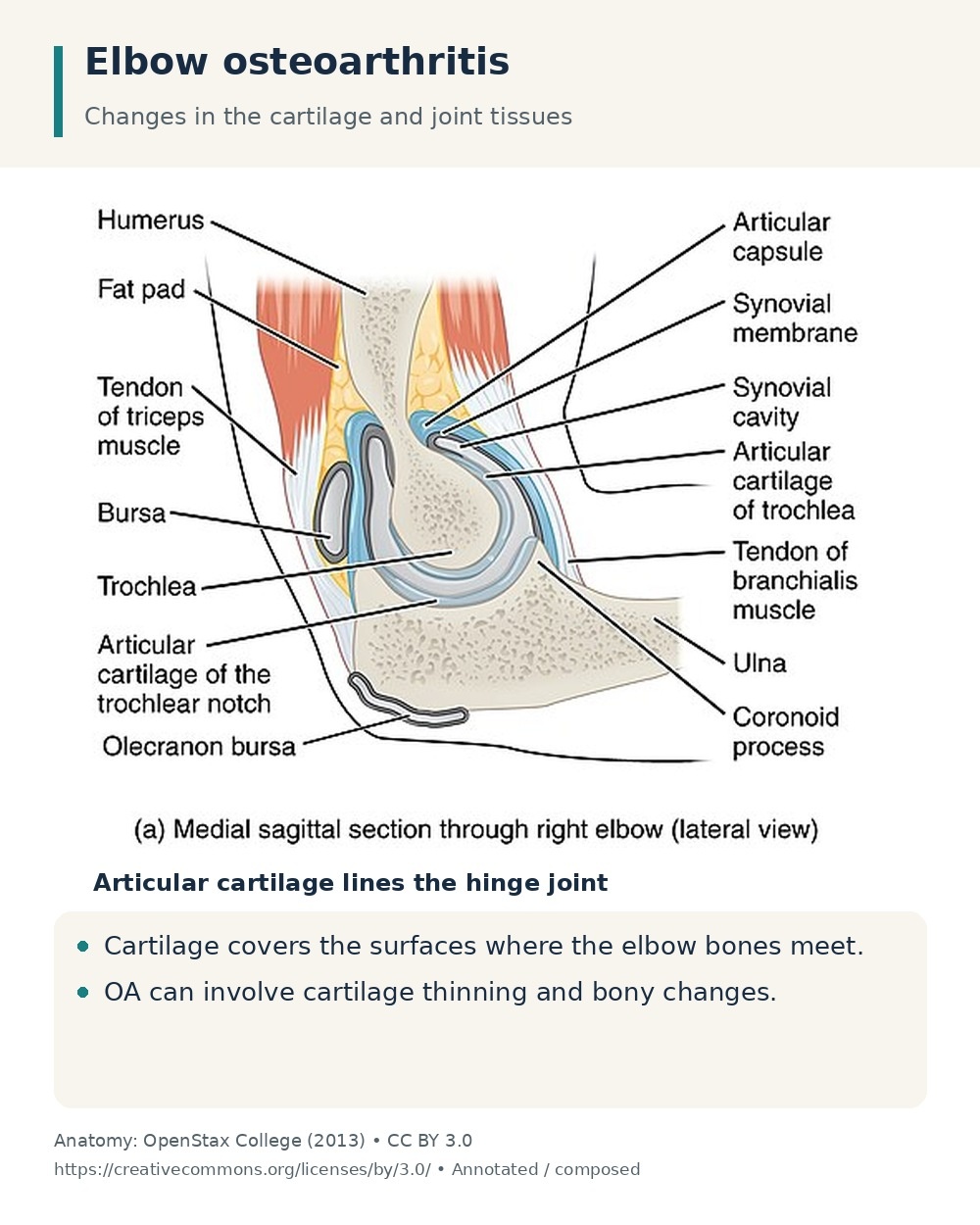
Illustration of elbow joint anatomy showing the ulnohumeral and radiocapitellar joints with bony spurs and a loose body

Elbow osteoarthritis is a degenerative joint condition in which the cartilage and underlying bone of the elbow gradually change, producing pain, stiffness and mechanical symptoms such as catching or locking. Your elbow is made up of three articulations that share a single joint capsule: the ulnohumeral joint between the ulna and the humerus, the radiocapitellar joint between the radial head and the capitellum, and the proximal radioulnar joint, where the radius and ulna rotate against one another to turn your palm up and down. Osteoarthritis can affect any of these compartments, but the ulnohumeral joint is the one most commonly involved.


Unlike osteoarthritis of the weight-bearing hip and knee, elbow osteoarthritis has a distinctive pattern. Because the ulnohumeral joint surfaces fit together closely, a good proportion of the cartilage is often relatively preserved. The hallmark features instead are widespread osteophytes (small bony spurs), loose bodies — fragments of cartilage and bone that break free inside the joint — and tightening of the joint capsule (Biswas et al., Arthritis, 2013). Spurs typically form first at the tip of the olecranon and coronoid processes and in their matching hollows on the humerus, and loose bodies are a common cause of painful locking or catching when they become trapped between the joint surfaces.


Progression is usually gradual. Early on, pain tends to be felt at the very ends of straightening and bending as the bony spurs engage, with relative comfort through the mid-range — and loss of full extension is classically the first movement to be affected. As the spurs enlarge and the capsule tightens, discomfort is felt across more of the arc and the loss of movement becomes more noticeable. Turning your forearm palm-up and palm-down is often relatively well preserved, because the compartments responsible for rotation are frequently less involved.


There are two broad forms. Primary elbow osteoarthritis is age-related degeneration with no single identifiable cause, and it is uncommon — affecting an estimated 2 to 3% of the population, with an average age at first presentation of around 50 years and the dominant arm involved in roughly 80% of cases (Martinez-Catalan and Sanchez-Sotelo, Journal of Clinical Orthopaedics and Trauma, 2021). A UK study of 1,000 patients found a 2% prevalence of symptomatic elbow osteoarthritis, significantly more common in men and in heavy manual workers (Stanley, Journal of Shoulder and Elbow Surgery, 1994). Secondary, or post-traumatic, osteoarthritis follows an earlier elbow injury such as a fracture into the joint or a dislocation, and can develop in younger people, sometimes years after the original injury.


One clinically important feature is the link with ulnar nerve symptoms. Because spurs and loose bodies tend to form on the inner side of the joint, they can narrow the cubital tunnel through which the ulnar nerve passes, and some degree of ulnar nerve irritation is a common accompaniment to elbow osteoarthritis. Surgical series report ulnar nerve symptoms in a meaningful proportion of patients, and careful clinical examination detects signs of nerve involvement more often still. For this reason, our assessment always includes a careful examination of ulnar nerve function.

Do You Experience These Symptoms?

✓  Stiffness and a progressive loss of movement, with difficulty fully straightening your elbow often the earliest sign

✓  Pain at the ends of range — felt when you straighten or bend the elbow as far as it goes, rather than in the middle of the movement

✓  Locking, catching or clicking, caused by loose fragments moving inside the joint

✓  A grating or grinding sensation (crepitus) when you move the elbow

✓  Aching after activity, and pain when carrying loads with the arm held straight

✓  Pins and needles, numbness in your little and ring fingers, or hand weakness, if the ulnar nerve is irritated

✓  Difficulty with everyday tasks such as lifting, carrying, washing your hair, or reaching into a cupboard

These symptoms can be treated.
The sooner you begin, the better your chances of a smoother recovery.

What Causes Elbow Osteoarthritis?

•  Primary (age-related) degeneration

Primary elbow osteoarthritis develops gradually without a single identifiable cause and is largely a condition of middle-aged men, usually affecting the dominant arm.

Inherited differences in how cartilage and bone respond to load are thought to contribute, alongside the cumulative demands of a lifetime of use.


•  Previous elbow injury (post-traumatic osteoarthritis)

A past fracture into the joint, a dislocation, or another significant elbow injury can alter how the joint surfaces load and accelerate degenerative change.

This post-traumatic form can affect younger people and often appears years after the original injury has healed.


•  Heavy manual work and repetitive loading

Jobs and activities involving heavy lifting, forceful gripping and repeated elbow loading are strongly associated with primary elbow osteoarthritis.

Research has found the condition significantly more common in heavy manual workers, and it typically affects the arm you use most.


•  Throwing and overhead sport

Repetitive high-velocity throwing and similar overhead activities place large, repeated stresses across the elbow joint.

Over many years this loading may drive spur formation and degenerative change, particularly in athletes with a long history of throwing.


Not sure which condition applies to you?

How We Treat Elbow Osteoarthritis at J&J Therapy

Hands-On Manual Therapy

Gentle elbow joint mobilisation, mobilisation-with-movement, and soft-tissue techniques to ease stiffness, reduce pain, and improve the quality of your elbow movement — always delivered alongside an active exercise programme, as recommended by NICE.

Shockwave Therapy*

Swiss Storz Medical MASTERPULS
may complement your manual therapy and exercise programme when your physiotherapist identifies specific indications during assessment.
It is not a first-line treatment for elbow osteoarthritis itself, and current research does not support its use for the arthritic joint.
Non-invasive, evidence-based, and applied with care to avoid the ulnar nerve on the inner elbow.

Targeted Exercise Programme

Personalised range-of-movement work, progressive strengthening for the elbow, forearm and shoulder, and practical activity and load management to reduce flare-ups and maintain your progress over the long term.

When to Seek Urgent Medical Help

While most symptoms are not serious, urgent medical attention is required if you experience any of the following:

  • Progressive numbness, tingling or weakness in your little and ring fingers, or wasting of the hand muscles (possible significant nerve compression)

  • A hot, red, swollen and acutely painful elbow, especially with a fever or feeling unwell (possible joint infection)

  • Sudden complete locking of the elbow or an inability to move it, particularly after an injury

  • Severe pain after a fall or impact, with visible deformity or an inability to use the arm

FAQs About Elbow Osteoarthritis

  • Can physiotherapy reverse my elbow osteoarthritis?

No treatment can reverse the underlying joint changes of osteoarthritis, and we would be cautious of anyone who promises otherwise. What physiotherapy can do is help you manage the condition well — research suggests that therapeutic exercise combined with hands-on manual therapy may reduce pain and improve movement and function, helping you stay active and get more out of daily life.


  • Should I rest my elbow or keep it moving?

In general, keeping the joint moving is beneficial, as prolonged rest tends to increase stiffness. Our physiotherapists will guide you on the right balance — using gentle movement and graded exercise while modifying the activities that aggravate your symptoms, so you protect the joint without letting it stiffen further. Evidence shows that joint pain may increase slightly when you first start exercising, and that consistent, longer-term activity brings the greatest benefit.


  • Why do I get pins and needles in my little finger?

Elbow osteoarthritis commonly irritates the ulnar nerve, which passes through a narrow tunnel on the inner side of your elbow where bony spurs and loose fragments tend to form. This can cause tingling, numbness or weakness in the little and ring fingers. Please tell us about these symptoms — we will assess the nerve carefully, and persistent or worsening symptoms should be reviewed promptly.


  • Do you offer shockwave therapy for elbow osteoarthritis?

Shockwave therapy (Swiss Storz Medical MASTERPULS radial ESWT) is not a first-line treatment for elbow osteoarthritis, and we will be honest with you about the evidence: most research supports its use for tendon conditions and, to a moderate degree, knee osteoarthritis, and there are no clinical trials in elbow osteoarthritis specifically.

We may consider it only as a complementary option where your assessment identifies a specific indication, such as a co-existing tendon problem, and we take particular care to avoid the ulnar nerve on the inner elbow. Your physiotherapist will discuss openly whether it is appropriate for you.


  • When might I need surgery?

Most people with elbow osteoarthritis are managed without surgery. It is usually considered only when pain, stiffness or mechanical locking persist despite a fair trial of conservative care and significantly affect your daily life.

Options range from joint-preserving procedures that remove spurs and loose bodies, through to elbow replacement, which is generally reserved for older patients with advanced disease. If surgical opinion is appropriate, we can help arrange onward referral to a shoulder and elbow surgeon.

Not sure this condition matches your symtoms?
Find your condition and explore related pain areas.

Logo_Navy.png

Ready to start your recovery?
Book your Initial Assessment today.

This page is for general information only and does not replace professional medical advice.

Reviewed by Lavya Arigalayan, MSc, HCPC Registered Physiotherapist.

Last reviewed

2026년 8월 20일

bottom of page