top of page
Physiotherapist assessing a patient's lower back for spondylolisthesis at J&J Therapy in New Malden

Spondylolisthesis

300+ Reviews 5.0

Open 7 Days

10+ Years' Experience

HCPC Physio On Team

Insurance Accepted

85% Return Rate

PHYSIOTHERAPY & THERAPEUTIC MASSAGE IN NEW MALDEN

Quick Summary

Spondylolisthesis occurs when one vertebra slips forward over the one below it, most commonly at the L5–S1 or L4–L5 level of your lower back. It can cause aching back pain, stiffness and, in some cases, nerve-related symptoms in your legs.


Most low-grade cases respond well to conservative care. Research suggests that supervised physiotherapy focusing on core stabilisation, movement retraining and activity modification may help reduce pain and improve function. At J&J Therapy we typically structure care over an initial course of 6–8 sessions, reviewing your progress regularly and adjusting your programme to your grade, age and activity goals.

What Is Spondylolisthesis?

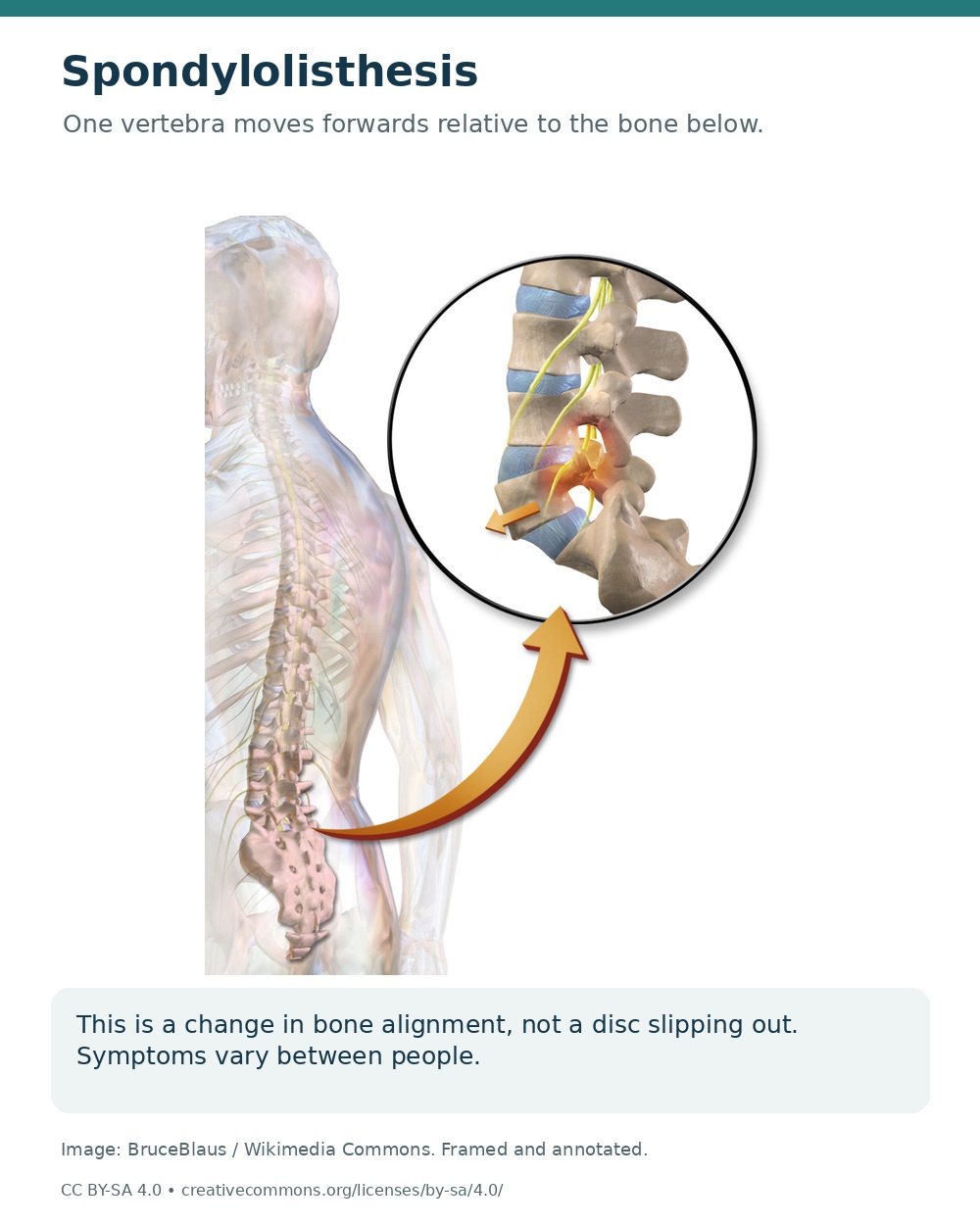
Diagram showing a lumbar vertebra slipped forward over the vertebra below in spondylolisthesis

Spondylolisthesis describes the forward slippage of one vertebra relative to the vertebra beneath it. It sits on a continuum with spondylolysis — a stress reaction or defect of the pars interarticularis, the small bony bridge between the facet joints — which can precede the slip.


The slip itself does not always cause symptoms and is frequently found incidentally on imaging. When it does become symptomatic, it typically produces mechanical back pain, and in higher grades it may narrow the spinal canal or nerve-root openings and cause nerve compression.


How the slip is graded

Clinicians use the Meyerding scale to describe severity: Grade I (0–25% slip), Grade II (25–50%), Grade III (50–75%), Grade IV (75–100%) and Grade V (complete slippage). The majority of cases are low-grade, with Grade I accounting for around three quarters of all cases.


The two types we see most often

Isthmic spondylolisthesis results from a pars interarticularis defect, most often at L5–S1. It is the most common form in children, adolescents and young adults, and is strongly associated with repetitive lumbar extension and rotation in sport.

Degenerative spondylolisthesis results from age-related facet joint and disc degeneration, most often at L4–L5. It is more common in adults over 50 and in women, and frequently occurs alongside lumbar spinal stenosis and neurogenic claudication.


An important point for reassurance: evidence shows the degree of slip correlates poorly with how much pain you experience, and reducing the slip is not necessary for clinical improvement. This is why our care focuses on your symptoms, strength and function rather than on the appearance of the scan.


(O’Sullivan et al., Spine, 1997; Wiltse, Newman & Macnab, Clinical Orthopaedics and Related Research, 1976)

Do You Experience These Symptoms?

✓  Lower back pain, often aching, typically worse with standing, walking and bending backwards, and eased by rest or sitting

✓  Stiffness and muscle guarding or spasm in your lower back

✓  Tight, overactive hamstrings, a shortened stride or an altered walking pattern

✓  Pain spreading into your buttocks, and in some cases tingling or numbness down one or both legs

✓  Leg pain, heaviness or numbness brought on by standing and walking, and relieved by sitting or leaning forwards

✓  Symptoms that ease when you bend forwards and worsen when you arch backwards

✓  In many people, no symptoms at all — the slip is found by chance on a scan

These symptoms can be treated.
The sooner you begin, the better your chances of a smoother recovery.

What Causes Spondylolisthesis?

•  Pars interarticularis stress and defects

Repetitive arching and twisting of the lower back loads the pars interarticularis, the bony bridge between the facet joints, and can cause a stress reaction that progresses to a stress fracture.

If the defect develops on both sides, the vertebra can slip forward, producing isthmic spondylolisthesis.


•  Age-related degeneration

With advancing age, the discs lose height and the facet joints become arthritic and less able to resist forward shear.

This degenerative instability allows the vertebra — most often L4 — to slip, and is commonly accompanied by narrowing of the spinal canal.


•  Sport and repetitive loading in young athletes

Sports involving repeated lumbar extension and rotation — gymnastics, cricket fast bowling, rugby, football, diving and dance — carry a markedly increased risk of pars stress injury.

Rates are considerably higher in adolescent athletes in these sports than in the general population.


•  Congenital predisposition

Some people are born with dysplastic facet joints or posterior spinal elements that provide less inherent stability.

This can allow a slip to develop earlier and, in a minority of cases, to progress further.


•  Trauma and bone-weakening conditions

Less commonly, an acute high-energy injury can fracture the posterior elements and produce a slip.

Conditions that weaken bone, such as osteoporosis, infection or tumour, may also contribute.


Not sure which condition applies to you?

How We Treat Spondylolisthesis at J&J Therapy

Hands-On Manual Therapy

Our physiotherapists use soft-tissue techniques, mobilisation of stiff neighbouring segments and myofascial release to ease the secondary pain, muscle guarding and stiffness that accompany spondylolisthesis. We are honest about the limits of hands-on treatment: manual therapy does not reduce or reverse the vertebral slip, and national guidance recommends it only as part of a package that also includes exercise. We use it to create a comfortable window in which you can engage with the active rehabilitation that drives lasting improvement.

Shockwave Therapy*

Shockwave therapy is not a treatment for the vertebral slip itself, and we never apply it over the slipped segment, the spine, or any area with nerve involvement. In carefully selected low-grade cases without neurological symptoms, our physiotherapists may consider the Swiss Storz Medical MASTERPULS only to help secondary muscular pain in the surrounding paraspinal muscles, where assessment indicates it may be appropriate. The evidence for shockwave in spondylolisthesis specifically is limited, so we use it only as an adjunct alongside manual therapy and exercise, and never as a first-line treatment.

Targeted Exercise Programme

Exercise is the cornerstone of your care and the intervention with the strongest supporting evidence. Your programme is individualised and typically includes lumbar stabilisation and motor control work, training the deep abdominal muscles alongside the lumbar multifidus, progressed from isolated activation to functional and load-bearing tasks. Because symptoms are usually provoked by arching backwards and eased by bending forwards, we often favour flexion-based and neutral-spine exercise, alongside hamstring and hip flexor flexibility, activity modification and graded loading. Research suggests a supervised stabilisation programme may produce meaningful reductions in pain and disability that are maintained in the longer term. For young athletes with pars stress injuries, the great majority return to sport with structured non-operative management and a graded return once symptom-free.

When to Seek Urgent Medical Help

While most symptoms are not serious, urgent medical attention is required if you experience any of the following:

  • Loss of bladder or bowel control, difficulty starting to pass urine, or losing the normal sensation of a full bladder or of needing to open your bowels

  • New or worsening numbness or altered sensation around the saddle area — your genitals, buttocks or inner thighs

  • Progressive weakness, numbness or pins and needles in both legs, or rapidly worsening leg weakness

  • Sudden severe worsening of back or leg pain accompanied by any of the above

FAQs About Spondylolisthesis

  • Will my vertebra slip further if I stay active?

For most low-grade spondylolisthesis, further slippage in adulthood is uncommon, and appropriate activity and exercise are encouraged rather than avoided. Research suggests that staying active and building core stability helps symptoms. We guide you on which movements to modify, particularly repeated backward bending, during a flare-up.


  • Can physiotherapy correct the slip or put the vertebra back?

No — physiotherapy does not move the vertebra back into place, and no conservative treatment reliably reduces the slip. However, evidence shows that targeted exercise and manual therapy may substantially reduce pain and improve function, which is what matters most for your daily activities and quality of life.


  • Do I need a scan or surgery?

Most people with low-grade spondylolisthesis do not need surgery and improve with conservative care. Imaging is useful to confirm the grade and type of slip. Surgery is generally reserved for severe, persistent symptoms or significant nerve compression that has not responded to conservative treatment.


  • Is it safe to exercise if I have leg symptoms?

Often yes, with the right guidance — but leg symptoms mean we assess you carefully first to understand what is driving them. If you have any of the urgent warning signs listed above, you should seek emergency medical care rather than exercising.


  • Can I have shockwave therapy for my spondylolisthesis?

Shockwave therapy is not a treatment for the vertebral slip itself, and we do not apply it over the slipped segment or the spine. This is consistent with the manufacturer guidance for our Swiss Storz Medical MASTERPULS device and with international shockwave society contraindications, which list the spine as an area to avoid.

In selected low-grade cases without any nerve involvement, it may occasionally be considered only to help secondary muscle-related pain in the surrounding muscles, as an adjunct to exercise and manual therapy. The evidence for shockwave in spondylolisthesis specifically is limited, so we are transparent that it is never a first-line treatment for this condition.


Not sure this condition matches your symtoms?
Find your condition and explore related pain areas.

Logo_Navy.png

Ready to start your recovery?
Book your Initial Assessment today.

This page is for general information only and does not replace professional medical advice.

Reviewed by Lavya Arigalayan, MSc, HCPC Registered Physiotherapist.

Last reviewed

2026년 8월 20일

bottom of page